Graphic: Inside China AI
Megvii: China’s Face-Recognition Pioneer Rebuilds Itself Around “Physical AI” — Still on the US Entity List
Company profile · 21 November 2026.
Megvii made its name with Face++, one of China’s first face-recognition platforms. Since 9 October 2019 it has been on the US Entity List, which Washington justified with the surveillance of Uighurs in Xinjiang. Its founders have left, its logistics-robot business has been spun off, and two attempts to go public have failed. What remains is a Beijing company that now sells AI “agents” for cameras, buildings and city management. For Europe, Megvii is less a market player than a test case: its core technology is face recognition, and the EU AI Act has prohibited some uses of it since February 2025. Its international face-recognition API is still on offer, under a privacy policy that names servers in China and Canada and does not mention the GDPR.
Origins and backing
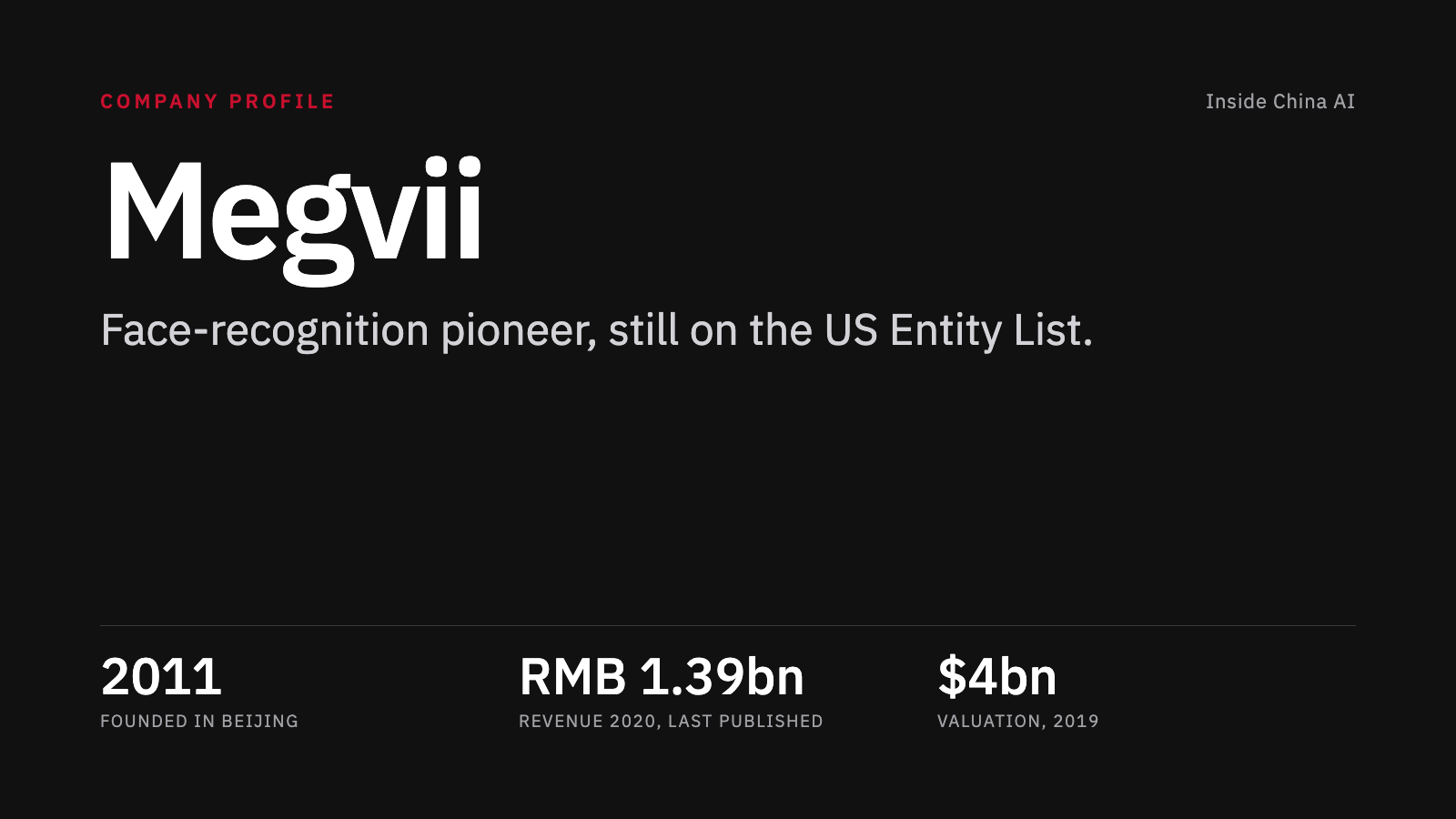
Megvii (旷视科技) was founded in Beijing in 2011 by three graduates of Tsinghua University, Yin Qi, Tang Wenbin and Yang Mu (Economic Observer via Huanqiu). Its holding company, Megvii Technology Limited, was incorporated in the Cayman Islands on 30 January 2013 and controls the operating company Beijing Kuangshi Technology, according to the audited accounts it filed for its Shanghai listing in 2021. The same accounts list early backers such as Innovation Works and Qiming, and preferred shares sold to Alibaba’s Taobao China Holding in July 2018 (audited accounts). In October 2019 Megvii was valued at $4 billion on the basis of its latest private round (Fortune). No later valuation has been confirmed.
Its attempts to list have failed. A Hong Kong filing in August 2019 (Fortune) never led to a listing. Megvii then applied to Shanghai’s STAR Market in March 2021, aiming to raise RMB 6.02 billion (Jiemian). The listing committee approved the application in September 2021, but the registration stalled. In November 2024 Megvii and its sponsor withdrew, and the China Securities Regulatory Commission terminated the registration; the Shanghai Stock Exchange published the decision on 29 November 2024 (TMTPost; Jiemian). Yicai dates the regulator’s decision to 14 November 2024 (Yicai). In April 2025 business records showed new registered shareholders in Beijing Kuangshi, including units of Ant Group and Legend Holdings and the Chongqing Industrial Investment Parent Fund. STAR Market Daily reported that this was the unwinding of the structure built for the Hong Kong listing, not new money (STAR Market Daily via ifeng). As of 20 November 2026 the Hong Kong exchange’s index of active listing applications contained no application from Megvii (HKEXnews).
The founders are gone. Yin Qi, long the face of the company, has been chairman of the carmaker-turned-tech company Afari (千里科技, formerly Lifan) since November 2024 (Lieyun via Jiemian) and still held the post in October 2026 (Xinhua Finance); since January 2026 he has also chaired the model developer StepFun (Yicai). Tang Wenbin founded the robotics company Yuanli Lingji (原力灵机) in March 2025 (36Kr). Megvii is now led by Zhao Kang, named as its chairman and chief executive in July 2026 (Beijing News); when he took over has not been published.
What they build
Megvii began with vision algorithms. Its own timeline says that between 2011 and 2019 it “launched the world’s first AI camera and facial recognition access solution” and built a business in “enterprise management and urban governance” (Megvii). Face++, its developer platform, still sells face comparison, liveness detection and identity verification for banks, ride-hailing and border control, and the company says it is “trusted by thousands of multinational enterprises” (Face++).
Today the company calls itself “an AI company focused on physical space operations” that provides “government and enterprise clients with intelligent agents for physical space operation and management” (Megvii). In practice that means software agents and hardware for city management, traffic, business intelligence, industrial safety and workplaces: face-recognition access terminals, AIoT servers and analysis boxes, tied together by an operating system for physical spaces it calls POA OS (Megvii). For the period from 2024, its timeline says it “built the ‘Megvii Taiyi’ large model brain” (Megvii). We found no technical paper, model card or open weights for it. In July 2026 Zhao Kang said Megvii’s own vision foundation model ran inference 30 per cent faster on accelerators from the Chinese chipmaker Hygon after joint optimisation (Beijing News), which matters for a company cut off from most US technology.
Megvii has narrowed its business. According to a 36Kr report of 5 June 2026, its logistics-robot business, which Tang Wenbin had led, was carved out in July 2024 as a separate company, Atomix, which Tang’s new company has since acquired (36Kr); we found no second source for the carve-out. The robotics pages on Megvii’s English website now redirect to the homepage. In 2021 Megvii set up a driving brand, Maichi (迈驰智行), for assisted driving (Economic Observer via Huanqiu); in 2023 it became one of Geely’s suppliers of driving technology, according to Lieyun (Lieyun via Jiemian). In March 2025 Afari, chaired by Yin Qi, agreed with Geely, Lotus and others to set up a new driving company, into which a company called Maichi Zhixing (Chongqing) Technology (迈驰智行(重庆)) would transfer “all” of its existing car business. Afari’s filing says that company was set up in September 2024 and that Yin Qi holds an indirect stake in it; Megvii is not among the main shareholders it lists (Afari announcement, China Securities Journal). The new company, Chongqing Qianli Zhijia, was registered on 27 June 2025 (Afari announcement). Afari said it had no plan to inject Megvii itself (Lieyun via Jiemian).
Megvii has published no financial statements since mid-2021. The last audited figures show revenue of RMB 1.39 billion in 2020 and a net loss of RMB 3.33 billion that year (audited accounts).
Key numbers
- Founded 2011, Beijing, by Yin Qi, Tang Wenbin and Yang Mu (Economic Observer via Huanqiu; audited accounts); chairman and CEO Zhao Kang (as of July 2026, Beijing News)
- Ownership Private; holding company in the Cayman Islands. Investors include Alibaba (audited accounts), Ant Group and Legend Holdings units, and the Chongqing Industrial Investment Parent Fund (STAR Market Daily via ifeng)
- Valuation $4 billion in 2019 (Fortune); no later figure confirmed
- Listing Hong Kong filing of 2019 not completed; STAR Market registration terminated after withdrawal, published by the Shanghai exchange on 29 November 2024 (TMTPost); no Hong Kong application as of 20 November 2026 (HKEXnews)
- Revenue RMB 1.39 billion (2020), RMB 670 million (first half of 2021); net loss RMB 3.33 billion (2020) — the last published figures (audited accounts)
- Products Face++ platform; face-recognition access terminals; AIoT servers and edge boxes; POA OS; “intelligent agents” for city, traffic, business intelligence, safety and workplace (Megvii)
- Patents Nearly 1,700 AI-related patents, the company says (Megvii)
The European angle
- Physical presence None found. We found no European office, subsidiary, current partner or named customer of Megvii. In 2019 it announced a development partnership on 3D face recognition with the Austrian sensor maker ams (Biometric Update); we found no later sign of it. In 2023 its logistics unit received a CE certificate for a pallet robot at LogiMAT in Stuttgart (Robotics & Automation News), and in 2024 it delivered a first warehouse project in Romania with a Greek integrator (Xinhua Silk Road). According to 36Kr, that business now belongs to Atomix, not Megvii.
- Who a European developer deals with The Face++ privacy policy, last updated on 30 September 2020, names Beijing Kuangshi Technology and its affiliates. It states: “Our servers are located in China and Canada.” For customers outside China, the client chooses which of the two is used. The policy does not mention the GDPR or an EU representative (Face++ privacy policy).
- US Entity List Megvii has been on the US Entity List, an export-control list, since 9 October 2019, and was still listed in the US government’s Consolidated Screening List on 20 November 2026. The Commerce Department’s rule named Megvii among eight companies “enabling activities contrary to the foreign policy interests of the United States” and said the 28 entities added that day had been “implicated in human rights violations and abuses in the implementation of China’s campaign of repression, mass arbitrary detention, and high-technology surveillance against Uighurs, Kazakhs, and other members of Muslim minority groups” in Xinjiang. Exports of most items subject to US export rules face a presumption of denial (Federal Register). Megvii said at the time there were “no grounds” for the listing and that Xinjiang projects had made up about 1 per cent of its 2018 revenue (Fortune).
- US investment ban On 16 December 2021 the US Treasury added Megvii Technology Limited to its list of Chinese military-industrial complex companies, which bars US persons from buying or selling publicly traded securities connected with it; it was still on that list on 20 November 2026. Treasury said the operating company had built software “designed to conduct surveillance activities of ethnic minorities, including Uyghurs” (US Treasury). The Pentagon put Megvii on its 1260H list of “Chinese military companies” on 31 January 2024 and removed it in the list published on 7 January 2025 (Federal Register); it is not on the list of 10 June 2026 (Federal Register). The 1260H list is not a sanction. We found no EU sanctions against Megvii in our check of the EU’s consolidated list on 15 November 2026.
- The AI Act Since 2 February 2025 the EU has prohibited biometric categorisation systems that infer a person’s race or religion, among other traits, and AI that builds face databases by untargeted scraping of internet or CCTV images (AI Act, Article 5). Face recognition itself is not banned, but it is the most closely regulated AI use in Europe. We found no action by a European data-protection authority against Megvii.
- What a European buyer would actually encounter A face-recognition API run from Beijing with data in China or Canada, and a supplier on two US lists. Any European company that also relies on US technology would need to check its own export-control exposure before working with Megvii.
What we could not verify
- Current revenue, profit and headcount. Nothing has been published since mid-2021.
- Today’s shareholder structure, including reports that the founders pledged their shares to a Chongqing fund in January 2025.
- Whether Megvii plans a new listing. A reported Hong Kong plan from October 2026 appeared only second-hand; a Megvii spokesperson said there was no concrete IPO plan (Tech商业 via 36Kr).
- The “Megvii Taiyi” model: size, release date and licence.
- Who controls Maichi Zhixing (Chongqing) beyond Afari’s disclosure, whether it took over Megvii’s Maichi driving business, and whether Megvii’s whole driving team moved to Afari.
- Whether Face++ has European customers, and whether its international data still sits in Canada.
The open question for Europe: is there a European market for Megvii now that it has left logistics, or does its future depend on Chinese cities and factories?

Comments are closed