Graphic: Inside China AI
Meitu: The Xiamen Photo-App Maker Counts Europe Among Its Subscriber Markets — Without a European Company
Company profile · 23 November 2026.
Meitu (美图) has made photo-retouching apps in Xiamen since 2008 and now sells AI editing to almost 20 million paying subscribers. Europe is among the regions that, the company says, brought most of its new paying subscribers outside mainland China in the first half of 2026, and Alibaba has put US$250 million into the company through convertible bonds. In the EU, though, Meitu has no company of its own: its privacy policies name controllers in Hong Kong, Xiamen and Sydney, and processors in China. For European regulators and users, Meitu is a case of a Chinese AI consumer app maker that reaches Europeans through app stores and websites alone.
Origins and backing
Meitu was founded in 2008 and describes itself as “an AI technology company with the mission to unite art and technology” (interim results, 26 August 2026). Its founder Wu Zeyuan, also known as Wu Xinhong, began developing photo-editing software in 2008, according to the company, and is today chairman, executive director and chief executive (Annual Report 2025). The holding company, Meitu, Inc., is incorporated in the Cayman Islands and has been listed on the Main Board of the Hong Kong Stock Exchange (1357) since 15 December 2016 (Annual Report 2025).
On 30 June 2026 Wu held 12.93 per cent of the shares, mostly through a trust, and the investor Cai Wensheng 9.91 per cent through a controlled company and a trust (Interim Report 2026). Since 2025 Alibaba has been a backer too. On 20 May 2025 Meitu agreed to issue US$250 million of convertible bonds to Alibaba.com China Limited, a subsidiary of Alibaba Group; the bonds were issued on 31 December 2025, carry 1 per cent interest and convert at an initial price of HK$6.00 per share. Full conversion, including interest to maturity, would give Alibaba at most 335.5 million new shares, about 6.82 per cent of the enlarged number of shares, according to the company (Annual Report 2025). A separate cooperation agreement of 30 December 2025 covers e-commerce, “AI models and technologies, computing and cloud services”; details are left to later specific agreements (Annual Report 2025). On 26 August 2026 Alibaba used its right to nominate a board member: Jin Qin, an investment director at Alibaba International Digital Commerce Group, became a non-executive director (HKEX announcement). By the date of the Interim Report 2026 (24 September 2026), no bonds had been converted or redeemed.
What they build
Meitu splits its apps into two groups. The “leisure” apps — the Meitu app, BeautyCam and the AI video editor Wink — are for retouching selfies, beautifying portraits and restoring video quality. The “productivity” apps target small businesses and creators: Designkit for e-commerce product images, Kaipai and Vmake Labs for talking and marketing videos, MVLAND for AI music videos and Picchi, a retouching agent launched in June 2026 (interim results). Since June 2026 Designkit has run several cooperating AI agents (“Agent Teams”) for tasks from market research to the finished product image, and since June 2026 its design functions have been built into the WPS Office suite, the company says.
Underneath sits Meitu’s own image model, MiracleVision, which it presented on 19 June 2023 (Meitu). Version 6, launched on 17 June 2026, uses a Mixture-of-Experts architecture and accepts text, image, video and audio input, the company says (Meitu). Meitu does not claim to do everything itself: its agents choose for each request between “our self-developed MiracleVision model, fine-tuned open-source models and third-party API” (Annual Report 2025). In his statement with the interim results, the chairman writes that MiracleVision is trained “deliberately narrow” on the operations that make a portrait acceptable — relighting, makeup, hair and portrait detail. We found no published benchmarks, parameter counts or open weights.
The business model is subscription; in 2020 Meitu switched its core model from advertising to subscriptions, the company says (Meitu). Advertising brought RMB 414.7 million in the first half of 2026, down 4.4 per cent, against RMB 1,769.1 million from photo, video and design products, up 30.9 per cent (interim results). On 1 November 2025 Meitu left the cosmetics supply-chain business; its AI skin-analysis unit, EveLab Insight, remains as a small business line.
Key numbers
- Listing Hong Kong Stock Exchange, 1357, since 15 December 2016; founder Wu Zeyuan 12.93 per cent (30 June 2026)
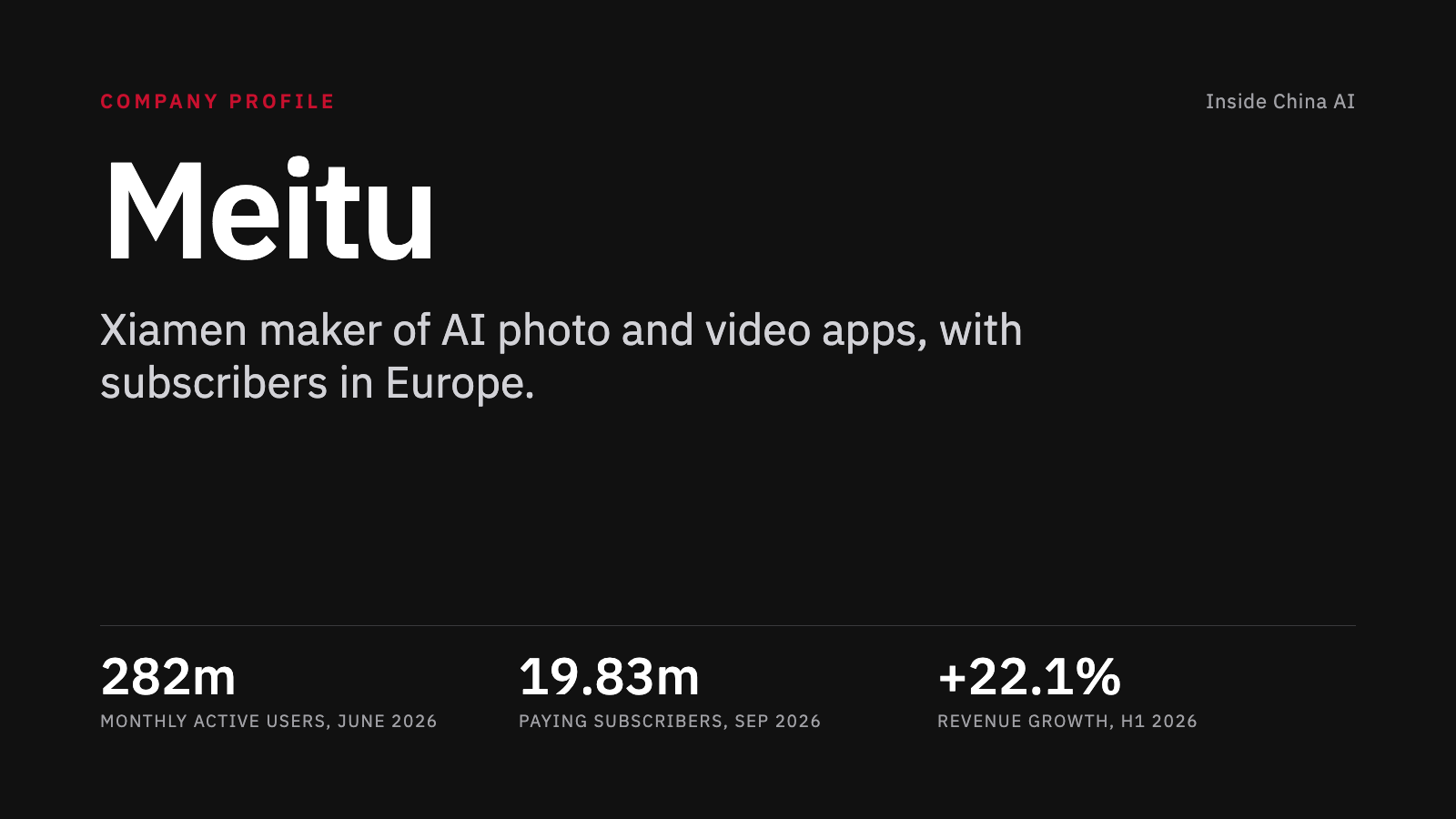
- Revenue RMB 3,858.7 million in 2025, up 28.8 per cent (Annual Report 2025); RMB 2,212.8 million in the first half of 2026, up 22.1 per cent, with a gross margin of 71.5 per cent, down 3.8 points (interim results)
- Profit RMB 619.5 million net profit attributable to shareholders from continuing operations in the first half of 2026, up 40.0 per cent; research and development spending RMB 473.1 million (interim results)
- Third quarter 2026 RMB 1.0 billion from photo, video and design products, up 28.2 per cent (unaudited); annual recurring revenue of the AI productivity apps RMB 655 million in September, up 40.1 per cent, the company says (Q3 business update, 23 October 2026)
- Users 282 million monthly active users in June 2026, of whom 101 million outside mainland China (interim results); 19.83 million paying subscribers in September 2026 (Q3 business update)
- Staff 1,974 full-time employees on 30 June 2026, most of them in China (interim results)
- Alibaba US$250 million convertible bonds, issued 31 December 2025, not converted; one board seat since 26 August 2026
The European angle
- Users and subscribers Meitu does not give a European figure. In the first half of 2026, it says, most new paying subscribers outside mainland China came from regions with high average revenue per paying user, “including East Asia, Latin America, and Europe” (interim results). In 2025 a viral “AI Group Photo” feature brought “over 3 million new active users from European markets”, the company says (Annual Report 2025). Meitu also says Vmake Labs “continued to expand” in markets including Europe (interim results). Revenue is not broken down by region: Meitu “does not distinguish between markets” in its internal reporting (Annual Report 2025).
- Physical presence None found. The principal subsidiaries listed in the Annual Report 2025 sit in Hong Kong, the British Virgin Islands and mainland China; at the end of 2025, 48 of Meitu’s employees worked outside China (Annual Report 2025). Vmake Labs is run by Starii Tech Pty Ltd in Sydney, of which Wu is a director (Vmake Labs privacy policy); the global Meitu app’s privacy policy of 22 December 2022 names Xiamen Meitu Technology Co., Ltd. and says data may be stored “anywhere in the world”, including China and the EU (Meitu app policy).
- Data For BeautyCam, the GDPR notice of 16 March 2026 names Meitu (China) Limited in Hong Kong as controller and Rivacy GmbH in Hamburg, a service provider, as EU representative. Among its processors it lists Huawei Cloud, Tencent and Meitu companies in China, along with US providers, and relies on standard contractual clauses for China, because “there is no adequacy decision of the EU Commission for the P.R. China” (BeautyCam privacy policy). The same policy says the app may collect “facial feature information (including but not limited to facial images)” for its features; it says this information is used only for those features, discarded when the app is closed and “not shared with any third parties”. We found no proceeding by a European data protection authority against Meitu.
- Business partners We found no European partner or customer for Meitu’s AI. A Dior AI skin-analysis feature listed on Meitu’s partner page was launched in 2020 in Meitu Xiuxiu, the China version of the Meitu app (KrASIA, 9 May 2020); it does not count as a European presence.
- Lists Meitu does not appear on the US Consolidated Screening List, which includes the Entity List and the Chinese Military-Industrial Complex (CMIC) list (file retrieved 23 November 2026), nor on the Pentagon’s Section 1260H list (OpenSanctions mirror, retrieved 23 November 2026).
- What a European user would actually encounter A Chinese photo and video app downloaded from the app store, with AI features built partly on Meitu’s own model, a contact address in Hong Kong and data processing that can reach China.
What we could not verify
- How many Europeans use or pay for Meitu’s apps, and how much revenue Europe brings.
- Which outside models Meitu’s agents call for European users, and whether the Alibaba agreement brings Alibaba models into the apps.
- Technical details of MiracleVision: size, benchmarks and training data are not published.
The open question for Europe: will Meitu set up its own company in the EU as its European subscriber base grows — or keep serving Europeans from Hong Kong and China?

Comments are closed