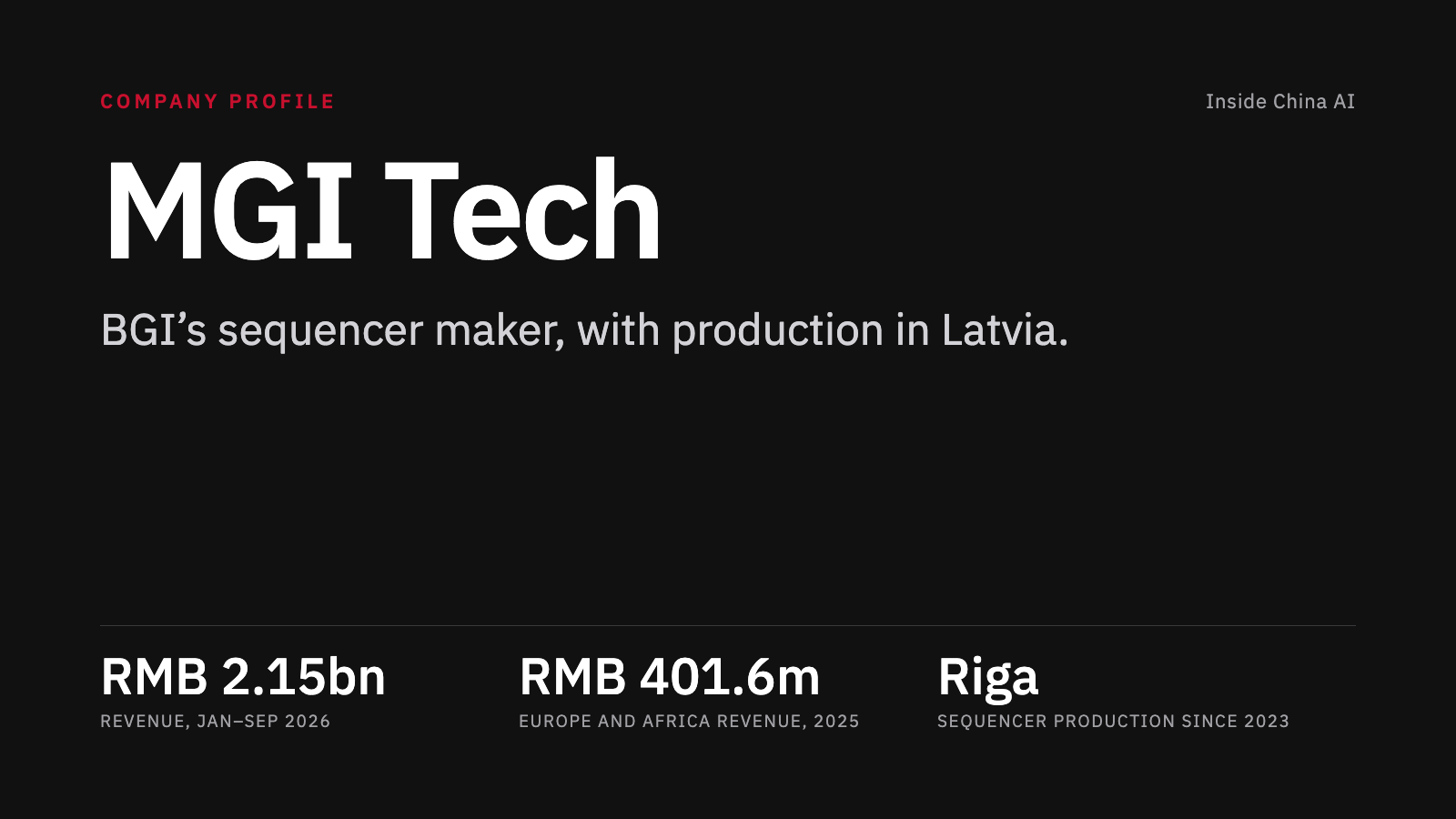
Graphic: Inside China AI
MGI Tech: BGI’s Sequencer Maker Builds in Latvia While Washington’s BIOSECURE Clock Runs
Company profile · 21 November 2026.
MGI Tech (华大智造) makes DNA sequencers, laboratory robots and the reagents that run on them, and is the instrument arm of the BGI group founded by its chairman, Wang Jian. It also builds in the EU: a subsidiary near Riga airport has produced sequencers since May 2023. At the same time MGI sits on the US Defense Department’s 1260H list, which makes it a “biotechnology company of concern” under the US BIOSECURE Act, and it is selling its American subsidiary to a Swiss buyer. For European laboratories, MGI is a supplier with local production and service, whose standing in the United States is shaped by Washington.
Origins and backing
MGI says it was founded in 2016 (MGI). It is based in Shenzhen’s Yantian district and has been listed on Shanghai’s STAR Market (688114) since 9 September 2022, the start date of its sponsor’s supervision period (2025 annual report). Its founder and chairman, Wang Jian, set up BGI in 1999 to take on China’s share of the Human Genome Project and founded BGI Group in Shenzhen in 2007, the annual report says. On 30 September 2026 Shenzhen BGI Technology Holding Group held 36.73 per cent of MGI and a second Wang-controlled vehicle held 9.95 per cent (Q3 2026 report). Day-to-day management passed in April 2026 from Mou Feng, now vice chairman, to Liu Jian, previously executive vice president (H1 2026 report).
The BGI ties run both ways. BGI Genomics, the group’s separately listed testing business, is a related party: in 2025 MGI sold goods and services worth RMB 719.2 million to the BGI Genomics group, about a quarter of its revenue (2025 annual report), and it names the high share of related-party transactions as a risk in its H1 2026 report. On 10 March 2026 MGI completed the purchase of two group companies, the Stereo-seq spatial-omics business and the nanopore-sequencing unit, from a BGI-group company (Q3 2026 report).
In February 2026 MGI agreed to sell its US subsidiary Complete Genomics, Inc. for about $50 million to Swiss Rockets AG, a biotech incubator in Basel (SSE announcement, 23 February 2026; Jones Day). MGI’s H1 report gives “potential policy uncertainty in overseas markets” as the reason. Swiss Rockets already holds an exclusive licence to MGI’s CoolMPS sequencing chemistry for the world outside Asia-Pacific and Greater China; MGI expects at least $120 million in licence fees, including $20 million it received in November 2025, the company says. MGI’s shareholders approved the sale on 12 March 2026; its filing of 24 October 2026 still describes completion as a future step (SSE announcement), and MGI had announced no completion by 20 November 2026.
What they build
MGI’s core products are DNBSEQ short-read sequencers, from the benchtop G99 to the high-throughput T7+, plus nanopore long-read and Stereo-seq spatial instruments, liquid-handling robots such as the MGISP-960 and the reagents they consume. The H1 2026 report splits the business into sequencing (SEQALL), intelligent automation (GLI) and multi-omics (OMICS).
MGI now calls itself an “AI-driven” provider of life-science tools. The evidence is narrower than the label. MGI does not publish general-purpose AI models of its own. In March 2026 it set up Genoria AI (涌生智能), a subsidiary working on software agents that turn experiment plans into protocols and instructions for laboratory robots. Its instruments ship with AI image analysis, and its αCube data-centre appliance comes with pre-installed “gene AI agents”, the company says. The most concrete research result is a preprint with Google: researchers from Google, MGI, BGI Genomics and the University of Chinese Academy of Sciences trained variant-calling models on DNBSEQ data (bioRxiv, posted 11 May 2026). The preprint has not been peer-reviewed. In short, MGI uses AI to improve its instruments, which remain the core of the business.
Key numbers
- Revenue RMB 2.15 billion in January–September 2026, up 11.98 per cent on restated prior-year figures; RMB 783.7 million in the third quarter, up 1.65 per cent (Q3 2026 report)
- Net result loss attributable to shareholders of RMB 187.0 million in January–September 2026, after RMB 219.4 million a year earlier (restated); operating cash flow positive at RMB 449.8 million
- R&D RMB 412.3 million in January–September 2026, 19.18 per cent of revenue
- Full year 2025 revenue RMB 2.78 billion (down 7.73 per cent), net loss RMB 222.1 million (2025 annual report)
- Europe and Africa revenue RMB 401.6 million in 2025 and RMB 171.1 million in the first half of 2026, up 11.83 per cent (H1 2026 report)
- Ownership 36.73 per cent Shenzhen BGI Technology Holding Group; actual controller Wang Jian
- US lists DoD 1260H list since January 2025, confirmed in June 2026; not on the Entity List
The European angle
- Production in Latvia LATVIA MGI TECH, SIA opened what it calls a “large-scale production line” near Riga on 8 May 2023 for DNBSEQ-G400 sequencers and HotMPS reagents, and showed the first G400 built there (MGI). The company describes the 7,000 m² site near Riga airport as its European hub for R&D, manufacturing, logistics and training (MGI). In its H1 2026 report MGI calls the plant its core overseas production and delivery hub, says it has achieved local production of sequencers and reagents and can mass-produce low-, mid- and high-throughput sequencers and reagents, and reports that among the products the plant made itself in the first half of 2026, the share produced and delivered locally rose 41 per cent year on year (H1 2026 report). MGI publishes no unit numbers for Latvia.
- Companies MGI-Tech GmbH in Berlin is the European contact and runs a customer experience centre (MGI Europe); the H1 2026 report also lists subsidiaries in the UK, France, the Netherlands (a holding company) and Serbia. MGI says it has five offices, 29 distributors and more than 200 employees in Europe and Africa (MGI Europe).
- Customers and partners According to MGI’s 2025 annual report, it installed 70 new sequencers in Europe and Africa in 2025, added more than 50 customers in Germany, France, the UK, Spain and other countries, and signed a framework agreement with Eurofins covering Germany, France and other countries. In the first half of 2026 it reported its first European OEM deal, with France’s SAS Apollon, whose jointly developed MGISP-NEX carries CE-IVDR certification. In Germany MGI works with Fraunhofer IIS on image analysis for its VisiOmics pathology system, launched in Europe in September 2026 (MGI Europe), and it launched the T7+ for Europe at Analytica in Munich in March 2026 (MGI Europe). These are company statements.
- Switzerland If the sale closes, Complete Genomics will belong to Basel-based Swiss Rockets, which already holds the CoolMPS licence for Europe and the rest of the world outside Asia-Pacific and Greater China.
- US lists and BIOSECURE MGI Tech Co., Ltd. is on the US Defense Department’s Section 1260H list of “Chinese military companies” in the versions published on 7 January 2025 and 10 June 2026; the June 2026 list also names BGI Group with subsidiaries including BGI Genomics and Complete Genomics (Federal Register, 7 January 2025; Federal Register, 10 June 2026). The list is not a sanction. MGI is not on the US Entity List, although several BGI affiliates have been since 2020 and 2023, among them BGI Research and BGI Tech Solutions (Hongkong) since March 2023 (Federal Register, 6 March 2023). The BIOSECURE Act, enacted on 18 December 2025 as part of the FY2026 defence bill, treats every company on the 1260H list as a “biotechnology company of concern” and will bar US federal agencies and their contractors from buying its equipment (Latham & Watkins). As of 20 November 2026 the bans are not yet in force: the Office of Management and Budget must publish its list by 18 December 2026 and had not done so by 20 November, and for companies already on the 1260H list the bans start 60 days after the federal procurement rules are revised. MGI’s H1 2026 report says the bans “have not yet been implemented” (未实施).
- Disputes in Europe MGI says it is bound by settlements with Illumina, confirmed by courts in Germany, the UK and France, that limit some of its products there. In a case filed on 5 December 2024 in the High Court of England and Wales, Oxford Nanopore Technologies names MGI, its nanopore unit and five other BGI-related companies as defendants over alleged misuse of confidential information relating to a nanopore sequencer. The claim is at least £10 million, and on 29 July 2026 the defendants contested jurisdiction, MGI’s H1 2026 report says.
- Public tenders Since 30 June 2025 an EU measure has excluded Chinese bidders from public tenders for medical devices worth €5 million or more (Implementing Regulation (EU) 2025/1197). Whether it covers MGI’s instruments, and whether units built in Riga count as Chinese, we could not establish.
- What a European lab would actually encounter Sequencers and robots sold and serviced from Berlin and Riga, some of them built in Latvia, from a company that is still loss-making but reported positive operating cash flow for January–September 2026, and whose owner and US listings tie it closely to the BGI group.
What we could not verify
- How many sequencers and reagent kits the Riga plant produces. MGI discloses capability and a growth rate, not volumes.
- Whether the Complete Genomics sale has closed. We found no completion announcement up to 20 November 2026.
- Whether the EU’s medical-device procurement measure applies to MGI’s products.
The open question for Europe: if Washington shuts MGI out of federal procurement in 2027 or later, will the Riga plant become more important to MGI, and will EU buyers treat Riga-built sequencers as European?

Comments are closed