Graphic: Inside China AI
Mindray: A Shenzhen Device Maker With Clinical AI Models, Reagent Production in Europe and an EU Tender Barrier
Company profile · 23 November 2026.
Mindray (迈瑞医疗) makes the patient monitors, ultrasound scanners, defibrillators and laboratory analysers found in hospitals worldwide — and since December 2024 it has also offered medical large language models, called QiYuan, the first of them released together with Tencent. Europe matters to it more every year: the region brought in 10.1 per cent of revenue in 2025, and Mindray says European sales grew by nearly 20 per cent in the first nine months of 2026. Through two acquisitions, DiaSys in Germany and HyTest in Finland, it also owns European makers of reagents and raw materials. At the same time, since June 2025 the EU has kept Chinese companies out of large public tenders for medical devices.
Origins and backing
Mindray’s roots go back to Mindray Electronics, founded in Shenzhen in March 1991 by Li Xiting and co-founded by Xu Hang; the current company was established in January 1999 (Hong Kong application proof, 11 May 2026). Its former parent listed on the New York Stock Exchange on 26 September 2006 and was taken private and delisted on 15 March 2016; the Shenzhen company has been listed on the Shenzhen Stock Exchange since 16 October 2018 (stock code 300760), according to the same filing.
The founders still control it. At 30 September 2026, Smartco Development, indirectly held by Li Xiting, owned 26.99 per cent and Magnifice (HK), indirectly held by Xu Hang, 24.50 per cent; the two act in concert (Q3 2026 report). Li Xiting is chairman and Wu Hao general manager, both confirmed when the board was re-elected on 19 May 2026 (SZSE announcement). Mindray applied for a second listing in Hong Kong on 10 November 2025 and updated the application on 11 May 2026; the listing still needed approval from Chinese and Hong Kong regulators (SZSE announcement). Mindray has published no further notice on the listing since then, and on 22 November 2026 the Hong Kong exchange still listed the application as active (HKEX, applications). By 23 November 2026, Mindray’s shares were not listed in Hong Kong.
What they build
Mindray’s core business is hardware and reagents in four lines: in-vitro diagnostics, patient monitoring and life support, medical imaging (mainly ultrasound) and a group of “emerging businesses” that includes minimally invasive surgery and, through APT Medical, which it bought in 2024, interventional products. In-vitro diagnostics is now the largest line, at 39 per cent of revenue in the first nine months of 2026 (Q3 2026 report).
The AI comes in two layers. The first sits inside the devices. Mindray’s “Smart Scene” ultrasound software is meant to recognise the scan situation by itself and capture standard image planes, measurements and annotations automatically; its ventilators adjust tidal volume and breathing rate to a target minute volume, the company says (Mindray, Responsible AI). The second layer is QiYuan (启元), a family of domain-specific language models. The QiYuan Critical Care Medical LLM was introduced in December 2024; by the end of 2025, together with Mindray’s critical-care decision-support system, it had been deployed in 30 top-tier (Class III Grade A) hospitals in China (application proof). Tencent Cloud announced the critical-care model as a joint release with Mindray (Jiemian, 27 December 2024, citing Tencent Cloud); Mindray’s own materials call QiYuan proprietary and do not name Tencent. Further models followed for perioperative care, medical engineering, obstetrics and gynaecology, breast diagnostics and the laboratory (application proof); in the third quarter of 2026 Mindray launched a QiYuan agent that reviews laboratory reports (Q3 2026 report).
Mindray gives figures for these tools: septic-shock warnings “up to 6 hours in advance” and a laboratory model that filters out 30 to 40 per cent of non-critical samples, the company says. We found no independent validation. Mindray’s own AI page adds that it “does not constitute a commitment regarding product registration, certification, intended use, performance or clinical claims”, and that regulatory status varies by country (Mindray). In May 2026 Mindray announced an ISO/IEC 42001 certificate for its AI management system, audited by DNV and covering AI-enabled products in all three core lines (Mindray). This is a management-system standard, not a product approval.
Key numbers
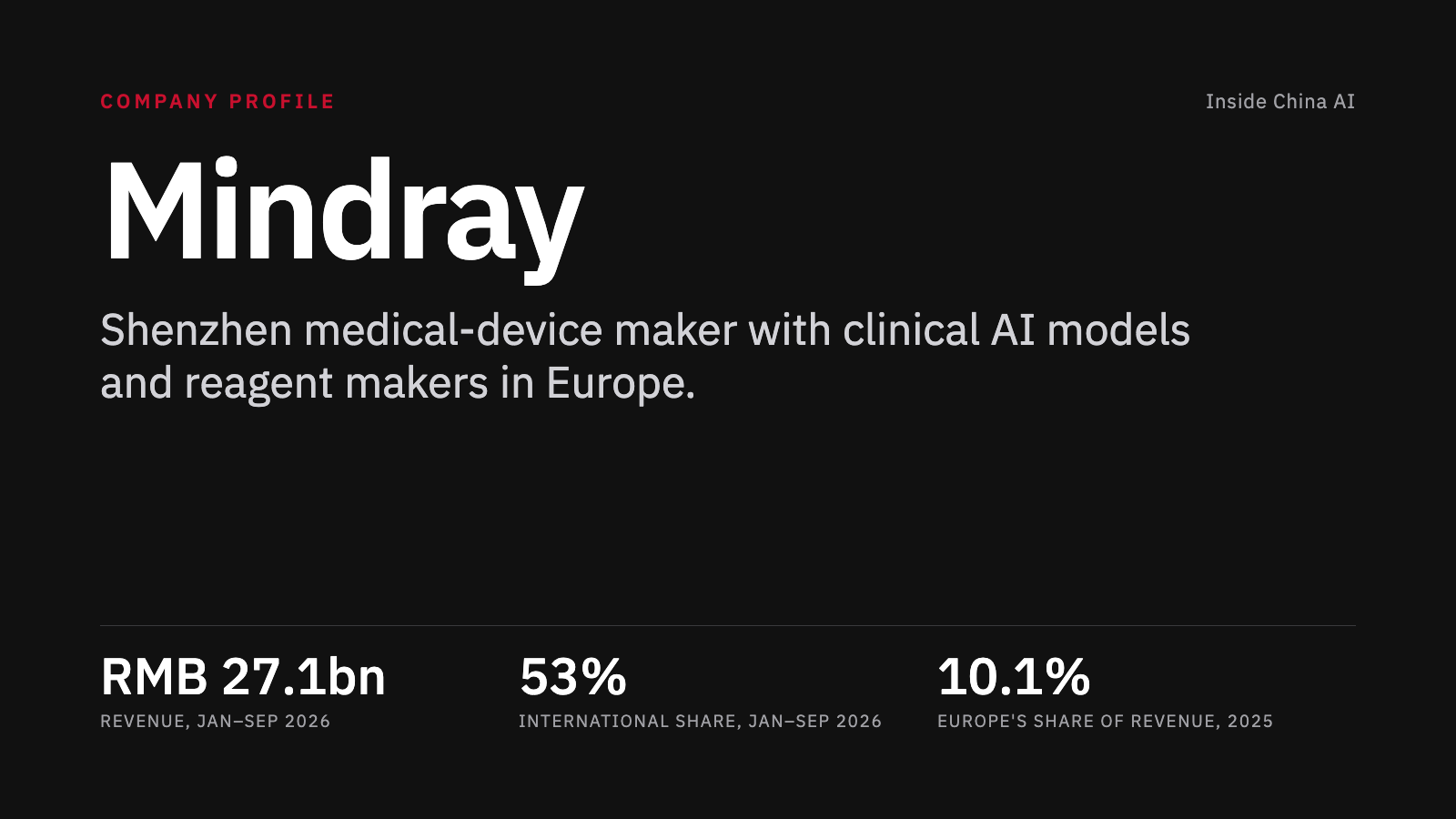
- Revenue RMB 27.10 billion in January–September 2026 (+4.89%); RMB 9.35 billion in Q3 (+2.85%) (Q3 2026 report)
- Net profit attributable to shareholders RMB 7.18 billion in January–September 2026 (−5.10%); RMB 2.39 billion in Q3 (−4.55%)
- International share RMB 14.36 billion, 53% of revenue in January–September 2026 (+11.04%); domestic revenue −1.28%
- R&D spending of RMB 2.74 billion, 10.11% of revenue (January–September 2026)
- Europe RMB 3.37 billion in 2025, 10.1% of revenue, up from 6.3% in 2023 (application proof)
- AI QiYuan medical LLMs (critical care since December 2024), ultrasound and ventilation automation; ISO/IEC 42001 certificate (May 2026)
- Owners founders Li Xiting and Xu Hang control 51.49% through two holding companies (30 September 2026)
The European angle
- Companies Mindray (UK) Limited, set up in 2005 as Mindray’s first overseas subsidiary, runs a service and repair centre in Huntingdon (Mindray UK). Further subsidiaries include Mindray Medical Germany GmbH in Darmstadt (Mindray Germany), Mindray Medical Italy, Mindray Medical España, Mindray Medical France and Mindray Medical Sweden (half-year report 2026), Mindray Medical Poland (Mindray Poland), and Mindray Medical Netherlands B.V., established on 8 August 2007, which also holds investments (application proof). Mindray says local staff made up more than 90 per cent of its European operations team at the end of 2025.
- Production and R&D Through Mindray Medical Netherlands, Mindray bought 75 per cent of DiaSys Diagnostic Systems in Holzheim, Germany, completing the deal on 30 November 2023 (half-year report 2026); the preliminary price was about €115 million, plus a €40 million capital injection shared with the seller (Mindray, Mindray). DiaSys, which “develops, manufactures and markets” diagnostic reagents and systems (DiaSys), has “production facilities across Europe”, Mindray says. In its half-year report of August 2026, Mindray states that local production of some lead products in Europe, Asia-Pacific and Latin America is supplying the market “continuously and stably” (our translation); its Hong Kong filing describes using DiaSys’s “localized manufacturing sites” in Europe for its supply chain. In Finland, Mindray owns HyTest in Turku, a maker of antibodies and antigens for diagnostic tests; according to the same half-year report, HyTest supplied the raw materials for five new chemiluminescence reagents launched in the first half of 2026; the seller put the price at about €545 million when the deal was agreed on 17 May 2021 (Summa Equity). Mindray lists R&D centres in both countries, each with around 50 R&D staff, the company says.
- Customers Public tender records name Mindray as a supplier: Hospital Clínic de Barcelona awarded Mindray Medical España a €311,500 contract for ceiling supply units for a new intensive-care unit on 23 March 2026 (TED), and the French purchasing body Resah signed a framework agreement for defibrillator-monitors for fire services with a group led by Mindray Medical France on 30 July 2025, with a tender value of €3.2 million (TED). In its Hong Kong filing, Mindray names Charité in Berlin among its customers; we found no confirmation from Charité. Mindray also says its Resona A20 ultrasound system is CE-certified and in use at the Royal Infirmary of Edinburgh and at Regensburg University Hospital, with which it announced a deeper partnership and an ultrasound training programme in March 2026 (Mindray); neither hospital has confirmed this in a source we found.
- EU procurement barrier On 19 June 2025 the European Commission adopted its first measure under the International Procurement Instrument: Chinese companies are excluded from EU public tenders for medical devices above €5 million, and successful bidders may supply no more than 50 per cent Chinese-origin devices (European Commission; Implementing Regulation (EU) 2025/1197). Mindray lists the measure as a risk in its Hong Kong filing. The two contracts above were both below the threshold.
- AI in Europe We found no evidence that QiYuan models are offered in Europe; every deployment Mindray names is in China. For the ultrasound and laboratory AI functions sold in Europe, we found no published CE certificate that covers the AI function specifically.
- Lists Our check of the US Consolidated Screening List (including the Entity List), the Pentagon’s 1260H list and the EU sanctions list found no entry for Mindray (name match in the lists as of 14 November 2026, checked 23 November 2026).
- What a European hospital would actually encounter A Chinese device maker that has been selling in Europe for two decades, with local sales and service companies, laboratory reagents partly made in Germany and Finland, and AI built into monitors and scanners — while its own medical language models are, so far, used only in China.
What we could not verify
- CE certification of individual AI functions, such as the Smart Scene ultrasound tools or the laboratory AI, under the EU Medical Device Regulation.
- How much is produced in Europe: Mindray describes ongoing production at DiaSys and HyTest but publishes no volumes, and does not say which of its 14 local manufacturing countries (end of 2025) are in Europe.
- Customer claims such as Charité, Edinburgh, Regensburg and “more than 660 teaching hospitals across Europe”, which come from Mindray alone.
- Tencent’s share in QiYuan: Chinese reports say the model is built on Tencent’s Hunyuan model; neither company has published the terms.
- The timetable of the Hong Kong listing: the application is still pending; Mindray has given no date.
The open question for Europe: will Mindray bring its QiYuan models to European hospitals — and under which approvals?

Comments are closed