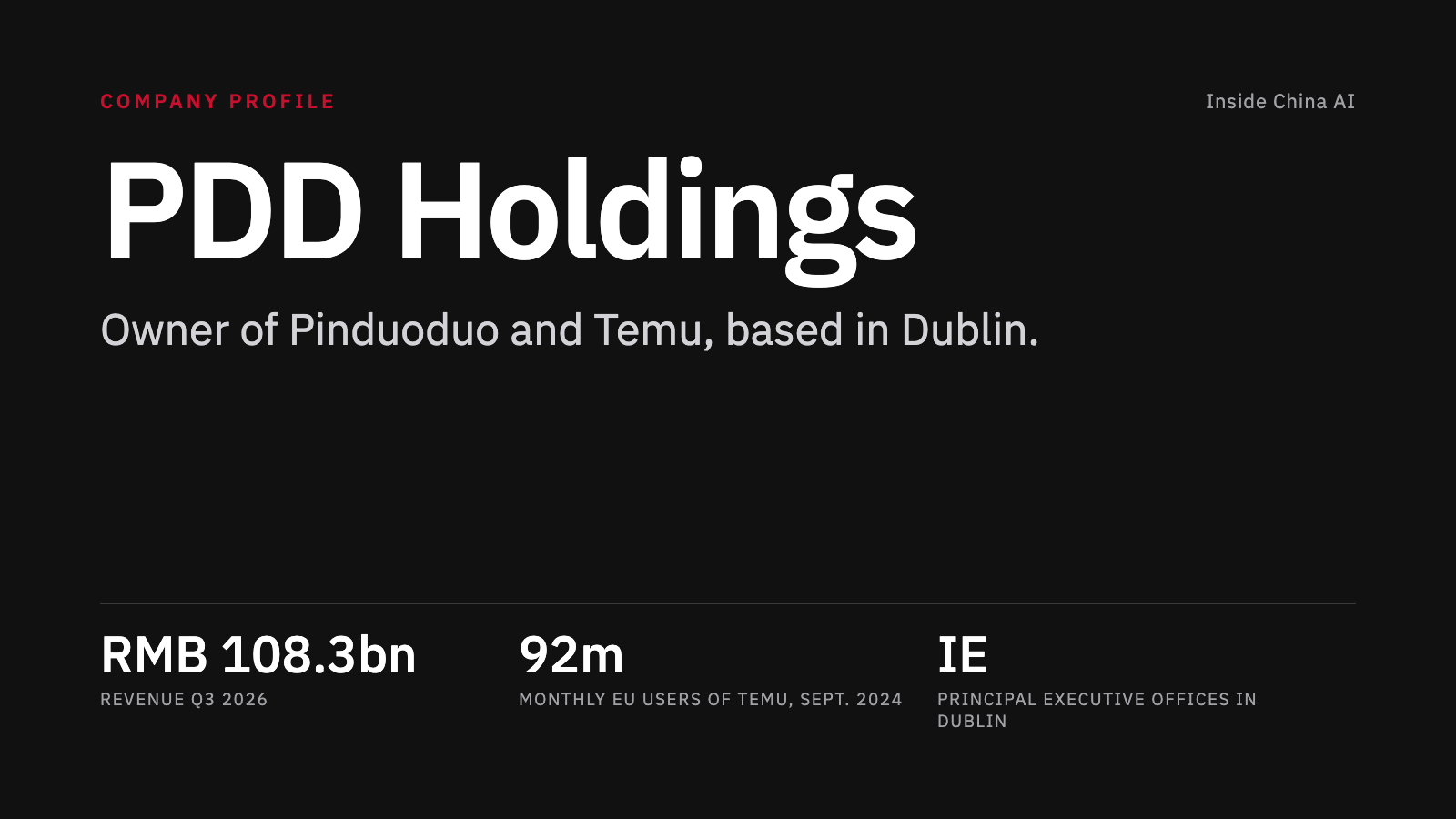
Graphic: Inside China AI
PDD Holdings: Owner of Pinduoduo and Temu, Based in Dublin
Company profile · 28 November 2026.
PDD Holdings runs Pinduoduo, one of China’s largest shopping apps, and Temu, the marketplace it launched in 2022 and brought to Europe in April 2023. Its principal executive offices are in Dublin, and according to the European Commission it operates Temu in the EU through its Irish subsidiary Whaleco. Temu has been designated a Very Large Online Platform under the Digital Services Act since May 2024. In 2026 the Commission fined Temu €200 million under the Digital Services Act, accepted its plan to fix the breach and issued new preliminary findings about unsafe products; EU consumer authorities accepted commitments from Temu under consumer law. For Europe the questions concern algorithms rather than AI models: how Temu’s recommender systems, moderation tools and seller controls work, and whether they keep illegal products off a platform for which Temu declared 92 million monthly users in the EU in September 2024.
Origins and backing
Pinduoduo was “founded in 2015 with a focus on agriculture” by Colin Huang, according to the company (PDD filing, 17 March 2021). It listed on Nasdaq in July 2018 (CNBC). Huang stepped down from the board in March 2021, and the ten-to-one voting rights attached to his shares were removed; chief executive Chen Lei also became chairman at that point (PDD filing).
Shareholders voted on 8 February 2023 to rename the company from Pinduoduo Inc. to PDD Holdings Inc. (PDD filing, 9 February 2023). Until early 2023 its filings gave Shanghai as the address of its principal executive offices; since then they have given Dublin, Reuters reported on 4 May 2023 (Reuters via Kitco). The latest annual report, filed on 29 April 2026, lists the holding company as incorporated in the Cayman Islands, with principal executive offices at St Stephen’s Green, Dublin (annual report 2025). According to the same report, “a significant portion of our assets and operations is located in China”, run through Chinese subsidiaries and a variable interest entity. Its principal subsidiaries include Pinduoduo (Shanghai) Network Technology, Whaleco Inc. in Delaware and Whaleco Technology Limited in Ireland (list of subsidiaries).
Since 19 December 2025 the group has had two co-chairmen who are also co-chief executives: Lei Chen and Jiazhen Zhao, a founding member who has been a director and co-CEO since April 2023 (PDD filing, 19 December 2025).
What they build
PDD describes itself as “a multinational commerce group that owns and operates a portfolio of businesses” (PDD Holdings). Pinduoduo is its marketplace in China. Temu, according to the annual report, “was founded in September 2022 in Boston, Massachusetts”, and expanded to Europe in April 2023. Its revenue comes from two lines: online marketing services and transaction services (Q3 2026 results).
PDD says little in public about artificial intelligence. Its annual report mentions “the use of AI solutions in our platforms, services, and internal operations”, but only among the risks, and in the parts we could read names no model, chip or AI product (annual report 2025). The results releases for the first three quarters of 2026 do not mention AI at all (Q3 2026 results). In the release for the second quarter, published on 24 August 2026, co-CEO Zhao said: “During the first half of the year, we continued to strengthen ecosystem governance within our daily operations, rolling out targeted trust and safety initiatives across categories” (Q2 2026 results). According to the annual report, research and development spending rose by 30.3 per cent in 2025, to RMB16.5bn.
The automated systems that matter most for Europe are the ones behind Temu’s storefront, and the European Commission is looking at them. In its decision of 28 May 2026 it found that Temu “did not properly assess how the design of its service – including recommender systems and product promotion programmes by affiliated influencers – could amplify dissemination risks of illegal products” (European Commission). In its preliminary findings of 17 November 2026 the Commission also said that “the number of human content moderators has not grown in line with the increase in the number of listings on the platform” (European Commission).
Key numbers
- Listing Nasdaq (PDD) since July 2018; incorporated in the Cayman Islands, principal executive offices in Dublin
- Revenue RMB108.3bn (US$16.2bn) in Q3 2026, flat on a year earlier; RMB431.8bn in 2025
- Revenue mix, Q3 2026 online marketing services RMB59.8bn (+12%); transaction services RMB48.5bn (−12%)
- Profit operating profit RMB31.2bn in Q3 2026; net income attributable to ordinary shareholders RMB29.5bn, against RMB29.3bn a year earlier
- Leadership Co-chairmen and co-CEOs Lei Chen and Jiazhen Zhao (since 19 December 2025)
- EU users 92 million monthly users declared by Temu in September 2024; Very Large Online Platform since 31 May 2024
- EU enforcement €200m DSA fine (28 May 2026); new preliminary DSA findings (17 November 2026); consumer-law commitments accepted (26 November 2026)
Sources: Q3 2026 results; annual report 2025; European Commission.
The European angle
- Physical presence Ireland. According to the Commission, PDD “operates the e-commerce platform Temu through its subsidiary WhaleCo” in the EU, and both companies have premises in Dublin (European Commission). Whaleco Technology Limited is the only European company in PDD’s list of principal subsidiaries.
- Operations Temu was designated a Very Large Online Platform under the Digital Services Act on 31 May 2024 and last declared 92 million monthly users in the EU in September 2024, the Commission says (European Commission).
- Digital Services Act The Commission opened formal proceedings on 31 October 2024 covering illegal products, “the potentially addictive design of the service”, recommender systems and data access for researchers (European Commission). On 28 May 2026 it fined Temu €200 million for failing to assess the risk of illegal products properly. It found that “consumers in the EU are very likely to encounter illegal items on Temu”, citing a mystery-shopping exercise in which “a very high percentage of the selected chargers failed basic safety tests” (European Commission). PDD Holdings and Whaleco Technology challenged the decision at the EU General Court on 12 August 2026, asking the court to annul it or, in the alternative, to annul or reduce the fines; the cases (T-535/26 and T-536/26) are pending (General Court). The Commission accepted Temu’s action plan on 26 October 2026, with four months to implement it and an independent audit to follow (European Commission). On 17 November 2026 it preliminarily found that Temu’s mitigation measures “include ineffective controls to check the compliance of products; a weak content moderation system; and an ineffective sanction system”; these findings are not final (European Commission).
- Consumer law On 26 November 2026 the EU’s network of consumer authorities, led by those of Belgium, Germany and Ireland, accepted commitments from Temu. They cover fake discounts, fake reviews, pressure selling and refunds, and include “an end to forced gamification features from all EU and EEA versions of Temu’s website, app, and advertisements” and a fake-review detector (European Commission).
- Foreign subsidies Between 2 and 5 December 2025 the Commission carried out an unannounced inspection at the Dublin premises of PDD and Whaleco under the Foreign Subsidies Regulation. On 31 July 2026 it sent both companies a Statement of Grounds, saying they “may have obstructed” the inspection. The main investigation into possible foreign subsidies continues; the Commission says the Statement of Grounds “does not prejudge the outcome” (European Commission).
- National proceedings PDD’s annual report says the group is subject to multiple investigations, inquiries and other proceedings by authorities “including in the U.S., Germany, France, Hungary, the Czech Republic, Poland, Australia and South Korea, among others” (annual report 2025).
- Lists PDD Holdings, Pinduoduo, Temu and Whaleco do not appear on the EU’s financial sanctions list, the US Consolidated Screening List (which includes the Entity List) or the Pentagon’s 1260H list, according to our check of the published lists on 28 November 2026. Nor are they on the FCC Covered List in the version of 20 August 2026, the latest we found (FCC public notice DA 26-870, Appendix A).
- What a European buyer would actually encounter A marketplace run from Dublin by a group whose operations are largely in China, now committed to EU consumer-law changes and still under DSA supervision. Its algorithms are examined by regulators rather than presented by the company.
What we could not verify
- Ownership and staff today: the current shareholdings of Colin Huang and the largest shareholders, and the number of employees, which the annual report gives in sections we could not retrieve.
- Temu’s current number of EU users; the company’s own DSA page could not be opened.
- Which AI systems PDD uses, and whether it develops its own models; the company names none.
- Warehouses and local sellers in Europe: locations and numbers.
The open question for Europe: will the action plan, the audit and the commitments of November 2026 change what European shoppers can buy on Temu — and will PDD ever explain the systems that decide what they see?

Comments are closed