Graphic: Inside China AI
PingCAP: The Beijing-Born Maker of TiDB Rebuilds Its Database for AI Agents
Company profile · 28 November 2026.
PingCAP is the company behind TiDB, an open-source distributed SQL database that speaks the MySQL protocol and now adds vector search, memory and file storage for AI agents. Its founding team started in Beijing in 2015; today the company is headquartered in Sunnyvale, California, and lists no office in Europe. For Europe it matters as infrastructure rather than as a model maker: its own case studies name the Tallinn-based mobility group Bolt and the Bucharest software firm Omniconvert as users, and its managed service is offered in the AWS Frankfurt region. On 19 October 2026 it reported a security incident in which data was copied from its internal systems.
Origins and backing
PingCAP was co-founded in 2015 by Max Liu, its chief executive, Ed Huang, its chief technology officer, and Dylan Cui (PingCAP). Liu and Huang still hold those roles: Liu signed the company’s security statement of 23 October 2026 as “Co-founder and CEO” (PingCAP), and Huang was quoted as co-founder and CTO on 25 August 2026 (PingCAP).
The Chinese roots are documented by the company itself. In a ten-year retrospective published on 19 May 2025, its first employee recalls being told in 2015, “You don’t have to come to Beijing; work remotely”, and writes that PingCAP later set up its global headquarters in Sunnyvale, California, and opened engineering hubs in the US, Europe, Japan and Southeast Asia (PingCAP blog). In June 2019 Bloomberg described the company as “Beijing-based” with more than 300 Chinese customers (Bloomberg via Caixin Global).
Today the company gives its headquarters as 440 N Wolfe Rd in Sunnyvale and lists offices in Singapore, Kuala Lumpur and Tokyo (PingCAP). Its privacy policy, last updated on 1 September 2026, names PingCAP (US), Inc. and its affiliates as the operator (privacy policy). The Chinese-language address cn.pingcap.com forwards to a separate site, pingkai.cn, which refused our requests on 27 November 2026.
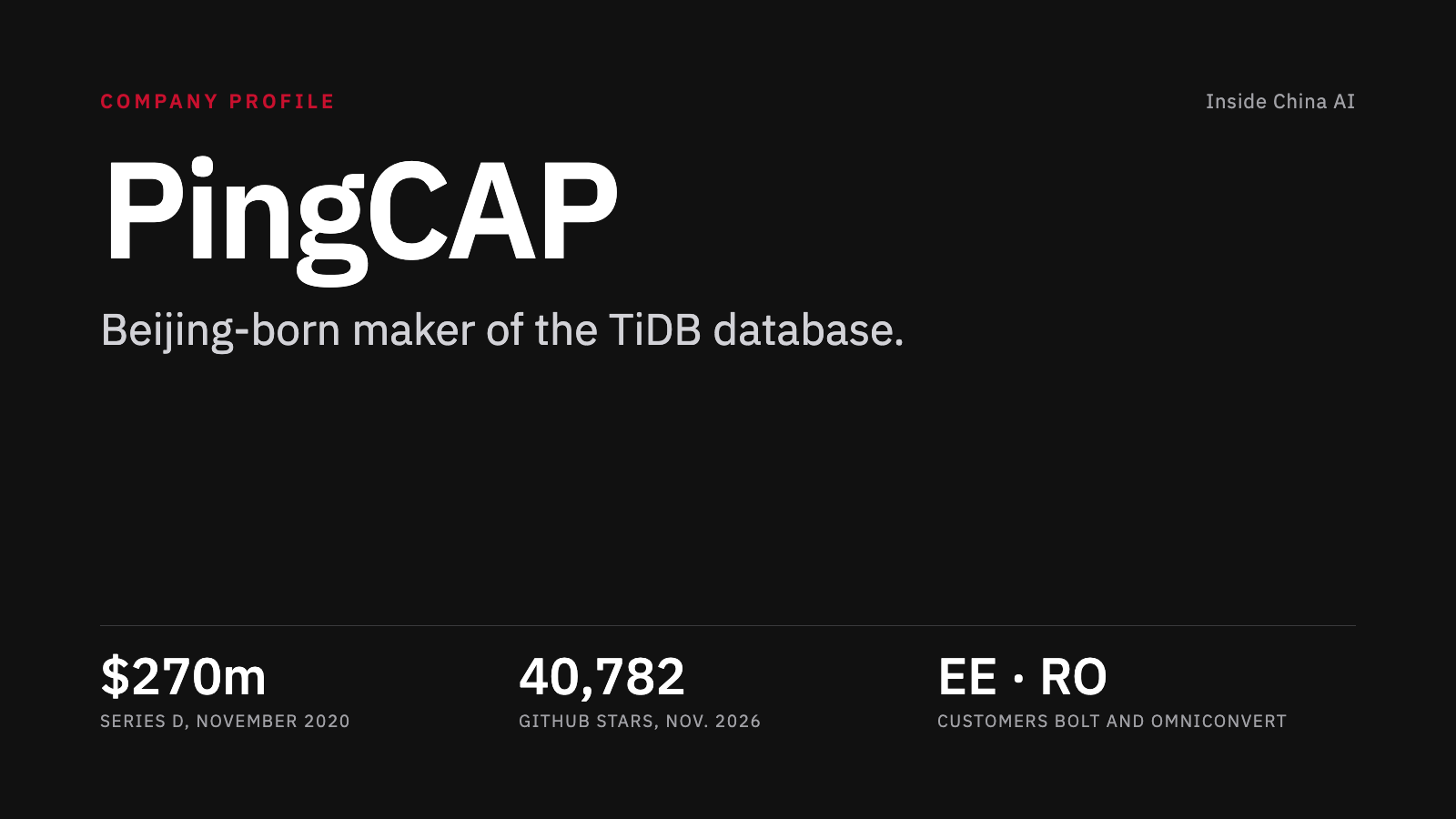
The last funding round PingCAP itself announced was a $270 million Series D on 17 November 2020, in which existing investors Matrix Partners China and Yunqi Partners also took part; the company said then it would use the money for growth in “North America, Japan, Asia Pacific, and Europe” (PingCAP; TechCrunch). PingCAP publishes no revenue, valuation or headcount. On 18 November 2026 it said it had grown revenue by 439% from 2022 to 2025 and ranked 165th on Deloitte’s 2026 Technology Fast 500 for North America (PingCAP).
What they build
TiDB is a distributed SQL database: it spreads data across many machines, keeps them consistent and lets applications written for MySQL run on it with few changes. The code is public under the Apache 2.0 licence (GitHub). Its storage layer, TiKV, is a graduated Cloud Native Computing Foundation project, the company says (PingCAP). TiDB can be run on a customer’s own servers or used as a managed service, TiDB Cloud.
PingCAP does not train AI models. Its AI relevance is the data layer underneath AI applications. On 8 October 2025 it announced TiDB X, an architecture that “makes object storage the backbone of TiDB”, together with a query engine that combines vectors, knowledge graphs, JSON and SQL, an AI developer kit and an MCP server for connecting AI agents (PingCAP). On 11 June 2026 it added the TiDB Agent State Stack, which bundles an instantly created database (TiDB Cloud Zero), an agent memory service (mem9) and file storage, to give agents “durable memory, persistent state, and continuous context” (PingCAP).
The company says agents, not people, are now its fastest-growing users. On 15 October 2026 it said AI agents had created “nearly 3 million database instances” on its entry-level TiDB Cloud Starter in six months, announced public previews of PostgreSQL support and of a filesystem for AI agents, and said it plans to open-source the core of TiDB X by the end of 2026 (PingCAP). One named AI customer is Kimi.ai, the platform of the Chinese model developer Moonshot AI, which uses TiDB Cloud Starter to provision isolated databases “in approximately one second” for the applications its agents generate, according to PingCAP (PingCAP, 25 August 2026). Among larger users the company names Atlassian, which it says consolidated more than 750 PostgreSQL clusters into 16 TiDB clusters (PingCAP).
On 1 September 2026 the company published a source-code security assessment by NCC Group, which, according to PingCAP, found no vulnerability above low severity (PingCAP). In its incident report of 19 October 2026 PingCAP said that between 9 September and 7 October 2026 “an unauthorized party used stolen service account credentials to access certain PingCAP internal systems, copy data, and obtain source code” (incident report). According to the report, the exported records included TiDB Cloud user names and email addresses, SQL editor text, customer contacts, contract terms, pricing and billing configuration, as well as encrypted API-key values; the company says there is “no evidence that data stored in TiDB was impacted”. In a note of 23 October 2026 Max Liu wrote: “We did not protect that information as we should have”, and asked customers to replace their TiDB Cloud management API keys and rotate anything shared with support (PingCAP).
Key numbers
- Founded 2015 by Max Liu (CEO), Ed Huang (CTO) and Dylan Cui; founding team in Beijing
- Headquarters Sunnyvale, California; offices in Singapore, Kuala Lumpur, Tokyo (PingCAP)
- Last announced funding $270 million Series D, 17 November 2020 (PingCAP); valuation not disclosed
- Growth Revenue up 439% from 2022 to 2025, the company says (PingCAP)
- Open source TiDB under Apache 2.0; 40,782 GitHub stars on 27 November 2026 (GitHub)
- Security incident Unauthorised access 9 September to 7 October 2026, disclosed 19 October 2026 (PingCAP)
The European angle
- Offices and entities None listed in Europe (PingCAP). A company blog post says it has engineering hubs in Europe, without naming a country (PingCAP blog).
- Customers In a PingCAP case study published on 20 February 2025, Bolt, the mobility company headquartered in Tallinn (Bolt), says it uses TiDB “as the store of record for our most critical applications, including microservices supporting order creation, commerce, and payment processing”, at 35,000 queries per second on average (PingCAP case study). In a case study of 30 September 2025, Omniconvert, an e-commerce experimentation platform with its main office in Bucharest (Omniconvert), describes moving from MongoDB to self-hosted TiDB (PingCAP case study).
- Where the data sits TiDB Cloud runs in the AWS region Frankfurt (eu-central-1); release notes of 9 June 2026 list it among the regions for full-text search on TiDB Cloud Starter (TiDB Cloud release notes).
- Data protection, in the company’s words The privacy policy names Bird & Bird GDPR Representative Services in Brussels as “our representative” for the EEA and says PingCAP has certified under the EU-U.S. Data Privacy Framework (privacy policy). On the October 2026 incident, PingCAP says it will “notify affected customers directly once we have established customer-specific impact” (incident report).
- Visibility In 2026 PingCAP sponsored The AI Summit London on 10–11 June, exhibited at GITEX AI Europe in Berlin on 30 June–1 July and ran a hands-on workshop at the AWS office in Stockholm on 3 November (London; Berlin; Stockholm).
- Lists PingCAP is not on the EU’s consolidated financial sanctions list, the US Consolidated Screening List (including the Entity List) or the Pentagon’s 1260H list, according to our name check of the published lists on 27 November 2026.
- What a European buyer would actually encounter An open-source database that can be self-hosted under Apache 2.0, or a managed service with a Frankfurt region, contracted with a US company whose engineering roots are in Beijing and which reported a security incident in October 2026.
What we could not verify
- The Chinese business: which company runs pingkai.cn, who owns it, and how much of TiDB’s development happens in China.
- Funding after November 2020, valuation, absolute revenue and headcount. A 2021 round has been reported, but PingCAP has not announced it.
- Where in Europe the engineering hubs the company mentions are, and whether any European legal entity exists.
- Whether European customers were affected by the incident of September and October 2026.
The open question for Europe: TiDB is open source and can run in Frankfurt, but the contract partner is in California and the roots are in Beijing. Will PingCAP build a presence of its own in Europe to match its European customers?

Comments are closed