Graphic: Inside China AI
Plaud: A San Francisco Company With Shenzhen Roots That Records Europe’s Meetings on American AI Models
Company profile · 26 November 2026.
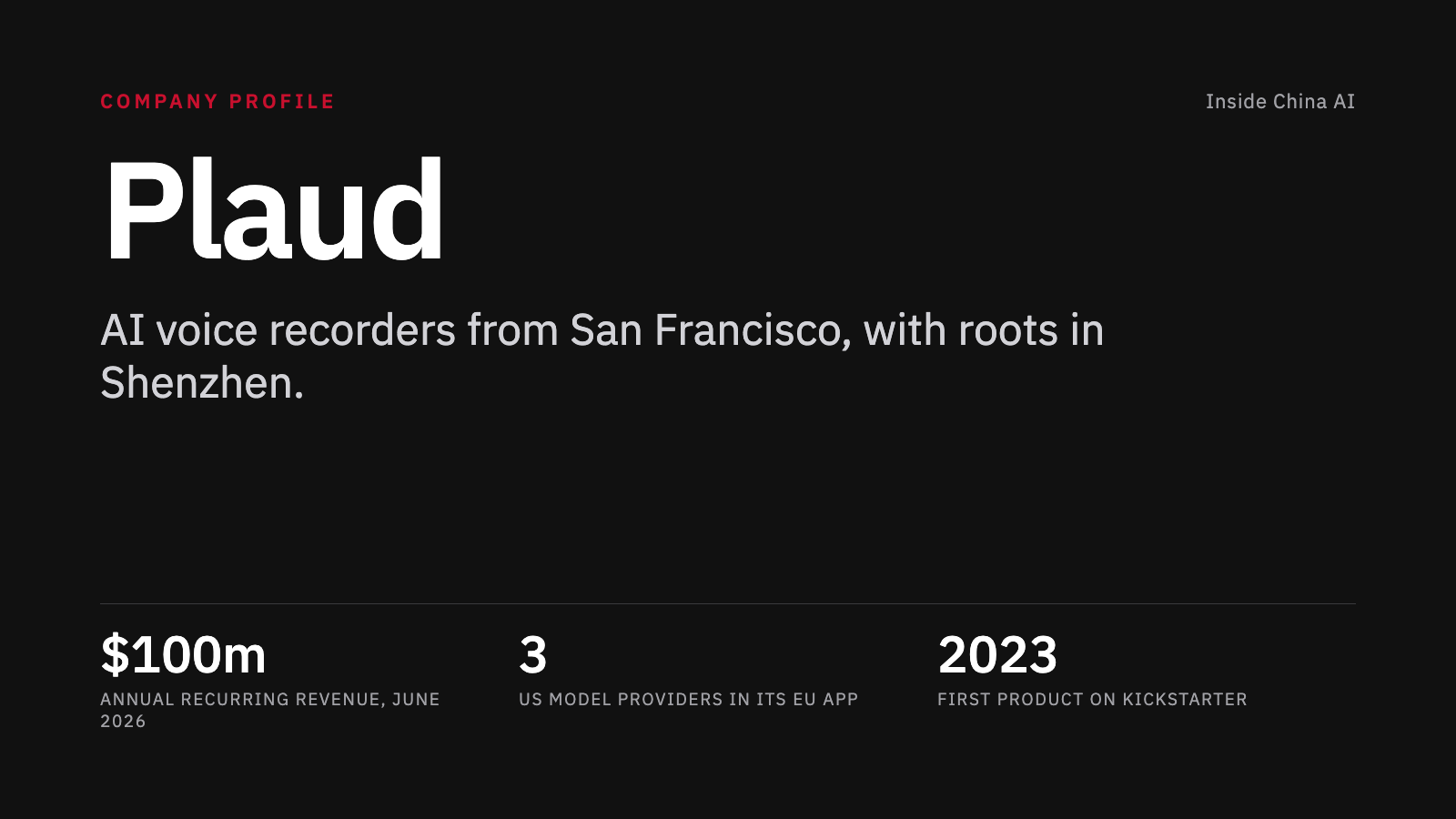
Plaud makes the card-sized Plaud Note and the wearable NotePin, recorders that turn conversations into transcripts and summaries. Legally it is Plaud Inc., a Delaware company that calls San Francisco its headquarters. Its roots are in Shenzhen: chief executive Nathan Xu co-founded it with Charles Liu, a Shenzhen factory owner, its hardware is designed in Shenzhen, and its Chinese website carries the name of a Shenzhen company. In Europe, Plaud sells through its own web shops and a Nordic distributor. The company says it stores European users’ data in Frankfurt. The summaries come from American AI models. In China, by the company’s own account, it uses Chinese models instead. For European buyers, the main questions are which company they contract with and who can access their recordings.
Origins and backing
Plaud describes itself on its website as “registered in: Delaware, US | Headquarter: San Francisco, US”, with offices in San Francisco, Palo Alto, Seattle, Singapore, London, Beijing, Shenzhen and Tokyo (Plaud). Its privacy policy names Plaud Inc., at a registered-agent address in Dover, Delaware, as provider and data controller (privacy policy).
The story behind it starts in China. Forbes, in a profile published on 3 September 2025, called Plaud a “San Francisco and Shenzen, China-based startup” (Forbes). The co-founder and chief executive is Nathan Xu, who also appears as Xu Gao (许高). He studied at Wuhan University and worked as an investor at the Beijing-based fund China Growth Capital. According to Forbes, he started the company with his own savings and with “his older cofounder Charles Liu, a Shenzhen factory owner”. The two had earlier built a small recorder called Izyrec together, and Forbes reported that they “still own the vast majority of the business”. Xu told Forbes: “We have the best talent in Shenzhen for hardware design, and the best engineers in San Francisco for AI development.” In the same piece he stressed that Plaud “is an American company”, citing the tensions between Washington and Beijing. In a Tencent News interview on 28 October 2025, Xu said Plaud had “started from Shenzhen” (Tencent News).
The Shenzhen company appears in plain view. Plaud’s Chinese website, plaud.cn, carries the page title “深圳机智连接科技官方网站”, the official website of Shenzhen Jizhi Lianjie Technology (plaud.cn). According to the Wall Street Journal, as summarised by PYMNTS on 17 September 2026, Plaud has about 300 employees in China and around 100 in San Francisco, and about 100 in Singapore, where it opened an Asia-Pacific headquarters on 16 September 2026 (PYMNTS). Plaud’s China business has its own chief executive, Mo Zihao, whom 36Kr described in October 2025 as “Plaud’s partner and China CEO” (KrASIA/36Kr). Plaud first launched in mainland China at a Shenzhen event on 22 September 2025, according to the same 36Kr article. Until then it had sold only outside China.
Plaud started out on Kickstarter in 2023, where the Note raised more than USD 1 million in pre-orders, according to Forbes. “We didn’t raise funding. We launched on Kickstarter and immediately sold well, turning profitable on day one,” Mo told 36Kr. Forbes, however, reported that Carbide Ventures had invested “around $5 million” in 2025. In September 2026 Xu told the Wall Street Journal that Plaud had been valued at more than USD 1 billion as of 2025 and would be ready for a US listing once annual revenue exceeds USD 1 billion; PYMNTS reported on 17 September 2026 that Plaud plans to file for an IPO in 2028 (PYMNTS).
What they build
Plaud sells five devices: the Plaud Note and Note Pro, which are card-sized and can stick to the back of a phone; the NotePin and NotePin S, which are worn on clothing; and the Plaud One earbuds, which are available for pre-order (Plaud). The devices record audio. The app and the “Plaud Intelligence” software turn the recordings into transcripts, summaries and, increasingly, follow-up tasks. The company says transcription covers more than 112 languages (Plaud Intelligence) and uses “multiple enterprise-grade models …, including proprietary fine-tuned models” (Plaud trust page). Xu told Tencent News that Plaud does not pre-train its own large models but invests in its own speech recognition.
The language models behind the summaries are bought in. Plaud’s European shop says Plaud Intelligence “is developed on leading AI models, including GPT-5.5, Gemini 3.1 Pro, Claude Sonnet 4.6, and more” (Plaud EU store). Its product page shows the ChatGPT, Gemini and Claude brands (Plaud Intelligence). For the Chinese market Mo named different models in October 2025: “In China, we use Doubao 1.6 Pro, Qwen3-235B-A22B, and DeepSeek” (KrASIA/36Kr). The company says that its AI providers are contractually barred from training on user content, and that Plaud itself trains only with users’ explicit consent (AI data usage policy, 20 May 2026).
Key numbers
- Legal entity Plaud Inc., Delaware; headquarters San Francisco, the company says; Chinese website run in the name of Shenzhen Jizhi Lianjie Technology
- Staff about 300 in China, around 100 in San Francisco and about 100 in Singapore (Wall Street Journal, as reported by PYMNTS on 17 September 2026)
- Revenue USD 100 million in annual recurring revenue, the company said on 16 June 2026; a target of USD 500 million in global sales for 2026, the company told the WSJ (PYMNTS, 17 September 2026)
- Users “over 3,000,000” worldwide, the company says (November 2026)
- Valuation more than USD 1 billion as of 2025, according to Xu (WSJ, September 2026); the company has not announced a funding round
- AI GPT-5.5, Gemini 3.1 Pro, Claude Sonnet 4.6 outside China; Doubao, Qwen and DeepSeek in China (October 2025); its own fine-tuned transcription models
- Lists no match for Plaud or Nicebuild on the US Consolidated Screening List or the US 1260H list (checked 26 November 2026); no match on the EU financial sanctions list (checked 15 November 2026)
The European angle
- Who sells to Europeans Two companies appear in Plaud’s own documents. Plaud Inc. is the data controller. Plaud’s German shop names Nicebuild Technology Limited, a Hong Kong company with a German VAT number, as its operator and Gao Xu as the person responsible for its content (Impressum). Plaud lists London among its “global offices” (Plaud) but does not name a UK company. We found no Plaud company registered in the EU.
- Sales Plaud runs its own euro shop for EU countries and separate shops for Germany, France, Italy, Spain and the UK. In April 2025 Vendora Nordic became exclusive distributor for Sweden, Norway, Denmark, Finland and the three Baltic states (Vendora). We found no named European business customers.
- Data The company says European data is stored in the AWS Frankfurt region and that “users in Europe will have EU-hosted, enterprise-grade subprocessors”, while “the rest of the world will rely on US-hosted LLMs” (trust page). The privacy policy says Plaud operates servers “in the United States, Germany, Japan, and Singapore”, names Prighter as its EU and UK privacy representative, relies on standard contractual clauses for transfers, and states: “Due to the global nature of our operations, our affiliates and service providers may also access your data from other countries only to the extent necessary for providing and operating the services described in this Policy” (privacy policy).
- Compliance Plaud says it complies with ISO 27001, ISO 27701, GDPR, SOC 2, HIPAA and EN 18031, the European cybersecurity standard for radio equipment (Plaud). We have not seen the certificates.
- An independent European test TU Dresden’s videoconference centre tested the Note Pro. It found that data always flows to an outside language-model provider, whether or not the private-cloud option is chosen, and that there is no option to use a privately hosted model (TU Dresden).
- What a European buyer would actually encounter A device designed in Shenzhen, sold in Germany by a Hong Kong company and run as a service by a Delaware company. Its summaries come from models such as GPT-5.5, Gemini 3.1 Pro and Claude Sonnet 4.6, the company says. Obtaining consent from the people recorded is left to the user: “complying with the recording-consent laws that apply where you record, is your responsibility”, the privacy policy says (privacy policy).
What we could not verify
- The corporate chain between Plaud Inc., Nicebuild Technology Limited, the UK company and the Shenzhen company, and who owns the Shenzhen company. We did not check the Chinese register.
- Who builds the devices and where. Xu speaks of hardware design in Shenzhen, but Plaud does not name its manufacturer.
- Which AI providers process European data in the EU. Plaud’s subprocessor list is not public.
- Whether staff in China can access European recordings.
- The founding year. Sources give 2021, 2022 and 2023.
- Revenue. We have only company figures: USD 250 million in annualised revenue expected for 2025 (Forbes, 3 September 2025) and USD 100 million in annual recurring revenue (company release, 16 June 2026). The company did not say whether the second figure covers subscriptions only.
The open question for Europe: when a Plaud device records a meeting in Munich or Madrid, which company is responsible for the recording, which AI models process it, and who outside Europe can access it?

Comments are closed