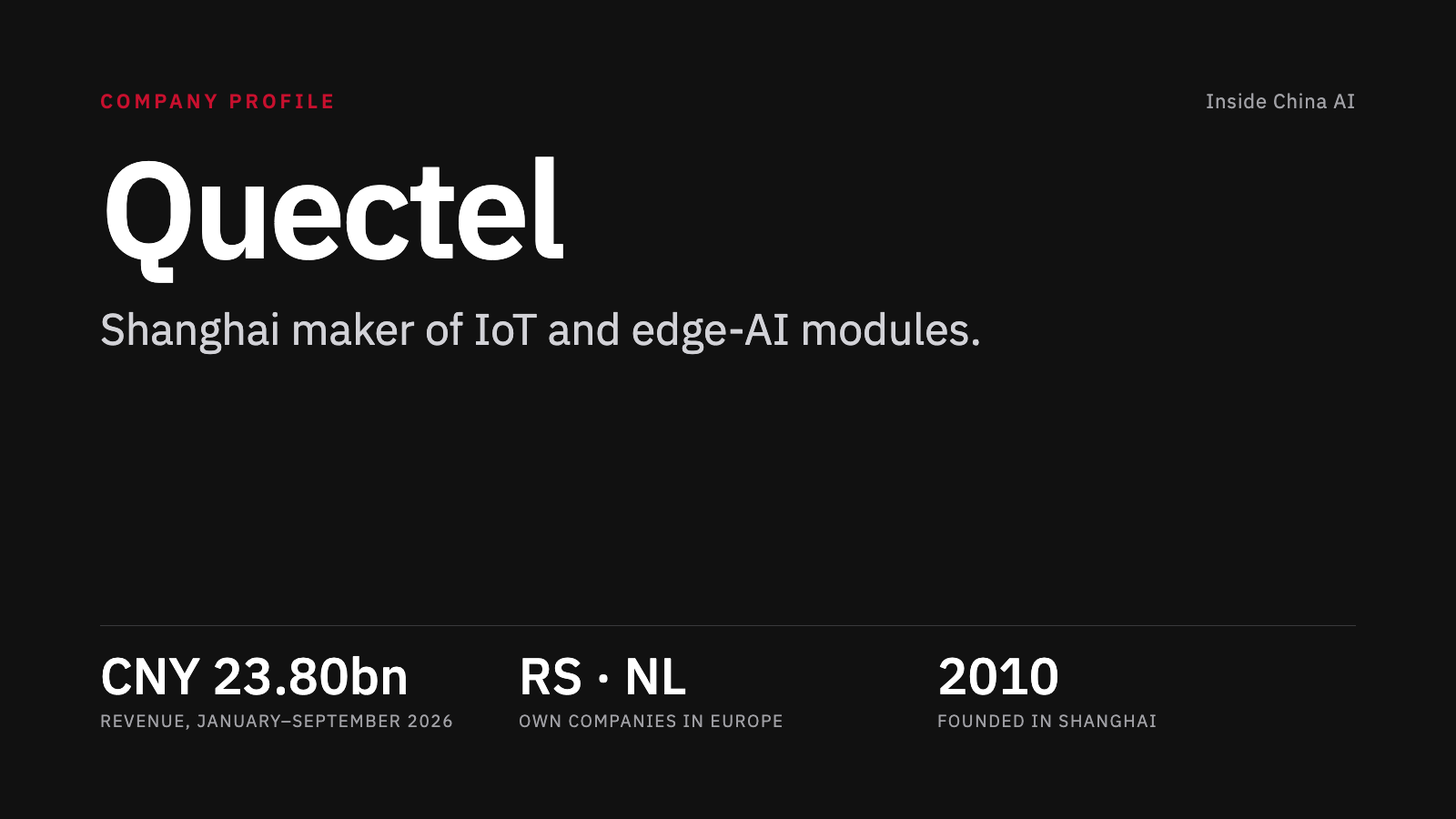
Graphic: Inside China AI
Quectel: A Shanghai IoT Module Maker Builds Out Edge AI
Company profile · 26 November 2026.
Quectel makes the small radio modules that connect meters, routers, trackers, cars and robots to mobile networks, and it now sells modules and software that run AI models on the device itself. In 2025 it booked CNY 12.85bn of its main-business revenue outside China and CNY 11.48bn at home, it runs a research centre in Belgrade, and in its own customer stories it names European industrial firms as customers. Since January 2025 it has also been on the US Department of Defense’s Section 1260H list of “Chinese military companies”, a designation the company rejects and is challenging in a US court. The 1260H list is not a sanctions list.
Origins and backing
Quectel (移远通信) was founded in Shanghai on 25 October 2010 by eight engineers, according to its company history. Its legal name is Shanghai Quectel Wireless Solutions Co., Ltd. (上海移远通信技术股份有限公司), and it has been listed on the Shanghai Stock Exchange since 2019 under the code 603236. It moved into a new global headquarters in Shanghai’s Songjiang district in 2025.
The company is controlled by its chairman and chief executive, Qian Penghe (钱鹏鹤), who held 15.49 per cent of the shares directly on 30 September 2026 and is the managing partner of Ningbo Yiyuan Investment, which held another 5.95 per cent (third-quarter report 2026). The 2025 annual report lists him as chairman, general manager, legal representative and CEO; his earlier career included a project manager role in ZTE‘s Shanghai handset division. The same report counts 8,956 employees at the end of 2025, 6,102 of them in research and development.
Quectel says it has eight R&D centres — Shanghai, Hefei, Foshan, Guilin, Wuhan, Vancouver, Belgrade and Penang — and its own factories in Changzhou, Ganzhou and Linyi in China and in Malaysia, alongside contract manufacturers (2025 annual report).
What they build
The core business is wireless modules: cellular (4G, 5G, RedCap, LPWA), GNSS positioning, Wi-Fi and Bluetooth, satellite and automotive modules, plus antennas, testing and certification, and contract electronics manufacturing. In its third-quarter report, published on 20 October 2026, the company describes four business lines — modules and antennas, automotive, IoT vertical solutions, and “edge AI and solutions” — and says compute modules, automotive and solutions all kept growing well (Q3 report). It does not break out revenue by line.
The AI business combines hardware and software. On the hardware side Quectel sells “smart” and AI compute modules — small computers built on third-party processors. On 11 November 2026, at the electronica trade fair in Munich, it announced the SP900BF-AP, built on Qualcomm’s Dragonwing IQ-9075 processor with up to 100 TOPS of on-device AI compute; the company says it can run large language and vision-language models “such as Qwen, DeepSeek, Gemma and LLaVA” locally on robots, inspection systems and edge gateways, and that engineering samples are available to selected customers (Quectel). These are other companies’ models; Quectel does not present a foundation model of its own.
On the software side, the company says its “Quectel AI” offer covers model optimisation, fine-tuning and deployment “enabling large AI models to run efficiently at the edge”, plus ready-made vision, voice and sensor algorithms (Quectel AI). Its 2026 half-year report describes a “module + AI agent + AI algorithm” approach, an “Agentic IoT” solution, a robot development platform called Q-Robotbox, its own wheeled-arm robot platform with 26 active degrees of freedom and a turnkey package for robotic lawn mowers (half-year report 2026). An algorithm marketplace, AlgoStore, went live in early 2026, the company says. Its annual report notes that the share-funded project for AI compute modules and AI solutions was still under construction and had not yet produced returns.
Key numbers
- Listing Shanghai Stock Exchange, 603236; controlling shareholder Qian Penghe, 15.49% on 30 September 2026 (Q3 report)
- Revenue Q3 2026 CNY 8.54bn, up 34.9% year on year; January–September CNY 23.80bn, up 33.1% (unaudited, Q3 report)
- Net profit Q3 2026 CNY 609m attributable to shareholders, up 132.3%; January–September CNY 1.21bn, up 65.2%
- R&D expense CNY 1.91bn in January–September 2026, against CNY 1.39bn a year earlier
- Cash flow and stock operating cash flow of minus CNY 1.86bn in January–September 2026; inventories CNY 10.31bn on 30 September, against CNY 5.52bn at the end of 2025 — the company cites stockpiling of raw materials
- Full year 2025 revenue CNY 24.33bn (+30.8%), net profit CNY 837m (+42.3%); main-business revenue outside China CNY 12.85bn (+32.2%), in China CNY 11.48bn (+29.4%) (2025 annual report)
- Staff 8,956 at the end of 2025, 6,102 in R&D
- AI AI compute and smart modules (latest: SP900BF-AP, Qualcomm-based, up to 100 TOPS); edge deployment of third-party models; vision and audio algorithms; robot platforms
- US list Section 1260H list (not a sanctions list) since the Federal Register notice of 7 January 2025, kept in the update of 10 June 2026; lawsuit filed 11 May 2026, no ruling as of 25 November 2026
The European angle
- Physical presence Yes. The 2025 annual report lists two subsidiaries in Serbia — Quectel Research & Development Center Europe in Belgrade, fully owned since Quectel bought out a minority holder in November 2025, and Quectel Connectivity Solutions — and a fully owned trading company in the Netherlands, Acceleronix B.V. (2025 annual report). Quectel calls Belgrade its “1st European center” and says it has more than 100 R&D engineers there, a test lab and an anechoic chamber (Quectel). Its company timeline also lists sales offices opened in France and Poland (2013), Denmark (2014) and the UK, Germany and Hungary (2016) (history); its contact page today lists no European address other than Belgrade.
- Named customers In its own customer stories, Quectel names INSYS icom of Regensburg, Germany, which uses an LTE 450 module in industrial routers (January 2025); EEVE of Waregem, Belgium, which uses LTE and GNSS modules in its Willow garden robots (September 2024); and the Spanish smart-meter maker Hidroconta of Murcia, for which it developed an NB-IoT antenna (September 2026). These are company accounts.
- Sales Europe is one of Quectel’s four global sales regions, according to its annual report. The report splits revenue only between China and the rest of the world, so European sales are not disclosed.
- AI in Europe Quectel chose Munich to launch its most powerful edge-AI module so far, on 11 November 2026. We found no named European customer for its AI modules or AI software.
- Patent dispute Quectel says it received a procedural order from the Unified Patent Court’s local division in The Hague in February 2026 in a patent-infringement suit brought by Royal Philips, in which the company and some of its subsidiaries are among the defendants; according to Quectel’s half-year report of 13 August 2026, the case has been accepted by the court but not yet heard (half-year report 2026). Quectel also reports two Philips patent suits in Delaware dating from December 2020, in which the court accepted an amended complaint in March 2026, and says a related US International Trade Commission investigation ended in its favour in July 2022; it says all these cases are at an early stage and that no damages amount has been stated (2025 annual report).
- Data Quectel’s privacy policy says it stores and processes user information “on cloud servers located in Europe and other regions” and names a law firm in Bonn as its EEA representative (privacy policy).
- The US list The Department of Defense added “Quectel Wireless Solutions Co., Ltd.” to its Section 1260H list in a notice published in the Federal Register on 7 January 2025 (Federal Register). The update published on 10 June 2026 kept the company on the list and gave as the reason that “Quectel is indirectly affiliated with MIIT”, China’s industry ministry (Federal Register). The 1260H list is not a sanctions list; Quectel points out that no export controls apply to listed companies. According to Reuters, placement on it “can prevent a company from accessing certain U.S. contracts, grants and other programs”. A year before the first listing, in a letter dated 3 January 2024, Mike Gallagher and Raja Krishnamoorthi, then chairman and ranking member of the House Select Committee on the CCP, asked the Secretaries of Defense and the Treasury about “the potential inclusion” of Quectel on the 1260H list, citing its affiliations with MIIT (House Select Committee).
- The company’s position On 7 January 2025 Quectel said it “does not engage in any work with military entities in any country, including China” and would contest the designation (Quectel). On 11 May 2026 it filed suit against the Department of Defense in the US District Court for the District of Columbia, seeking judicial review (Quectel; Reuters). According to the court docket (case 1:26-cv-01605, Judge Paul L. Friedman), Quectel moved for summary judgment on 11 September 2026 and the government cross-moved on 9 October; the oral argument set for 24 November was vacated in favour of supplemental briefs filed that day, and no ruling had been issued as of 25 November 2026 (docket via PacerMonitor). A name check by Inside China AI on 15 November 2026 found no entry for Quectel on the EU’s consolidated financial sanctions list or the US Consolidated Screening List.
- What a European buyer would actually encounter A Chinese module supplier with its own engineers in Belgrade and a trading company in the Netherlands, whose cellular and GNSS modules already sit in European routers, meters and robots — and which now wants the same customers to run AI models on its hardware.
What we could not verify
- The outcome of Quectel’s lawsuit against the Department of Defense; the court had not ruled as of 25 November 2026.
- Any FCC proceeding concerning Quectel modules; we found no primary document from the FCC.
- Which European offices from the company timeline still operate, and what Acceleronix B.V. does in the Netherlands.
- Revenue from Europe and from edge AI, which Quectel does not disclose separately.
The open question for Europe: will the industrial customers who already buy Quectel’s radio modules also run their AI on its hardware?

Comments are closed