Graphic: Inside China AI
RoboSense: China’s Lidar Maker Wants to Be the Eyes and Hands of Robots
Company profile · 26 November 2026.
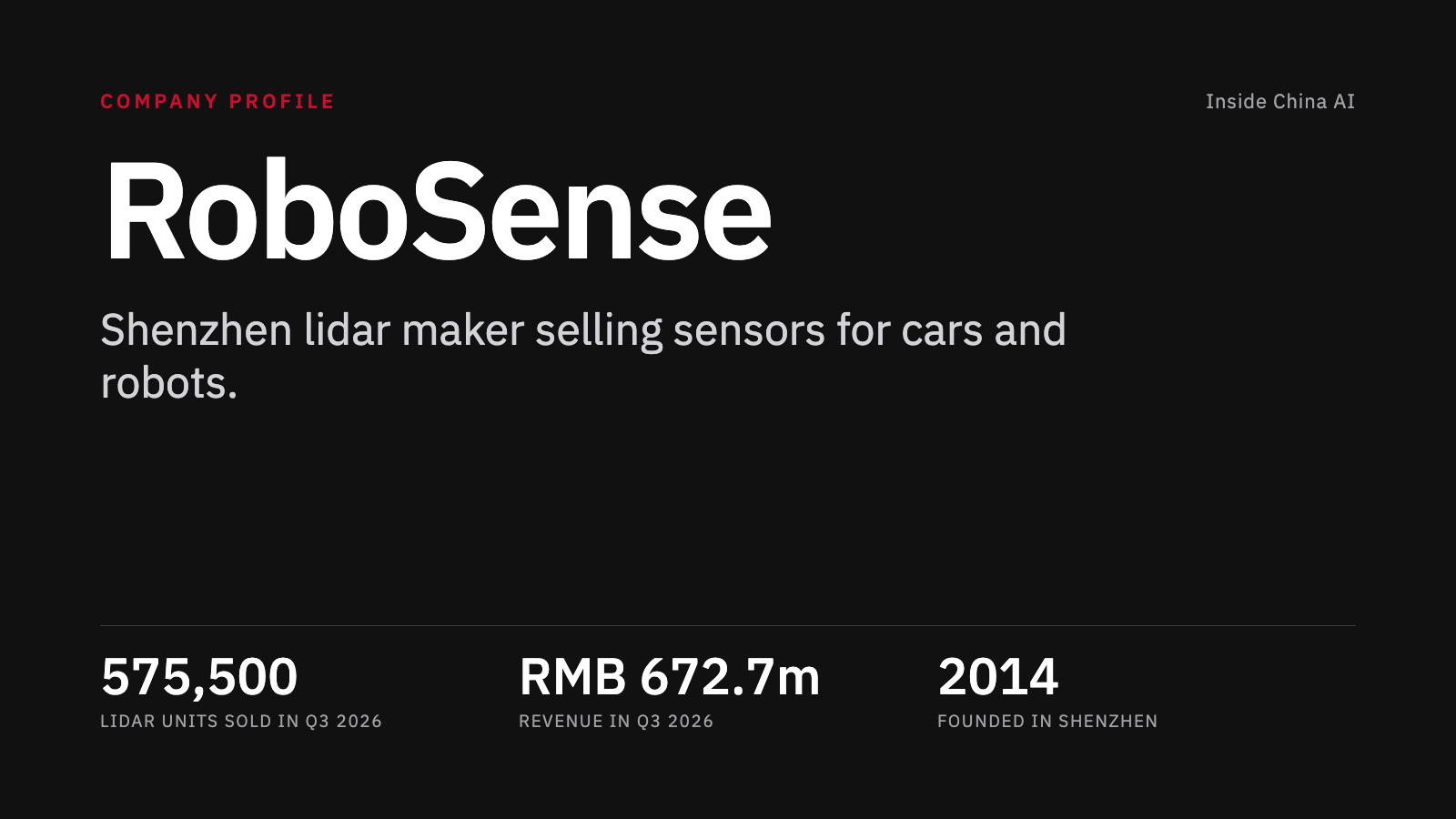
RoboSense, listed in Hong Kong, builds the laser sensors that let cars and robots see in three dimensions. It sold about 575,500 of them in the third quarter of 2026, and in the first half of the year robots brought in nearly half of its product revenue. Next it wants to supply robots with cameras, touch sensors and joint motors as well. Europe meets it in three places: an office in Germany, design wins with the Chinese joint ventures of European carmakers, and orders from European humanoid makers it does not name. Since June 2026 RoboSense has also been on the Pentagon’s list of “Chinese military companies”, which is a designation, not a sanction.
Origins and backing
RoboSense (速腾聚创) was founded in Shenzhen in 2014, where it still has its headquarters (RoboSense). Its three founders, Qiu Chunxin, Zhu Xiaorui and Liu Letian, had formally agreed to vote together (annual results 2025). They ended that agreement on 9 October 2026 and now exercise their voting rights independently (Q3 results). As of 13 November 2026 Qiu Chunxin is chairman and chief scientist, Liu Letian is chief technology officer and Qiu Chunchao is chief executive (HKEX announcement; interim results). Zhu Xiaorui left the board on 28 September 2026. Her replacement as non-executive director, Yao Haibo, is senior director of investment at Shenzhen Xiyuan Robotics (HKEX announcement).
The company is incorporated in the Cayman Islands, and its shares have traded on the Hong Kong stock exchange (2498) since 5 January 2024 (annual results 2025). The IPO raised HK$985 million. A state-owned investment company from Shenzhen’s Nanshan district was the cornerstone investor, and Alibaba’s logistics arm Cainiao was the largest shareholder before the listing, with 10.46 per cent (CNBC). Qiu Chunxin held about 10.5 per cent of the shares in October 2026 (HKEX announcement).
What they build
RoboSense’s main product is lidar, a sensor that measures distance with laser pulses. It sells one line for driver assistance in cars and another for robots. The company says its products run on its own optoelectronic chips and perception algorithms (RoboSense). In April 2026 it presented a chip architecture called EOCENE with two chip families, Peacock and Phoenix. The E2 lidar, built on Peacock, began volume shipments in the third quarter (interim results), and the first car model with Phoenix chips entered series production and began deliveries in November 2026, the company says. In the same month it started a fully automated lidar production line in Shenzhen with an annual capacity of 500,000 units (Q3 results). RoboSense describes its AI as perception software that works with its own hardware. We found no foundation model of its own.
Cars still account for most of the units it ships, 430,300 of 575,500 in the third quarter of 2026, but robots are catching up: robot lidar sales rose 309 per cent year on year to 145,200 units (Q3 results). In 2024 the revenue split between car and robot business was about nine to one. In the first half of 2026 robots brought in “nearly half” of product revenue (interim results). RoboSense names mower makers Mammotion and Navimow, a Segway-Ninebot brand, as customers (annual results 2025).
In its interim results of 26 August 2026 it describes a product structure for humanoid and other robots, which it calls “Eyes”, “Skin” and “Muscles”. The eyes are a depth camera called Space Camera, the skin is two kinds of tactile sensor, one of them small enough to fit into the fingertip of a robot hand, and the muscles are joint modules. The company says it has volume orders for the camera from “selected leading global enterprises” and “initial procurement demand” for tens of thousands of joint modules, with deliveries starting in the second half of 2026 (interim results). In its Q3 results of 25 November 2026 it says it has entered the supply chains of “several global leading AI companies”, without naming them (Q3 results). RoboSense has sold its own embodied-robot business, including the related patents and other intellectual property, for RMB 59.9 million to Shenzhen Xiyuan Robotics, which according to the filing is “controlled as to 35%” by chairman Qiu Chunxin. The deal was signed on 10 September and completed on 3 November 2026. RoboSense says it will concentrate on components for robot makers and expects to become one of the buyer’s suppliers (HKEX announcement; completion).
Most of its car customers are Chinese. As of 30 September 2026 RoboSense had design wins for 197 car models with 36 carmakers and suppliers, and 91 of those models were in series production (Q3 results). On 26 August, when the count stood at 194, it said 37 of them came from foreign carmakers and Sino-foreign joint ventures “which cover markets in Japan, North America and Europe” (interim results). The company names Xiaomi, whose SkyNomad N90 Max SUV uses only RoboSense’s solid-state lidar, according to the same filing. Its website lists design wins with Dongfeng Nissan, FAW Toyota, Great Wall Motor and SAIC Audi, a strategic partnership with SAIC Volkswagen, and robotaxi projects with Didi and Pony.ai (RoboSense).
Key numbers
- Listing Hong Kong (2498) since 5 January 2024; incorporated in the Cayman Islands, headquarters in Shenzhen
- Lidar sales About 575,500 units in Q3 2026, up 210.1 per cent (430,300 for cars, 145,200 for robots and other uses); 1,294,700 in January–September 2026. RoboSense deducted 20,100 car units, mainly replacements for one carmaker’s vehicles, from the 595,600 it had reported on 9 October (Q3 results). The company expects to sell more than one million units in Q4 2026 (RoboSense)
- Revenue RMB 672.7 million in Q3 2026, up 65.2 per cent; RMB 1,692.5 million in January–September 2026, up 42.2 per cent; RMB 1,941.0 million in 2025 (Q3 results; annual results)
- Profit Net loss of RMB 168.0 million in Q3 2026 and RMB 327.9 million in January–September 2026. Gross margin fell to 3.7 per cent in Q3 from 23.9 a year earlier, mainly because of a provision of about RMB 118.7 million for replacing lidar units in one carmaker’s vehicles, the company says (Q3 results). Q4 2025 was its first profitable quarter since 2014 (annual results)
- Outside mainland China RMB 183.2 million of January–September 2026 revenue, about 11 per cent (Q3 results)
- Staff More than 2,200 as of 30 June 2026, almost all in mainland China (interim results)
The European angle
- Physical presence Yes, in Germany. RoboSense’s website gives its “European Office” as Konrad-Zuse-Platz 8 in Munich (RoboSense), while its 2026 filings put its German office in Stuttgart (interim results). A March 2024 press release introduces staff of a RoboSense EMEA GmbH (PR Newswire). According to the interim results, “substantially all” of RoboSense’s non-current assets are in China. We found no European production.
- Car customers None named in Europe. RoboSense reports design wins from the Chinese joint venture of “a leading European luxury automaker” and from several joint ventures of “the largest European automotive group” (annual results 2025). Its website names SAIC Audi and SAIC Volkswagen, joint ventures that build cars for China. In March 2024 the company said it had helped bring the Lotus Emeya into series production (PR Newswire). We could not establish whether cars sold in Europe carry RoboSense’s sensor.
- Robot customers The company says its Active Camera solutions “secured volume orders from leading European humanoid robot manufacturers” in the first quarter of 2026, without naming them (Q1 results). It presented the camera at the ICRA robotics conference in Vienna in June 2026. In September 2026, according to its Q3 results, lidar with its Peacock chip went into consumer robots made by some of its customers, which were shown at the IFA trade fair (Q3 results).
- Quality On 21 August 2026 China’s market regulator published two recalls filed by Geely: 74,037 Lynk & Co cars and 18,878 Geely Galaxy M9s built in 2025, from 24 August 2026, because a supplier’s process variation may have damaged a power chip inside the lidar. The lidar units are replaced free of charge (SAMR). The recall notice does not name the supplier. The Chinese business site Jiemian reported, citing public information, that the lidars in the recalled Lynk & Co models came from RoboSense (Jiemian). We found no second independent source for this and no statement from RoboSense. In its Q3 results RoboSense booked provisions of about RMB 137.4 million in January–September 2026 for replacing lidar units in “one of our OEM customers’ vehicles”, without naming the carmaker (Q3 results).
- Regulatory exposure In June 2026 the US Department of Defense added RoboSense Technology Co., Ltd. to its Section 1260H list of “Chinese military companies”. The notice, dated 5 June and published in the Federal Register on 10 June 2026 (91 FR 35189), says RoboSense “is a military-civil fusion contributor to the Chinese defense industrial base because it is affiliated with the PLA” (Federal Register). The list is a US designation, not a sanction. RoboSense is not on the US Entity List or the other US export and sanctions lists, according to our check of the Consolidated Screening List on 20 November 2026 (trade.gov). We found no announcement or public response from RoboSense on the 1260H listing.
- Governance On 10 September 2026 RoboSense agreed to sell its embodied-robot business to Shenzhen Xiyuan Robotics, which is “controlled as to 35%” by its chairman (HKEX announcement). On 21 October 2026 Shenzhen Suteng, an indirect wholly-owned subsidiary, agreed to lend up to RMB 10 million each to the chairman and the chief technology officer; according to the filing, the unsecured loans are to be used for their personal tax liabilities (HKEX announcement). Both deals were disclosed as connected transactions under Hong Kong listing rules.
- What a European buyer would actually encounter A listed Chinese component supplier with a sales office in Germany. For a European carmaker or robot maker, it would deliver sensors made in China, from a company the Pentagon has designated as a “Chinese military company”.
What we could not verify
- Any named customer in Europe. The European humanoid makers and the European carmakers’ joint ventures are unnamed in the company’s filings.
- Whether cars or robot mowers sold in Europe carry RoboSense lidar, including the Lotus Emeya and Mammotion’s lidar mowers.
- Where exactly the German office is: the website and the register data give Munich, the 2026 filings Stuttgart.
- Which carmaker the replacement provision in the Q3 results refers to, and whether it is linked to the Lynk & Co recall.
- RoboSense’s reaction to the 1260H listing and to the Lynk & Co recall.
The open question for Europe: will a European carmaker or robot maker name RoboSense as a supplier, now that the Pentagon lists it as a “Chinese military company”?

Comments are closed