Graphic: Inside China AI
Rockchip: Fuzhou Chip Designer Adds Co-Processors to Run Language Models on Devices
Company profile · 26 November 2026.
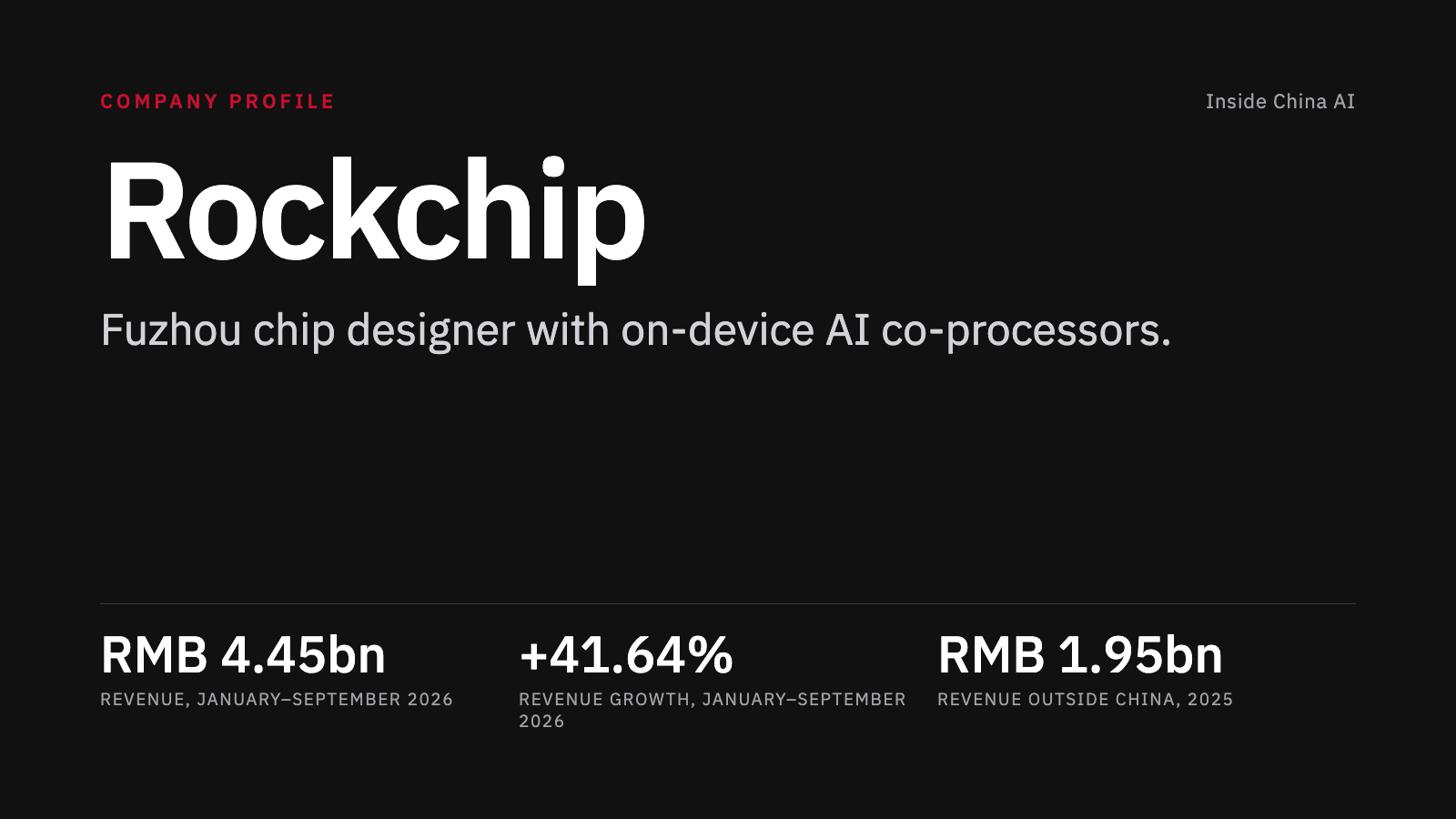
Rockchip designs the processors inside tablets, smart displays, cameras, industrial controllers, car cockpits and robots, and most of them now carry its own neural processing unit. It has added a second line of chips: co-processors that sit next to the main processor and run language and vision models locally, without the cloud. The company, listed in Shanghai and controlled by its co-founder Li Min, grew revenue by 41.64 per cent in the first nine months of 2026. In Europe it has no subsidiary, but its chips sit in industrial modules made here, and it has published guidance for customers selling into the EU under the Cyber Resilience Act. For European device makers, Rockchip matters as a supplier: a choice of chip that decides which AI models a product can run offline, and whose security support now has to meet EU rules.
Origins and backing
Rockchip was established in 2001 and is headquartered in Fuzhou, the capital of Fujian province, with branches and subsidiaries in Shenzhen, Shanghai, Beijing, Hangzhou and Hong Kong (Rockchip). Li Min and Huang Xu founded the company together in 2001 (listing announcement). Li Min has been chairman and general manager since November 2001 and is today the sole actual controller (annual report 2025). The company became a joint-stock company on 31 July 2015 and listed on the Shanghai Stock Exchange on 7 February 2020 under the code 603893 (listing announcement).
There is no outside investor that controls the company. On 30 September 2026 Li Min held 37.20 per cent and Huang Xu 13.23 per cent; Hong Kong Securities Clearing held 4.32 per cent (third-quarter report). Huang Xu, who retired as vice president on 20 January 2025, sold 6.43 million shares between 4 June and 3 September 2026 for RMB 1.198 billion under a plan disclosed on 13 May 2026, the company announced on 4 September 2026 (company announcement). Since its listing the company has completed seven employee option and restricted-share grants (annual report 2025); its 2026 plan granted options and restricted shares to more than 200 staff (interim report 2026). At the end of 2025 it employed 1,029 people, 799 of them in research and development (annual report 2025).
What they build
Rockchip describes its business as the design and sale of “edge and on-device AIoT chips” and supporting mixed-signal chips. It is fabless: wafer production, packaging and testing are outsourced, and most sales go through distributors (interim report 2026). Application processors made up about 90 per cent of revenue in the first half of 2026; the rest came mainly from mixed-signal and other chips, such as power-management, interface and wireless chips, sold alongside them. Most of its application processors contain a neural processing unit (NPU) designed in-house, ranging from below 1 TOPS to above 16 TOPS, the company says.
The best-known chip is the RK3588, an 8-nanometre processor with four Arm Cortex-A76 and four Cortex-A55 cores and a 6 TOPS NPU (Rockchip). According to the interim report, it is used in large displays, car cockpits, edge computers, robots, NAS storage, industrial equipment, education tablets, video-conferencing systems and payment terminals. A mid-range successor, the RK3572 with a 4 TOPS NPU, was launched in May 2026 and went into mass production in the third quarter; a new flagship, the RK3668, is “about to go into production”, with the RK3688 to follow, the company said on 27 October 2026 (third-quarter report). Arm lists Rockchip as a “Silicon Partner” (Arm).
The AI step is the RK182X family of co-processors. They combine a multi-core RISC-V CPU, up to 5 GB of memory and an NPU that supports “localized deployment of 3B/ 7B LLM”, and connect to a main processor over PCIe or USB (Rockchip). Rockchip says several hundred customers in dozens of industries are developing products with the first co-processor, and that the first of them, among them high-end televisions, commercial cleaning robots, companion robots and NAS devices, had reached launch or mass production by mid-2026. On 15 August 2026 it said several RK1828 chips linked together can run Alibaba’s Qwen3.8-27B model (Rockchip).
Rockchip does not build its own large models. Its RKNN3 software toolkit adapts other companies’ models to its chips; the interim report names Alibaba’s Qwen series, Google’s Gemma 4, MiniCPM and Zhipu‘s GLM Edge. The company’s own AI work is in algorithms for audio, video and vision, such as noise reduction and super-resolution. On 12 October 2026 it signed a strategic agreement with State Labs, a company building multimodal models for devices; Rockchip says their joint RK1828 systems for industrial inspection are already in use in production (Rockchip).
In cars, Rockchip says its chips, led by the cockpit processors RK3588M and RK3576M, are in more than a hundred production models and that more than 20 projects for an “AI box” running large models in the car are under way with leading carmakers and suppliers; it names none of them (interim report 2026). In robots, it presents its main chips as the robot’s “cerebellum” for motion and perception and the co-processor as its “brain”.
Key numbers
- Listing Shanghai Stock Exchange (603893) since 7 February 2020; founder Li Min 37.20% (30 September 2026)
- Revenue RMB 4.45 billion in January–September 2026, up 41.64%; RMB 1.57 billion in the third quarter, up 43.57% (Q3 report)
- Net profit RMB 1.33 billion in January–September 2026, up 70.90%; gross margin 46.37%, the company says
- 2025 revenue RMB 4.40 billion (+40.36%), net profit RMB 1.04 billion (+74.82%), R&D spending 15.53% of revenue (annual report)
- Outside China RMB 1.95 billion of RMB 4.40 billion main-business revenue in 2025; no breakdown by country
- Customers top five accounted for 60.67% of sales in 2025; none named
- Staff 1,029, of whom 799 in R&D (end of 2025)
- AI hardware in-house NPUs in most processors; RK182X co-processors for 3B and 7B models, cascaded RK1828 for Qwen3.8-27B
The European angle
- Presence None of its own. Rockchip’s subsidiaries are in mainland China and Hong Kong, and assets outside mainland China came to RMB 2.9 million, 0.04 per cent of the total, on 30 June 2026 (interim report 2026). Its contact page lists offices in Fuzhou, Shanghai, Shenzhen and Beijing only (Rockchip).
- Trade fairs Rockchip exhibited at embedded world in Nuremberg in March 2025 and again on 10 March 2026, at booth 3A-641, where it showed RK3588 and RK1828 systems for industry, robots and cars and, it says, the modules of more than ten partners, whom it does not name (Rockchip).
- Customers Cherry Embedded Solutions in Vienna, formerly Theobroma Systems and now part of Cherry SE, advertises “solutions made in Austria” and builds its system-on-modules on “ARM-based System-on-Chips (SoC) from Rockchip” (Cherry Embedded Solutions). Its TIGER module uses the RK3588 (Cherry Embedded Solutions), and its JAGUAR single-board computer, built on the same chip, is designed for autonomous mobile robots (Cherry Embedded Solutions). Rockchip itself names no European customer, and its filings give no figure for Europe.
- Partners The open-source consultancy Collabora, registered in Cambridge, UK (Collabora), has worked on mainline Linux support for the RK3588 and wrote on 13 April 2026 that it “teamed up with Rockchip and Ideas on Board” on a new camera driver (Collabora). That work makes it easier for European device makers to run standard Linux on Rockchip chips.
- Regulation In August 2026 Rockchip published a Cyber Resilience Act whitepaper for “Customers developing products destined for the EU market based on Rockchip SoCs”. It says the service windows of its product security incident response team, among them a vulnerability-reporting address, officially opened in September 2026, and that it has selected compliance-service partners, without naming them (Rockchip).
- Open-source dispute On 18 December 2025 GitHub published a takedown notice under the US Digital Millennium Copyright Act (DMCA) from a copyright holder in the FFmpeg project over specific files in Rockchip’s MPP video software; the notice says code from FFmpeg’s LGPL-licensed libavcodec library is infringed (GitHub). GitHub blocked the repository, heise reported on 8 January 2026 (heise). On 27 November 2026 the repository was publicly available again; its most recent code change dates from 3 November 2026 (GitHub). We found no statement from Rockchip.
- Lists Rockchip does not appear on the US Entity List or other US export and sanctions lists combined in the Consolidated Screening List, on the Pentagon’s 1260H list of “Chinese military companies”, or in the EU’s financial sanctions file (checked 27 November 2026).
- What a European buyer would actually encounter A Chinese chip inside an industrial panel, a camera, a single-board computer or a robot, sometimes under a European module maker’s brand, and in newer designs with a second chip next to it that runs an open model offline.
What we could not verify
- How much Rockchip sells in Europe. Its filings split revenue only into China and outside China.
- Which European companies buy directly from Rockchip and which through distributors, and who the unnamed partners at embedded world 2026 were.
- How the FFmpeg dispute was resolved before the repository came back online.
- Which carmakers use Rockchip cockpit chips, and whether any of those cars are sold in Europe.
- Which companies are Rockchip’s CRA compliance partners, and whether its chips have been assessed against the draft European standards it cites.
The open question for Europe: as the Cyber Resilience Act takes effect, will Rockchip’s security support be enough for the European module makers that build on its chips?

Comments are closed