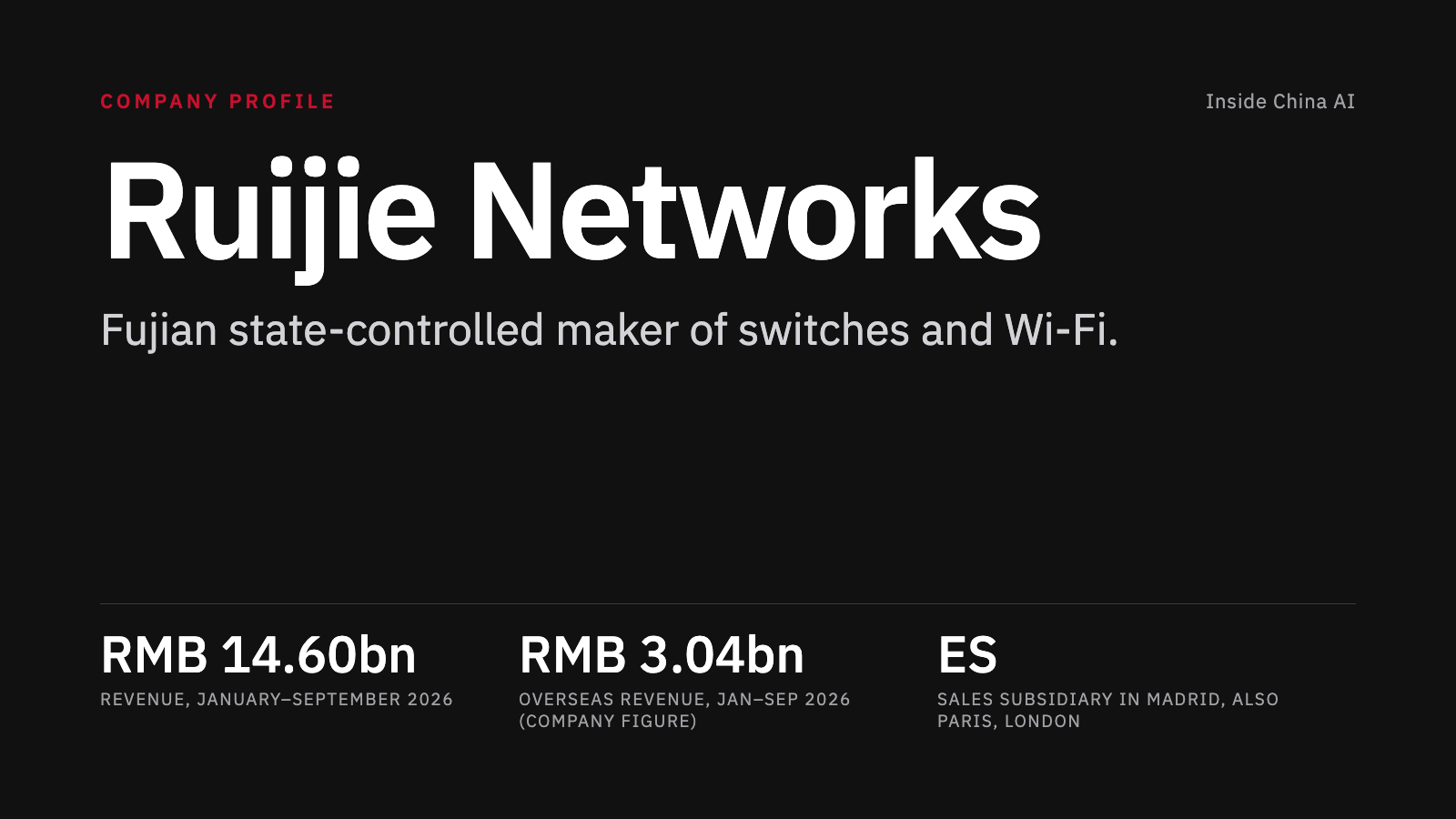
Graphic: Inside China AI
Ruijie Networks: A State-Controlled Switch Maker Grows With China’s AI Data Centres and Sells Wi-Fi in Europe
Company profile · 26 November 2026.
Ruijie Networks builds the switches that connect GPUs inside Chinese AI data centres, and data-centre switches now account for about 65 per cent of its revenue, according to the company. In Europe the same company is known for something else: Wi-Fi access points and campus switches sold through local partners, from sales subsidiaries in Madrid, Paris and London. Ruijie is controlled by the Fujian provincial government, and by its own account it depends on foreign switch chips for its most advanced products.
Origins and backing
Ruijie (锐捷网络) was founded in 2003 and is headquartered in Fuzhou, Fujian province. It listed on the ChiNext board of the Shenzhen Stock Exchange on 21 November 2022 (H1 2026 report). Its largest shareholder is Fujian Star-Net Ruijie Communication, itself listed in Shenzhen, with 44.88 per cent. An employee shareholding platform holds another 43.12 per cent (Q3 2026 report). The H1 report names Fujian Electronics & Information (Group) as the indirect controlling shareholder and the Fujian provincial state-asset regulator (SASAC) as the actual controller (H1 2026 report). That control shows in practice: the convertible bond and the share-incentive plan announced in September 2026 both need Fujian SASAC approval (Q3 2026 report).
Ruan Jiayong has been chairman since November 2024 and a director since 2003. He also chairs Star-Net Ruijie. Liu Zhongdong has been general manager since 2003 (2025 annual report). The company had 6,681 employees at the end of 2025, of whom 3,359 worked in research and development (2025 annual report).
On 18 September 2026 the board approved a plan to raise up to RMB 2.6 billion through convertible bonds. Most of the money is meant for high-speed interconnect networks for large AI computing clusters and for switching units for high-density computing clusters (bond plan). The company told investors that this would be its first fundraising since the IPO (investor-relations record, 21 October 2026). The plan still needs approval from Fujian SASAC, the shareholders, the Shenzhen exchange and the China Securities Regulatory Commission.
What they build
Ruijie makes network equipment, network-security products and cloud-desktop systems (H1 2026 report). It does not publish AI models of its own. Its link to AI is the network fabric that ties GPU clusters together. The company says it offers data-centre switches at 400G, 800G and above for model training and inference, including a 128-port 800G box switch. It also sells cluster network designs called AI-Fabric and AI-FlexiForce (H1 2026 report). In September 2026 it launched RG-ETH 128, a rack-scale super-node design that, the company says, connects up to 128 GPUs per rack with 3.2 Tbps of Ethernet bandwidth per GPU. It also says 400G linear-drive optics are in volume production and 1.6T versions exist as prototypes (investor-relations record).
The customer list for this business is Chinese. In its 2025 annual report and its H1 2026 report, Ruijie names China Mobile, Alibaba, ByteDance, Baidu, Tencent, Kuaishou and 360 as users of its AI data-centre networks for training and inference (H1 2026 report). Citing IDC data, the company says it ranked first in China’s market for 800G data-centre switches in the first half of 2026 (investor-relations record).
Chips are the constraint. In its H1 report Ruijie says it mainly buys its chips from outside chip makers, international and Chinese, and that switching its existing products entirely to Chinese chips in the short term is of low feasibility (H1 2026 report). In October 2026 the company told investors that demand for the TH5 switch chips of its supplier Broadcom was high and supply tight, and that it has worked with Broadcom as an upstream chip supplier for more than ten years. As far as Ruijie understands, it said, a Chinese chip comparable to the TH5 is only expected to complete tape-out in the fourth quarter of 2026 (investor-relations record).
For small businesses Ruijie runs the cloud-managed Reyee brand. In the first half of 2026 it added Cybrey, which it describes as an AI-native networking brand for small and medium-sized enterprises (H1 2026 report). These are the products Ruijie mainly sells abroad.
Key numbers
- Listing Shenzhen ChiNext (301165) since 21 November 2022; controlled by Fujian SASAC through Star-Net Ruijie (44.88%)
- Revenue RMB 14.60bn in January–September 2026 (+36.66%); RMB 5.76bn in Q3 (+42.98%) (Q3 report)
- Net profit RMB 1.08bn attributable in January–September 2026 (+58.87%) (Q3 report)
- AI data centres RMB 9.47bn data-centre switch revenue in January–September 2026, up about 70% and about 65% of total revenue; internet companies more than 90% of it, according to the company (investor-relations record)
- Overseas about RMB 3.04bn in January–September 2026 (+65.60%), 20.83% of revenue, according to the company (investor-relations record)
- Balance sheet inventory RMB 9.10bn at 30 September 2026 (RMB 2.96bn at the start of the year); operating cash flow RMB −3.34bn in January–September (Q3 report)
- Staff 6,681 at end-2025, 3,359 of them in R&D (annual report)
The inventory figure needs context. The Q3 report attributes the increase mainly to stocking raw materials and to larger production. In October the company told investors that chips and memory have been in tight supply since 2025, and that large customers had asked it to hold stock on top of existing orders (investor-relations record). Short-term bank loans rose to RMB 6.50 billion over the same period, from RMB 1.30 billion (Q3 report).
The European angle
- Own companies Ruijie’s H1 2026 report lists wholly owned sales subsidiaries in Madrid, Paris and London, held through other group companies (H1 2026 report). Its office page gives addresses in Issy-les-Moulineaux near Paris, in Madrid and in London (Ruijie). Ruijie also has a sales subsidiary in Istanbul; its website lists that office under Asia.
- Customers and partners According to case studies published by Ruijie, the Hotel Jeravi in Sunny Beach, Bulgaria, runs a cloud-managed Wi-Fi 6 network from the company (Ruijie Reyee), and the restaurant El Nacional in Barcelona uses its Wi-Fi 7 equipment (Ruijie Reyee). Ruijie names Albicontrol as its Reyee value-added distributor in Austria (Ruijie Reyee). At an Iberian partner summit in Marbella in October 2025, the company called Iberia its most important European market and said almost 100 partners attended (Ruijie Reyee).
- What Europe buys Not the AI switches. Ruijie told investors that its overseas customers are mainly small businesses and enterprise campuses, buying switches, gateways and Wi-Fi access points. It said its customers include European countries, but not those “subject to relevant restrictions” (our translation), without naming them, and that it has very few customers in North America (investor-relations record).
- Growth The company says overseas revenue grew by more than 40 per cent in 2025 and that its Asia-Pacific and European markets grew significantly (2025 annual report). It does not publish a figure for Europe.
- Security On 3 December 2024 the US Cybersecurity and Infrastructure Security Agency published an advisory on ten vulnerabilities in Ruijie’s Reyee OS (versions 2.206.x up to but not including 2.320.x), reported by the security firm Claroty, with a highest severity score of 9.3. According to the advisory, Ruijie said the issues had been fixed in the cloud and that users did not need to act (CISA).
- Lists Ruijie Networks did not appear on the US Consolidated Screening List, which includes the Entity List, in the version downloaded on 27 November 2026 (trade.gov), nor on the Pentagon’s Section 1260H list of Chinese military companies (checked against the OpenSanctions copy, last changed 9 November 2026).
What we could not verify
- How large Ruijie’s European business is: the company reports only total overseas revenue.
- Which European countries Ruijie excludes when it says its European business does not cover countries subject to relevant restrictions.
- Partners in Germany and Italy: Ruijie runs localised websites for both, but we found no named distributor or customer there.
- The IDC market rankings Ruijie cites: we did not check them against IDC.
The open question for Europe: will a company whose AI growth comes from Chinese cloud providers also bring its data-centre switches here, or will it stay a supplier of office and hotel Wi-Fi?

Comments are closed