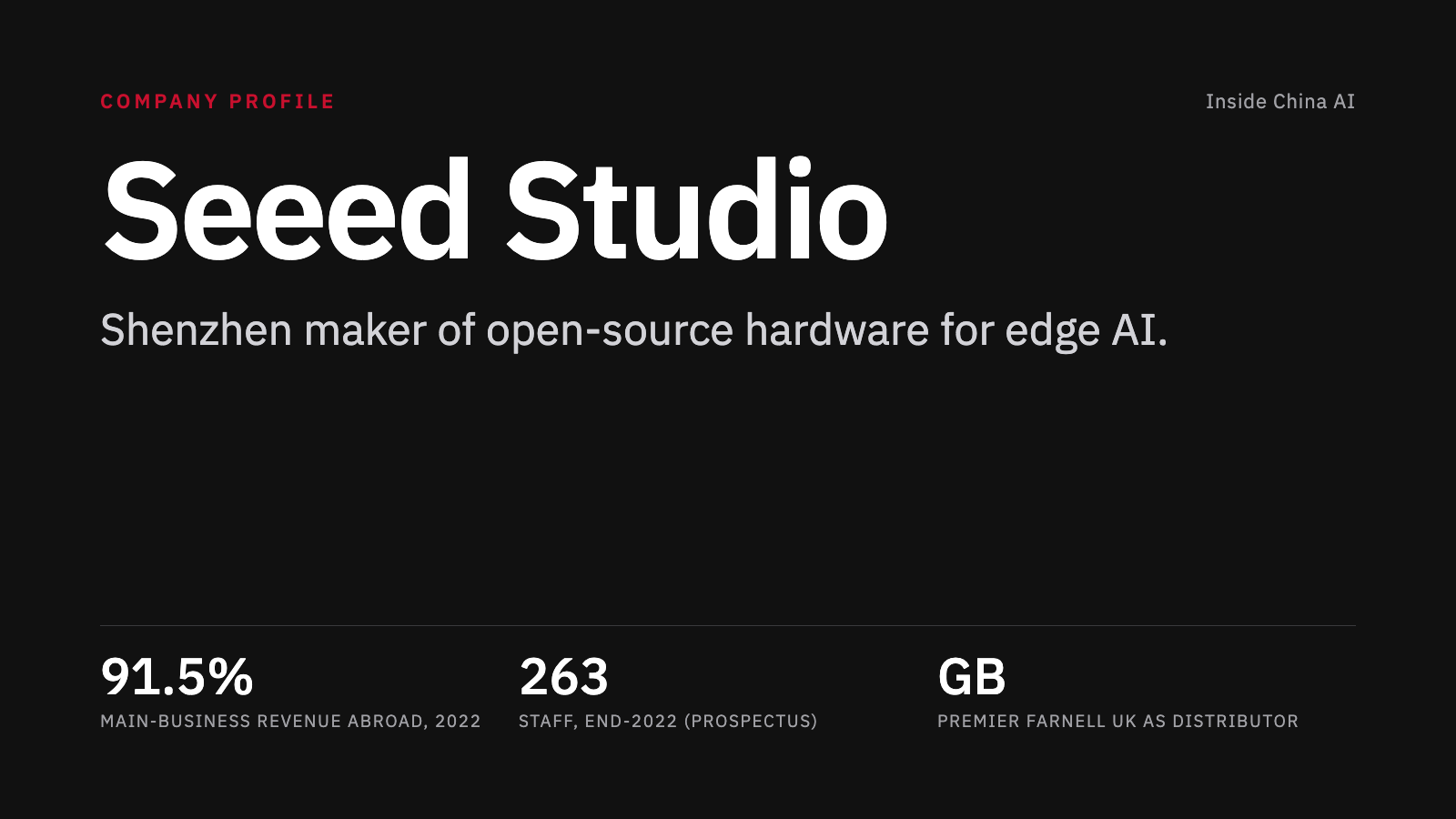
Graphic: Inside China AI
Seeed Studio: A Shenzhen Hardware Maker Moves from Sensors to Robotics Computers
Part of The Model Layer — profiles of the Chinese AI companies Europe is about to meet. Company profile · 28 November 2026.
Seeed Studio does not train large language models. It builds the boards, cameras, sensors and small computers on which developers run AI models at the edge — from thumb-sized XIAO microcontrollers to carrier boards for Nvidia’s Jetson Thor robotics chip. More than 90 per cent of its revenue came from outside China in 2022, with North America and Europe its main markets, according to the prospectus it filed for a Shenzhen listing in 2023 and then withdrew. Seeed reaches European engineers through distributors and a warehouse in Germany rather than through a European company of its own.
Origins and backing
Seeed traces its origins to 2008 (“© 2008-2026 Seeed Technology Co.,Ltd.”, says its website). The current company, Shenzhen Seeed Technology (深圳矽递科技股份有限公司), was registered on 11 August 2009 and converted into a joint-stock company on 17 December 2015, according to its draft ChiNext prospectus, published in May 2023. Its registered office is in Shenzhen’s Nanshan district. The same document names Pan Hao (潘昊) as founder and, since December 2015, chairman and general manager; that is his role according to the 2023 prospectus. Before founding Seeed he had worked as a product engineer at Intel Products (Chengdu).
Seeed is controlled by its founder. Pan Hao held 15.78 per cent of the shares directly and, through his wholly owned holding company Shenzhen Seeed Investment, controlled 56.72 per cent of the voting rights in total, the prospectus says; China Economic Net reported the same figure.
The listing did not happen. The Shenzhen Stock Exchange accepted Seeed’s application on 15 February 2023; on 30 November 2023 Seeed and its sponsor, GF Securities, applied to withdraw it, and the exchange terminated its review in a decision dated 5 December 2023 and published the next day; Shanghai Securities News and China Economic Net reported it on 6 and 7 December 2023. Seeed had planned to raise RMB 774.8 million for sensing and edge-computing production, an R&D centre and working capital. We found no new listing application or funding round since then; Seeed remains unlisted and does not publish financial results.
What they build
Seeed describes itself as “a leading open-source hardware provider focused on emerging technologies like edge AI, robotics, smart sensor system” (Seeed). Its prospectus groups the business into edge-computing hardware, network-communication hardware, smart-sensing hardware and R&D-support products and services. The best-known lines are:
- XIAO, thumb-sized microcontroller boards, and Grove, a modular connector system for prototyping (Seeed wiki).
- reComputer edge computers built on Nvidia Jetson modules, and reTerminal panel computers built on the Raspberry Pi Compute Module 4.
- SenseCAP sensors and LoRaWAN gateways for environmental and industrial monitoring (Seeed wiki).
Seeed’s AI work sits at the deployment end. It does not publish its own foundation models. Its SenseCraft AI platform offers “the model library, no-code training, and application community” and includes “more than 400 models for SBC devices”, the company says (Seeed wiki); a separate SenseCraft Robotics tool is meant to collect demonstrations and train robotic-arm behaviour.
Robotics has become a larger part of the range. In April 2025 Hugging Face released the SO-101, a low-cost robot arm for its LeRobot software, with The Robot Studio, WowRobo, Seeed Studio and PartaBot (TechCrunch); Seeed sells kits of the arm (The Robot Studio on GitHub). In July 2026 Seeed launched the reComputer J601, a carrier board for Nvidia’s Jetson AGX Thor module aimed at humanoid and other robots, and highlighted support for Nvidia’s Isaac GR00T N1.7 model with its own reBot Arm (eeNews Europe, 24 July 2026). Nvidia lists Seeed among the Jetson partners “already providing Thor-based solutions” (Nvidia, 15 July 2026).
The prospectus also shows how much one product shaped Seeed’s growth. Its LoRa M1 gateways, used mainly on the blockchain-based Helium network, earned RMB 223.6 million in 2021 and RMB 273.8 million in 2022, 39.5 and 36.5 per cent of revenue. After the price of the network’s HNT token fell, gateway sales dropped to RMB 1.1 million in the second half of 2022, the company disclosed. In its first round of questions, issued on 13 March 2023, the stock exchange asked Seeed to explain whether the gateways it sold for the Helium network were in substance crypto “mining machines” (矿机). In its reply of May 2023, Seeed said its main products did not fall under the definition of “mining machines” in the relevant Chinese documents; its sponsor reached the same conclusion. Seeed did not give a reason for withdrawing its application.
Key numbers
- Founded 2008 (company’s own dating); current company registered 11 August 2009, Shenzhen
- Ownership Private; founder Pan Hao controlled 56.72% of voting rights (prospectus, 2023)
- Revenue RMB 285.2 million (2020), 566.0 million (2021), 749.2 million (2022); no later figures published
- Net profit RMB 15.3 million (2020), 78.8 million (2021), 145.3 million (2022)
- Revenue outside China 91.5% of main-business revenue in 2022, mainly North America and Europe
- Staff 263 at end-2022, 95 of them in R&D
- AI Edge hardware (Nvidia Jetson, Raspberry Pi, microcontroller boards), SenseCraft AI model and deployment platform, robot-arm kits; no own foundation models
All financial figures are from the 2023 draft prospectus.
The European angle
- Market Europe is, with North America, one of Seeed’s two main sales markets, according to the 2023 prospectus. The company does not break out European revenue.
- Distribution partners Avnet’s Farnell is Seeed’s main documented European partner. The prospectus names Premier Farnell UK, an Avnet subsidiary, as the designated distributor of an industrial compute-module line from 2020 and as Seeed’s largest trade debtor at the end of 2020 and 2022; RS Components is also among the five largest trade debtors listed for 2020, 2021 and 2022. In June 2023 Avnet’s distribution arm signed a “global distribution agreement” for Seeed’s entire range, including reComputer, reTerminal, XIAO and Grove (Newark; eeNews Europe, 4 July 2023).
- Logistics Seeed ships European orders from what it calls “Seeed Studio’s Germany warehouses”, charging VAT at the rate of the destination country (Seeed support). It does not say who operates the warehouse.
- Legal presence In 2023 Seeed had subsidiaries in Hong Kong, the United States and Japan, which handle its overseas sales, but none in Europe (prospectus). Its privacy policy, last updated on 29 February 2024, is issued by “Seeed Technology Co., Ltd and/or its affiliates(including but not limited to Seeed Development limited)”, its Hong Kong company (Seeed). Its contact page lists a separate e-mail address for Europe but no European office.
- Lists A name check on 27 November 2026 found no entry for Seeed on the EU consolidated financial sanctions list, the US Consolidated Screening List (including the Entity List) or the Pentagon’s 1260H list.
- What a European buyer would actually encounter A Chinese supplier of development and edge-AI hardware, bought from a European distributor or from Seeed’s own web shop with delivery from Germany — much of it built around Nvidia and Raspberry Pi modules.
What we could not verify
- Revenue, profit and headcount after 2022: Seeed has published no figures since withdrawing its listing application.
- Who leads Seeed today: the latest primary source naming Pan Hao as chairman and general manager is the 2023 prospectus.
- Who runs the German warehouse, and whether Seeed has set up a European company since 2023.
- Named European customers beyond distributors.
- Why the listing was withdrawn, and whether Seeed plans another.
The open question for Europe: as Seeed moves from sensors and boards into robot arms and Thor-class robotics computers, will it keep selling to Europe only through distributors and a warehouse — or set up the European company that larger industrial customers usually expect?

Comments are closed