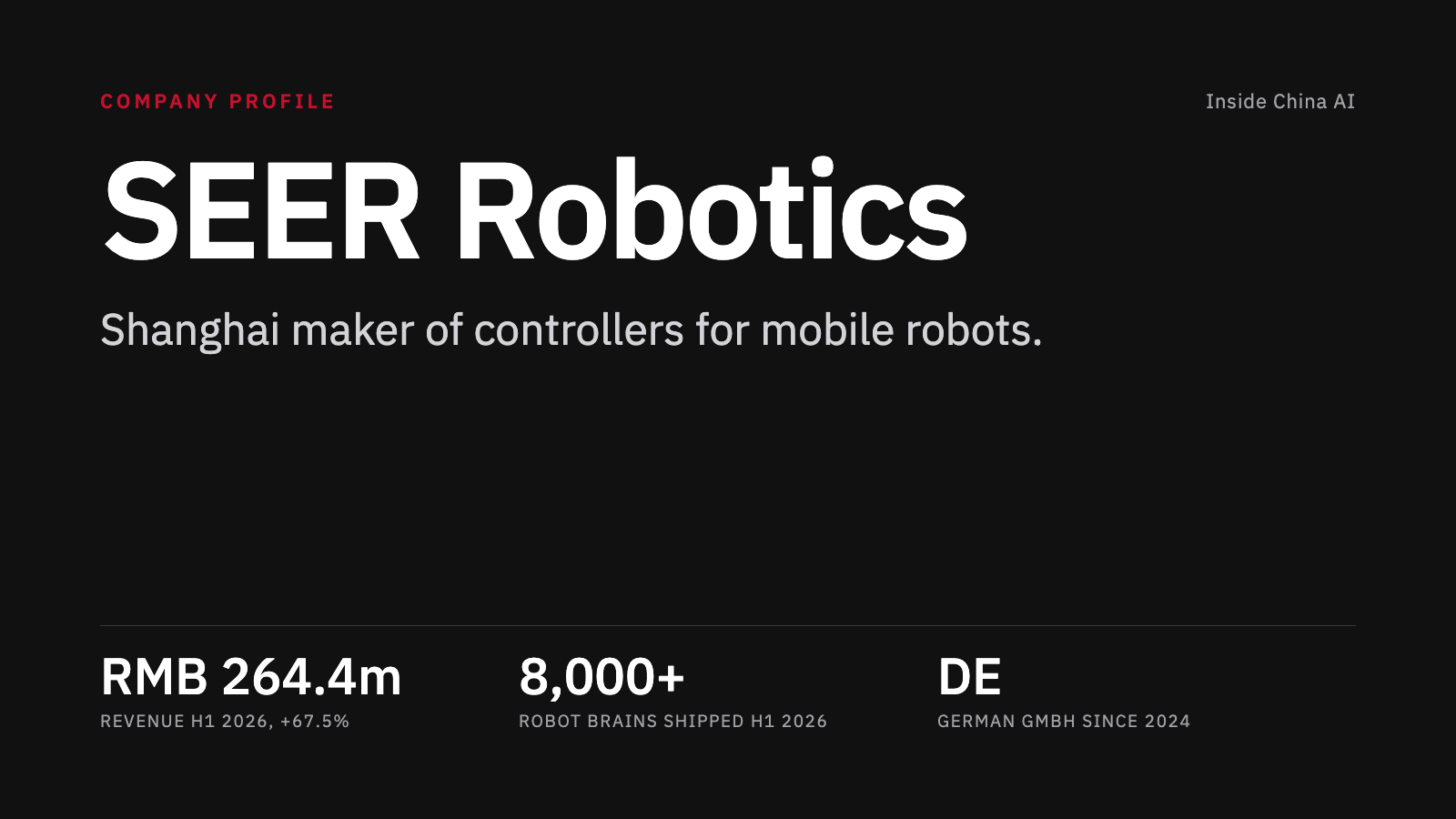
Graphic: Inside China AI
SEER Robotics: The Shanghai Maker of “Robot Brains” for Factory and Warehouse Robots
Company profile · 28 November 2026.
SEER Robotics (仙工智能) makes the controllers that let mobile robots, autonomous forklifts and, increasingly, humanoids find their way around factories — and sells many of those robots itself. Listed in Hong Kong since 24 June 2026, it still earns three-quarters of its revenue in China, but its overseas revenue rose by 197.5 per cent in the first half of 2026 and it runs a subsidiary in Germany. For European manufacturers and system integrators, SEER is less a robot brand than a supplier of the software and hardware layer underneath robots, sold through partners and already in use, the company says, at sites in the Netherlands, Sweden and Poland.
Origins and backing
The listed company, Shanghai Seer Intelligent Technology Co., Ltd., traces back to a predecessor set up in April 2020 and became a joint stock company on 24 March 2025 (prospectus). The team is older: the co-founders Zhao Yue, Ye Yangsheng and Wang Qun had founded an earlier company, Shanghai Seer Robotics, in 2015; its shareholders decided in March 2020 to liquidate it, and the founders started again the following month, according to the same prospectus. Zhao Yue, a Zhejiang University graduate who led the university’s team to RoboCup world titles in 2013 and 2014 (prospectus), is chairman and chief executive (HKEX list of directors).
Before the listing, investors valued the company at RMB 300 million after its Series A in 2020 and at RMB 3.27 billion after its Series C, paid in April 2025 (prospectus). On 24 June 2026 it sold 10,497,300 new H shares at HK$101.60 each, for net proceeds of about HK$995.4 million (interim results). The Hong Kong retail tranche was 5,934.56 times subscribed, and eight cornerstone investors took 43.34 per cent of the offer shares (allotment results). In the following weeks the stabilizing manager bought back shares at prices between HK$71.00 and HK$101.60, and the over-allotment option lapsed on 18 July 2026 (HKEX announcement).
After the listing, Zhao Yue held 15.43 per cent directly and a further 32.43 per cent through five partnerships of which he is the general partner; he and these vehicles belong to the company’s controlling shareholder group. Other substantial shareholders named in the prospectus are Zhuhai Yinshan, an investment fund with a general partner controlled by GLP (12.90 per cent), Ningbo Huilidaoqin (8.74 per cent) and the robot vacuum maker Ecovacs through a subsidiary (5.83 per cent) (prospectus).
What they build
SEER’s core product is the SRC series of controllers — the “robot brain” in the company’s language — which sits inside a robot and handles perception, positioning, decision-making and motion control. According to the prospectus, the controllers run a stack that includes simultaneous localisation and mapping (SLAM), reinforcement learning, end-to-end navigation models and vision-language-action (VLA) models, and connect to more than 400 component types, so that integrators can assemble their own robots. On top sits fleet software: the M4 system, which combines fleet, warehouse-control and warehouse-management functions and is usually installed on customers’ private clouds (prospectus).
Most of the revenue, however, comes from complete robots. In the first half of 2026, robots brought in RMB 185.4 million, 70 per cent of revenue, and controllers and software — the “robot brains” — RMB 59.0 million, or 22 per cent (interim results). The range covers stacker and counterbalanced forklifts, pallet trucks, lifting robots, carton-transfer and cleaning robots, legged robots and wheeled humanoids. SEER designs them but outsources the entire manufacturing of its controllers and robots to third-party manufacturers (prospectus). Newer machines include the X1 PRO wheeled humanoid and the D1 PRO quadruped, which the company showed in Europe for the first time in March 2026 (SEER).
The AI layer is where the company is now putting its emphasis. Its interim report says the X1 PRO, “powered by VLA models”, performs inspection and assembly tasks in customers’ factories; that its forklifts use end-to-end and VLA models; and that two new delivery robots, the P300 and P1500, navigate with end-to-end models rather than predefined paths. It plans further controllers for legged robots (SRC-900) and wheeled humanoids (SRC-4000), research on world models, more GPU capacity and “domestically developed computing solutions” (interim results). The company has not published a named model, model card or benchmark that would allow these claims to be checked.
SEER’s market claims rest on a report it commissioned from China Insights Consultancy (CIC), for a fee of RMB 750,000: by that count it ranked first worldwide in robot-controller sales volume in 2023, 2024 and 2025, with 24.8 per cent of the global and 45.2 per cent of the Chinese market in 2025 (prospectus).
Key numbers
- Listing HKEX 06106 since 24 June 2026; offer price HK$101.60; net proceeds about HK$995.4 million
- Revenue RMB 441.9 million in 2025 (2024: RMB 339.3 million); RMB 264.4 million in H1 2026, up 67.5 per cent
- Result net loss RMB 47.1 million in 2025; loss attributable to shareholders RMB 37.9 million in H1 2026
- Outside China 82.7 per cent of 2025 revenue came from mainland China; overseas revenue RMB 65.8 million in H1 2026, about 25 per cent of the total and up 197.5 per cent
- Orders new orders over RMB 467.0 million in H1 2026, of which over RMB 124.4 million from overseas
- Volume over 8,000 “robot brains” shipped in H1 2026, including controllers in robots and chargers; customers in 43 countries and regions
- Staff and cash 645 employees and RMB 1.01 billion in cash and cash equivalents at 30 June 2026
Figures from the prospectus (2025) and the interim results of 17 August 2026. SEER reports half-yearly; there are no third-quarter figures.
The European angle
- Physical presence Yes. SEER Robotics Europe GmbH is a wholly owned German subsidiary, set up in 2024 with share capital of EUR 100,000 (prospectus); the company’s contact page lists it in Wachtberg. The company says the subsidiary has “a professional local team” and works with “a well-developed partner ecosystem across Europe” (SEER, 27 March 2026). No production in Europe: manufacturing is outsourced in China.
- Customers and partners, according to the company In the Netherlands, SEER’s autonomous stacker forklifts move racks at a Philips facility, according to the prospectus of June 2026; a company case study published in July 2024 says two of them had then been working for nearly a year at Philips’ factory in Best. In Sweden, six of its forklifts run at Electrolux Professional’s factory in Ljungby, installed with unnamed European integrators (case study, December 2024). In Poland, the integrator PROMAG became a strategic partner in February 2024 (SEER), and the two deployed a robot solution at the pharmaceutical maker Polpharma (case study, August 2025). We found no statements from these customers themselves.
- Sales model Mostly through integrators, who build SEER controllers and software into their own automation projects. SEER says its European products are CE-certified and support the VDA 5050 interface for driverless transport vehicles; it exhibited at LogiMAT in Stuttgart for the fourth consecutive year in March 2026 and invited visitors to its stand at LOGISTICS & AUTOMATION in Hamburg in June 2026 (SEER, SEER).
- Plans Germany is one of five markets — with the United States, Japan, South Korea and Thailand — where SEER wants to win “benchmark customers”; it intends to build a sales and service network first, then local supply chains, then local product and R&D teams (interim results). The prospectus also plans product-management teams in Europe and the US.
- Regulation On 11 September 2026, when reporting duties under the EU Cyber Resilience Act began to apply, SEER published a vulnerability disclosure policy covering its controllers, robots, charging stations and scheduling systems (SEER).
- Lists In our name check on 27 November 2026, neither SEER nor its main operating subsidiary appeared on the EU’s consolidated financial sanctions list, the US Consolidated Screening List (which includes the Entity List) or the US Defense Department’s 1260H list. In its prospectus the company itself disclosed that on 9 November 2022 it sold one product subject to US export rules to a China-based customer, for RMB 15,000, “due to the lack of awareness to the export restrictions applied to such product”. According to the prospectus, its international sanctions legal adviser said the sale “represented a violation of the applicable U.S. export controls” and put the possible penalty at US$10,000 “if the BIS decided to pursue an enforcement” (prospectus).
- What a European buyer would actually encounter A Chinese controller and fleet-software platform, usually inside robots assembled or installed by a local integrator, with a small German subsidiary behind it.
What we could not verify
- The AI models behind the VLA and end-to-end claims: whether SEER trains its own base models or adapts third-party ones. No model card or benchmark is public.
- The size of the business in Europe: SEER does not break down overseas revenue by country, and the staff numbers of its German subsidiary are not published.
- The European deployments at Philips, Electrolux Professional and Polpharma, which rest on SEER’s own account.
The open question for Europe: will SEER’s “robot brain” stay a component that local integrators build in, or will the company sell AI-driven humanoids and forklifts under its own name here?

Comments are closed