Graphic: Inside China AI
Shengshu: The Tsinghua-Born Maker of Vidu Serves Europe From Hong Kong and Singapore
Part of The Model Layer — profiles of the Chinese AI companies Europe is about to meet. Company profile · 21 November 2026.
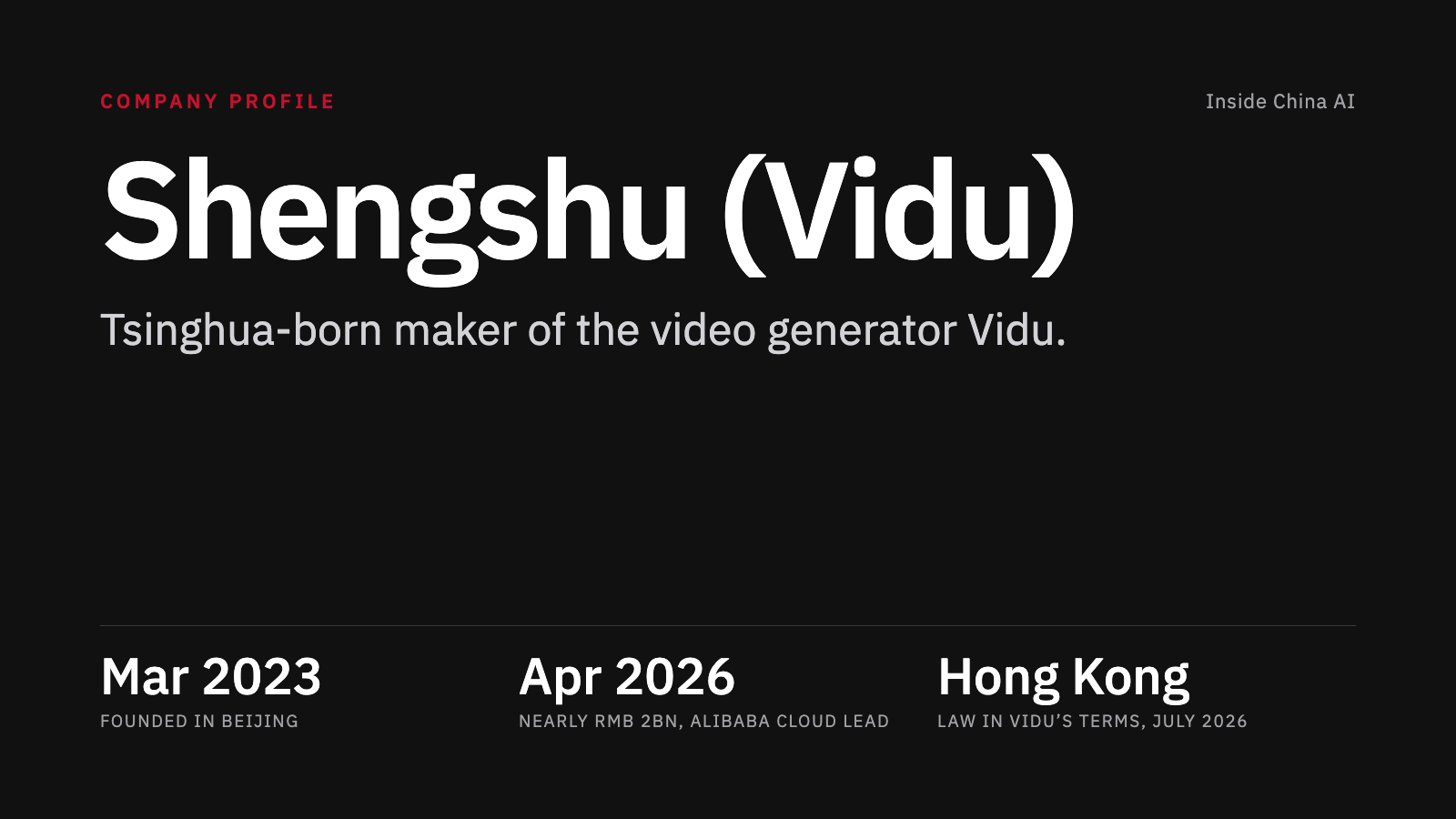
Shengshu Technology (生数科技) is the Beijing company behind the video generator Vidu, built on an architecture that its founders developed as researchers around Tsinghua University. It raised close to RMB 2 billion in a round led by Alibaba Cloud in April 2026 and now wants to move from generating video to controlling robots. Europeans can already use Vidu: the website has German, French and Spanish versions, and the Android app is on Google Play in Germany. The service, though, is run from Hong Kong: the privacy policy names a Hong Kong company and the terms apply Hong Kong law. The data sits in Singapore and may be processed in China, and the terms let Vidu use whatever users upload for AI training, permanently.
Origins and backing
Shengshu was founded in March 2023, the company says (Shengshu, 19 September 2025). Its founder and chief scientist is Zhu Jun, a professor in Tsinghua University’s computer science department (Zhu Jun’s homepage). The chief executive is Luo Yihang, whom the company calls a co-founder; Chinese tech media report that he joined in March 2025 (ifeng; Shengshu, 10 October 2026); the chief technology officer is Bao Fan (Shengshu, 20 November 2026).
The technical roots are academic. In September 2022, Bao Fan, Zhu Jun and co-authors published U-ViT, an architecture that combines diffusion models with transformers (arXiv paper). Shengshu says it trains its models on this “proprietary U-ViT architecture” (Shengshu, About). When Vidu was unveiled at the Zhongguancun Forum in Beijing on 27 April 2024, Xinhua described it as “developed by Tsinghua University and Chinese AI firm ShengShu Technology” and quoted Zhu Jun as deputy director of the Tsinghua Institute for Artificial Intelligence (Xinhua via People’s Daily). Whether Tsinghua holds shares in Shengshu, we could not establish. The legal entity is Beijing Shengshu Technology Co., Ltd. (北京生数科技股份有限公司), registered in Beijing’s Haidian district (Shengshu privacy notice); it became a joint-stock company on 30 March 2026, according to the Science and Technology Innovation Board Daily, citing business records (STAR Market Daily).
Money has come quickly. A Series A round of several hundred million yuan in September 2025 was led by Bohua Capital, with Baidu, Qiming and a Beijing municipal AI fund among existing shareholders (Shengshu). On 5 February 2026 the company announced more than RMB 600 million, led by Zhongguancun Science City and LINK-X Capital (Shengshu). On 10 April 2026 it raised nearly RMB 2 billion in a round led by Alibaba Cloud, with the China Internet Investment Fund, TAL Education and Baidu Ventures among the investors (Shengshu; Reuters via The Standard). After that round its valuation exceeded $2 billion, the STAR Market Daily reported on 12 April 2026, citing people close to the company; Shengshu had not responded to the paper on its listing plans (STAR Market Daily).
On 6 July 2026 Chinese tech media reported that Shengshu had closed a further round of $500 million (about RMB 3.4 billion), labelled Series B+ (ifeng; IT Juzi via 36Kr). Investors were not named, and the round does not appear in the company’s own news archive. In August 2026 Chinese media, citing people familiar with the matter, reported that Shengshu was considering a Hong Kong listing to raise more than $500 million, working with CICC and CITIC Securities, with an application possibly in 2027; Shengshu and the banks declined to comment (36Kr).
What they build
Vidu turns text, images and reference clips into video. Shengshu says it introduced “Reference-to-Video” — keeping the same characters and objects consistent across a clip — when Vidu launched globally in July 2024, and has since released Vidu Q1, Q2 and Q3 (Shengshu, 5 February 2026). Vidu Q3, announced on 30 January 2026, generates up to 16 seconds of video with sound in one pass, the company says (Vidu Q3). Vidu Q4 Preview followed in October 2026: it accepts up to 15 reference images and 3 audio clips and outputs up to 4K, the company says (Shengshu). Two real-time models, Vidu S1 (3 July 2026) and Vidu S2 (16 September 2026), generate and edit video while a user talks to an avatar (Shengshu news).
Shengshu’s ranking claims vary. In February 2026 it said Vidu Q3 ranked second globally and first in China on the Artificial Analysis leaderboard; in April it said Q3 had ranked first globally (February; April).
The Vidu models are closed. We found no Vidu weights on Hugging Face. What Shengshu’s researchers have published openly, under Apache 2.0, are research tools: TurboDiffusion, a framework to speed up video generation, and Motus, a model for robot control released in December 2025 (TurboDiffusion; Motus). Motus’s video component is built on Alibaba’s open Wan 2.2 model, not on Vidu, according to its model card. Motubrain, a “world action model” for robots, followed on 29 April 2026 (Shengshu news) — the second half of what the company now calls a “general world model” for the digital and physical worlds.
Vidu is sold as an app, as a subscription web service and through an API; Shengshu also offers Vidu Claw, an agent that turns a marketing brief into a finished advert (Shengshu news, 12 May 2026). Alibaba Cloud offers Vidu on its Bailian platform (Shengshu), and Cloudflare lists Vidu Q3 models in its Workers AI catalogue (Cloudflare). Shengshu publishes no revenue; it says users and revenue grew more than tenfold in 2025 (Shengshu).
Key numbers
- Founded March 2023, Beijing; founder and chief scientist Zhu Jun (Tsinghua professor), CEO Luo Yihang
- Funding Over RMB 600 million (February 2026); nearly RMB 2 billion led by Alibaba Cloud (April 2026); a further $500 million reported in July 2026, not listed on the company’s own news page
- Valuation Over $2 billion after the April 2026 round (reported, not confirmed)
- Listing Hong Kong IPO under consideration, reported August 2026; no filing confirmed
- Users More than 40 million creators and 10,000 developer and enterprise customers in over 200 countries and regions, the company said on 30 January 2026 (press release)
- Latest models Vidu Q4 Preview (October 2026), Vidu S2 (September 2026), Motubrain (April 2026); no open weights for Vidu
The European angle
- Availability Vidu is on the web in German, French and Spanish (vidu.com/de). The Android app on the German Google Play store lists ShengShu AI HK Limited as developer, with a Hong Kong address and more than one million downloads (Google Play). In the German App Store we found no app published by ShengShu on 21 November 2026; several apps there carry the Vidu name but come from other developers.
- Who Europeans deal with The terms of service name only “Vidu Team” as the other party; the privacy policy names ShengShu AI HK Limited in Hong Kong, also the developer listed on Google Play. The terms apply Hong Kong law, with arbitration at the Hong Kong International Arbitration Centre (terms, 3 July 2026). The privacy policy says: “Your Information is stored in Singapore”, and that it may be processed in other jurisdictions, “including China” (privacy policy, 3 July 2026). For the EEA, Switzerland and the UK it relies on the European Commission’s standard contractual clauses. It does not name the GDPR or an EU representative. Its list of service providers includes AWS for storage, ByteDance‘s Volcano Engine for analytics, and AI models from Google, Alibaba, Zhipu and MiniMax.
- Rights to uploads Users grant Vidu and its affiliates a “perpetual, irrevocable” licence to their content, including “the right to use User Content to improve and develop Vidu’s existing and future products, including artificial intelligence training”; the licence continues after an account is closed (terms). The privacy policy says facial and voice data in uploads may be collected “for the purpose of providing and improving the Services”.
- Partners None confirmed in Europe. Shengshu lists Freepik — based in Málaga, renamed Magnific in April 2026 (The Next Web) — among its international clients, and L’Oréal among its advertising clients (Shengshu). We could not confirm either from the other side. Shengshu lists offices in Beijing, Shanghai, Hong Kong, Shenzhen, Anhui and Wuxi, none in Europe (Shengshu).
- Compared with Kling Kuaishou‘s Kling, which we profiled, also stores European users’ data in Singapore. Unlike Kling’s privacy policy, Vidu’s has a section on transfers from the EEA.
- Regulatory exposure Shengshu has not signed the EU’s Code of Practice for general-purpose AI models; no Chinese company had as of 7 October 2026 (European Commission). It is not on the US Entity List or the Pentagon’s 1260H list, according to our name check of the published lists on 15 November 2026. We found no action by a European authority and no copyright lawsuit against Vidu.
- What a European buyer would actually encounter A video tool in their own language — with a Hong Kong provider, Hong Kong law, Singapore storage, possible processing in China, and a licence that lets the provider train on what they upload.
What we could not verify
- The July 2026 round: investors and terms; it does not appear on Shengshu’s own news page.
- Valuation and listing: only reported figures; no Hong Kong filing confirmed.
- Revenue and paying users, and how many users are in Europe.
- Tsinghua’s stake, if any, in the company.
- Whether Freepik/Magnific offers Vidu: its websites blocked our access.
The open question for European users: will Shengshu keep the right to train on everything they upload — and will Vidu ever store European data in Europe?

Comments are closed