Graphic: Inside China AI
SMIC: China’s Largest Contract Chipmaker Runs Near Full Capacity — and Sets the Limits for the Country’s AI Chips
Company profile · 21 November 2026.
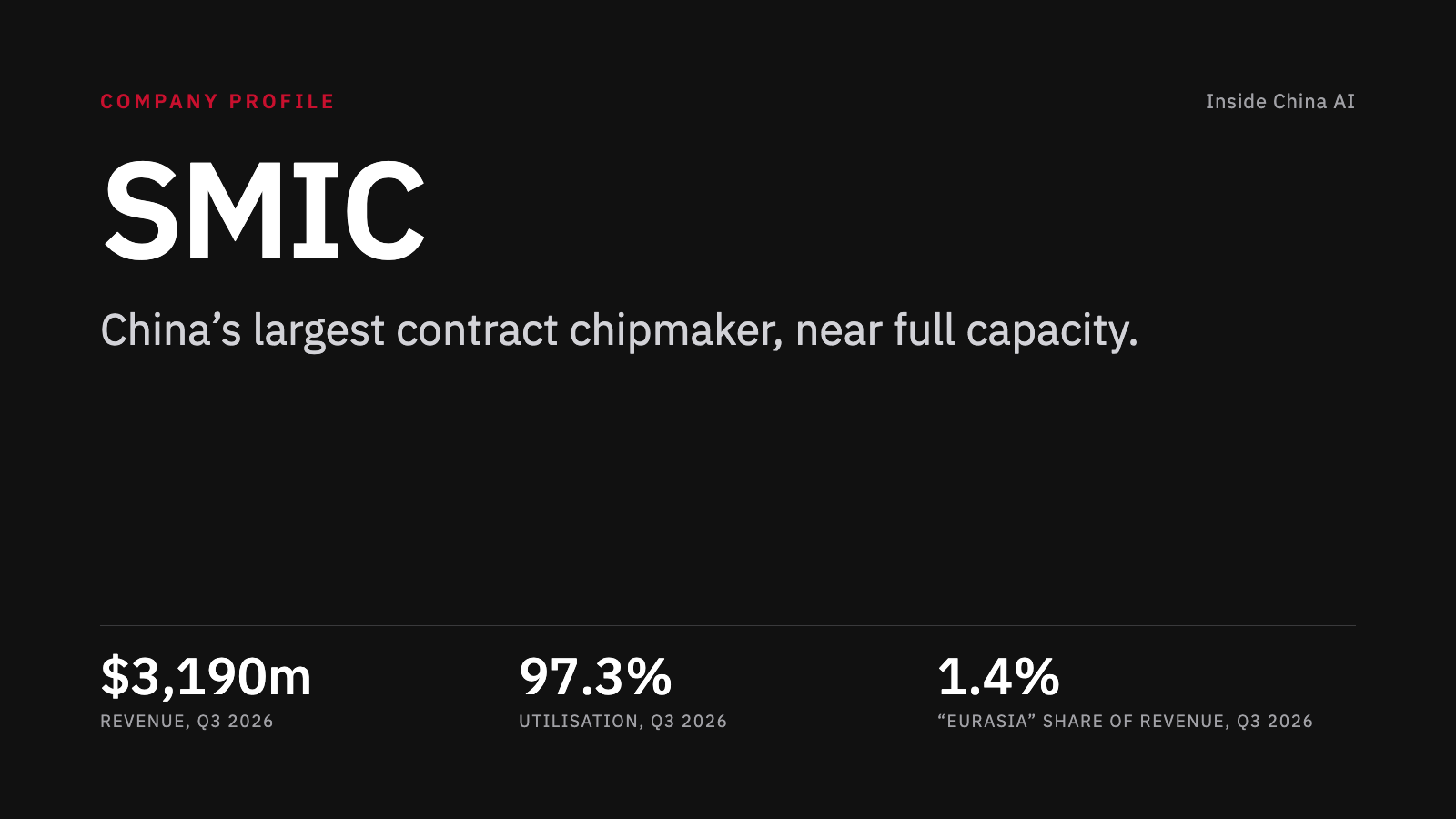
SMIC does not design AI chips and builds no AI models. It manufactures chips that others design, and it describes itself as mainland China’s “most advanced and largest foundry” (HKEX announcement, 3 March 2021). That makes it a bottleneck for Chinese AI: what SMIC can produce, and in what volumes, limits how far China’s own AI chips can go without foreign foundries. In the third quarter of 2026 SMIC reported revenue of USD 3.19 billion, 33.9 per cent more than a year earlier, ran its fabs at 97.3 per cent of capacity and booked 90.8 per cent of its sales in China (Q3 results). It has been on the US Entity List since December 2020. For Europe, SMIC matters in three ways: it has a small sales company in Milan, it has bought lithography equipment from the Dutch firm ASML, and US export rules on SMIC also bind European suppliers.
Origins and backing
Semiconductor Manufacturing International Corporation (中芯国际) was incorporated in the Cayman Islands on 3 April 2000 and is headquartered at 18 Zhangjiang Road in Shanghai’s Pudong district (interim report 2026). Its shares trade in Hong Kong (00981) and on the Shanghai STAR Market (688981). It has 8-inch and 12-inch wafer fabs in Shanghai, Beijing, Tianjin and Shenzhen (SMIC). At the end of 2025 it employed 19,952 people (annual report 2025).
The largest owners are state-linked. On 30 June 2026 China Information and Communication Technology Group, through its subsidiary Datang and directly, held 13.50 per cent of the shares. The national chip fund, China Integrated Circuit Industry Investment Fund, held 6.80 per cent (interim report 2026). In June 2026 SMIC completed the purchase of the remaining 49 per cent of its Beijing subsidiary SMIC Northern Integrated Circuit Manufacturing (SMNC). The sellers were the chip fund and four Beijing investors, among them Beijing E-town International Investment and Development, and SMIC paid with 547,182,073 new Shanghai-listed shares, registered on 23 June 2026 (interim report 2026).
The chairman is Liu Xunfeng, who previously chaired Shanghai Huayi (Group) and is a member of the 14th National Committee of the Chinese People’s Political Consultative Conference (SMIC). Zhao Haijun and Liang Mong Song are co-chief executives (interim report 2026).
What they build
SMIC is a foundry: it makes chips that customers design. Its platforms include logic, power and analog chips, display drivers, embedded and stand-alone memory, mixed-signal and radio-frequency chips, and image sensors (interim report 2026). Most of its output is ordinary electronics. In the third quarter of 2026, 40.6 per cent of wafer revenue came from consumer electronics, 19.3 per cent from industrial and automotive chips, 18.3 per cent from computers and tablets and 14.3 per cent from smartphones (Q3 results). The company does not name its customers. In 2025 its five largest customers together accounted for 35.8 per cent of revenue, the largest for 8.0 per cent (annual report 2025).
AI drives the current boom, according to the company. For the first half of 2026, SMIC wrote that “demand for AI peripheral chips remained robust”, that overseas orders had returned and that it had negotiated price increases for products in short supply (interim report 2026). On the earnings call on 13 November 2026, co-CEO Zhao Haijun said he expected full-year revenue above USD 12 billion and warned that tight supplies of chipmaking equipment and longer delivery times could disrupt the timing of capital spending, according to investingLive and TrendForce (citing the Chinese outlets IT Home and Cailian Press). These are press summaries; we have not seen a transcript of the call.
SMIC does not say which advanced processes it runs. Its reports name mature platforms such as 28-nanometre and 90-nanometre processes, and it has published no roadmap for 7- or 5-nanometre-class nodes. What is known comes from teardowns by the analysis firm TechInsights. In an analysis first reported on 3 September 2023 (Tom’s Hardware), TechInsights concluded that the Kirin 9000s processor in Huawei’s Mate 60 Pro phone was made by SMIC with a 7-nanometre-class process called “N+2” (TechInsights). On 11 December 2025 it reported that the Kirin 9030 in the Mate 80 Pro Max was made on SMIC’s “N+3”, a scaled evolution of that process (TechInsights). In a follow-up on 27 August 2026 TechInsights wrote that N+3 “remained significantly less scaled than the commercial 5nm processes offered by TSMC and Samsung” (TechInsights). According to TechInsights, both processes work without extreme ultraviolet (EUV) lithography. Neither SMIC nor Huawei has confirmed these findings.
That is where the bottleneck lies. On 17 March 2026 TechInsights argued that N+3 is not a viable process for data-centre AI chips: limits of the older deep-ultraviolet (DUV) technique and the newness of the process would lead to low yields for chips that are much larger than phone processors (TechInsights analysis). That is an analyst’s judgement, not a measurement. Which AI accelerators SMIC actually makes is not documented. Reports that SMIC produces Huawei’s Ascend or Cambricon‘s AI chips rest on unnamed sources. On 22 October 2024 Bloomberg reported that TechInsights had found a TSMC-made die in a Huawei Ascend 910B; Huawei and TSMC denied any recent cooperation (Tom’s Hardware, 23 October 2024).
Key numbers
- Revenue USD 3,190.0 million in the third quarter of 2026, up 6.1 per cent from the second quarter and 33.9 per cent from a year earlier (Q3 results, filed with HKEX on 12 November 2026); USD 8,701.1 million in January–September (our calculation from the Q3 results and the interim report); USD 9,326.8 million in 2025 (annual report 2025)
- Margin and profit Gross margin 29.9 per cent in the third quarter, after 25.3 per cent in the second; profit attributable to shareholders USD 428.4 million, up 123.4 per cent from a year earlier (Q3 results)
- Outlook The company expects fourth-quarter revenue to rise 4 to 6 per cent from the third quarter, at a gross margin of 26 to 28 per cent (Q3 results)
- Capacity 1,116,750 wafers a month (in 8-inch equivalents), utilisation 97.3 per cent in the third quarter (Q3 results)
- Spending Capital expenditure USD 1,094.3 million and research and development USD 258.4 million in the third quarter (Q3 results)
- Where it sells China 90.8 per cent, America 7.8 per cent, “Eurasia” 1.4 per cent of third-quarter revenue; a year earlier the shares were 86.2, 10.8 and 3.0 per cent (Q3 results)
- Balance sheet USD 13.41 billion in total cash on hand against USD 14.90 billion of debt on 30 September 2026 (Q3 results)
- Listing Hong Kong (00981) and Shanghai STAR Market (688981); US Entity List since December 2020
The European angle
- Presence SMIC owns all of SMIC Europe S.R.L., an Italian company with EUR 100,000 in capital that carries out “marketing related activities” (annual report 2025). Its European office is in Milan (SMIC). The annual report also names a service team in Munich, but we found no German company in SMIC’s list of subsidiaries.
- Production None in Europe today. SMIC once owned the Italian foundry LFoundry in Avezzano and agreed to sell it on 31 March 2019 (LFoundry). According to eeNews Europe, the stake finally went to Wuxi Xichanweixin Semiconductor for USD 112.8 million. One page on SMIC’s website still refers to the “LF Avezzano Fab in Europe” (SMIC), but LFoundry no longer appears among SMIC’s subsidiaries.
- Customers SMIC reports European sales only within “Eurasia”, 1.4 per cent of revenue in the third quarter of 2026 (Q3 results) and USD 260.4 million in 2025 (annual report 2025). We found no named European customer.
- ASML as supplier On 3 March 2021 SMIC told the Hong Kong exchange that it had placed orders worth USD 1,201,598,880 with the ASML Group between 16 March 2020 and 2 March 2021 for machinery used in wafer manufacturing, under volume purchase agreements with ASML’s Hong Kong and Shanghai subsidiaries that had been extended to 31 December 2021 (HKEX announcement). An ASML statement said the hardware under the deal was deep-ultraviolet (DUV) technology, not EUV, as Caixin reported. Since 1 September 2023 the Netherlands has required a national licence to export advanced DUV equipment outside the EU, and it widened the rule on 7 September 2024. The government decides case by case and says this is “not an export ban” (Dutch government).
- Export controls The US Commerce Department added SMIC and ten related companies to the Entity List, effective 18 December 2020 (rule published on 22 December 2020). It cited China’s military-civil fusion doctrine and activities between SMIC and “entities of concern in the Chinese military industrial complex”, and set a presumption of denial for items uniquely required for 10-nanometre and smaller processes (Federal Register). A rule effective 2 December 2024 added the “Footnote 5” designation to SMIC and three of its subsidiaries (SMIC Beijing, SMIC South China and SMIC Northern), extending US licence requirements to certain foreign-made items, and set a presumption of denial for all items subject to US export rules for SMIC, with case-by-case review for items used to make 200mm wafers at 200mm facilities (Federal Register). This binds European suppliers too when they ship such items. SMIC itself lists the risk of tight supply of “restricted equipment, raw material, parts, software and service supports” (interim report 2026).
- Other lists SMIC is on the US Treasury’s Non-SDN Chinese Military-Industrial Complex list, which bars US persons from buying its publicly traded securities. It was named in the annex to Executive Order 14032 of 3 June 2021 (Federal Register); according to the Treasury’s list the ban took effect on 2 August 2021. SMIC notes the listing in its interim report. SMIC and several subsidiaries are also on the Pentagon’s Section 1260H list of Chinese military companies, from the version published on 28 June 2021 (Federal Register) to the current one of 10 June 2026 (Federal Register). The 1260H list is not a sanction. SMIC is not on the EU’s consolidated financial sanctions list (version of 23 October 2026), according to our check.
What we could not verify
- Which AI chips SMIC makes, and for whom. SMIC names no customers. Huawei as a customer rests on TechInsights’ analyses of Kirin phone processors. Production of Huawei Ascend or Cambricon AI accelerators at SMIC is reported but not confirmed.
- Advanced-node capacity and yields. SMIC publishes no figures for its 7-nanometre-class lines.
- Europe’s share of sales. SMIC only reports “Eurasia”.
- The exact wording on the 13 November 2026 call. No transcript is published; we relied on press summaries.
The open question for Europe: as AI demand fills SMIC’s mature-node lines too, will European chip designers who use Chinese foundries still get the capacity they need, and under which export rules?

Comments are closed