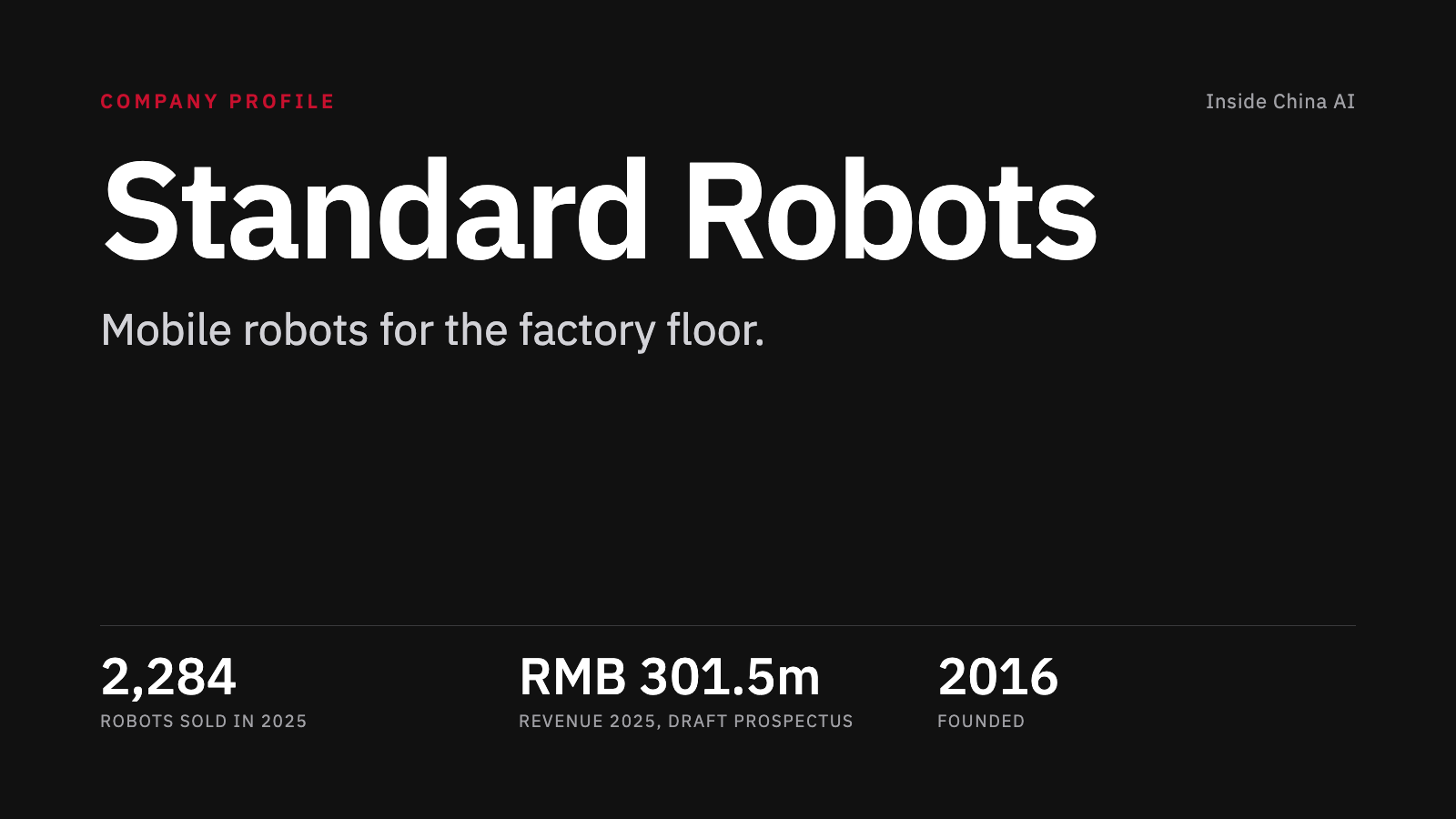
Graphic: Inside China AI
Standard Robots: Mobile Robots for the Factory Floor
Company profile · 28 November 2026.
Standard Robots builds autonomous mobile robots that move materials around electronics, car and semiconductor factories, and has added dual-arm “embodied” robots driven by vision-language-action models. On 27 July 2026 it filed its third application to list in Hong Kong. The draft prospectus shows a company that sold 2,284 robots in 2025, is still loss-making — and names Germany, Hungary, Italy and the United Kingdom as European target markets where it has, so far, no company, office or named customer. For European manufacturers it is a supplier to watch rather than one already on the shop floor.
Origins and backing
The company was founded in Shenzhen in June 2016 and launched its own robot operating system, SROS, and controller in the same year, according to its listing application. Its legal name today is Standard Robots (Wuxi) Co., Ltd.: the registered office is in Wuxi, Jiangsu province, while the head office remains in Shenzhen’s Bao’an district (corporate information). The company became a joint stock company on 29 May 2025. Robots are assembled at its own plant in Kunshan, Jiangsu, which started production in 2021.
The founder, Wang Yongkun, is chairman and chief executive; Li Hongxiang is chief technology officer. Under an acting-in-concert agreement the two, partly through the employee share platform Standard Automation, control 30.90 per cent of the voting rights, according to the filing’s summary. Xiaomi invested RMB 150 million in a Series C round in 2023 through its fund Beijing Xiaomi Zhizao, which holds about 8.40 per cent. The most recent round, a Series D agreed on 31 May 2024 with the Wuxi Liangxi Sci-Tech Innovation Industry Investment Fund (RMB 300 million, paid in two tranches), valued the company at RMB 2.1 billion after the money; that fund now holds about 14.29 per cent (filing).
Standard Robots wants to list on the Main Board of the Hong Kong Stock Exchange under Chapter 18C, the route for specialist technology companies. Applications posted in June 2025 and January 2026 lapsed, according to HKEX’s records; the current one, filed on 27 July 2026 with CITIC Securities (Hong Kong) and Guotai Junan Capital as joint sponsors (filing), was still listed as active by HKEX on 28 November 2026 (HKEX application proof). No revised proof or post-hearing information pack had been posted by then. Offer size and timetable are not yet public.
What they build
The company describes its offer as “1+N+S”: a technology platform (controller, SROS and algorithms), a range of robots, and a coordination system called RoboVerse. The robots fall into three groups, the filing says. “Standard robots” are mobile bases priced at RMB 60,000–350,000 per unit; “functional robots” add lifting, transport, forklift or towing modules and cost RMB 100,000–550,000; and “embodied robots” — the LINK mobile manipulators and DARWIN — add arms and grippers (filing).
DARWIN, launched in 2025, is a wheeled robot with two arms, more than 23 degrees of freedom and swappable hand-like end-effectors. The company says it is “equipped with end-to-end models such as VLA” — vision-language-action models — and (business section) and calls it “the first wheeled embodied robot with the highest degree of flexibility implemented in industrial settings in China” (history section). The filing also describes DARWIN as “a wheeled humanoid robot”; the company’s website calls it “a humanoid robot” (Standard Robots).
The AI behind it, as the filing describes it: perception models trained with deep learning, teleoperation data fed into imitation learning, a decision model combining a vision-language model with imitation learning, and a “dual-system VLA architecture” that the company says lets robots follow natural-language instructions and chain skills “without additional programming”. RoboVerse consists of Robo-World, which the company says reconstructs a factory digitally with “world modeling technology”, Robo-Set, a no-code task engine with built-in agents, and Robo-Team for fleet coordination. The filing does not name the base models used and we found no published model.
The bulk of the business is still material handling. The company says its customers include Xiaomi Auto, Foxconn and OPPO, and that over 400 customers use its solutions. Citing a report by China Insights Consultancy commissioned for the listing, it ranks itself the fourth-largest provider of industrial intelligent mobile robot solutions in China by 2025 sales volume, with a 4.0 per cent share. On 19 October 2026 it announced an indoor delivery robot, EasyGo (Standard Robots).
Key numbers
- Status Private; Hong Kong listing application (Chapter 18C) filed 27 July 2026, active
- Revenue RMB 301.5m in 2025 (2024: 250.5m; 2023: 162.2m); RMB 106.9m in January–April 2026, up from 44.7m
- Loss RMB 202.0m in 2025; RMB 61.8m in January–April 2026; adjusted net loss (non-HKFRS) RMB 35.0m and 23.8m; net cash used in operating activities RMB 64.5m in January–April 2026
- Robots sold 2,284 in 2025 (2024: 1,932); 556 in January–April 2026
- Overseas sales 25.3 per cent of revenue in 2025, 67.9 per cent in January–April 2026 — Hong Kong, Japan and “others”, mainly Taiwan, Vietnam and Thailand; the filing also counts sales to bonded and free-trade zones in mainland China here
- Customers Top five: 68.0 per cent of revenue in January–April 2026
- Staff 453 full-time, 141 in R&D (30 April 2026)
- Last valuation RMB 2.1bn post-money (Series D, 2024)
- AI VLA-based control for the DARWIN and LINK robots; RoboVerse fleet and “world modeling” software; own robot OS SROS
All figures are from the application proof of 27 July 2026, a draft that HKEX marks as incomplete and subject to change.
The European angle
- Physical presence None. All operating subsidiaries listed in the filing are in mainland China, and the company states that “all of our manufacturing activities are conducted in China” (filing). Local service exists in Japan, Taiwan and “certain Southeast Asia countries”.
- Plans Europe and North America are described as new regions the company “will continue to expand into … with the support of local integrator partners”. The filing names Germany, Hungary, Italy and the United Kingdom as “key countries of expansion” in Europe, and plans to use part of the listing proceeds for “dedicated teams” for key markets including Europe (use of proceeds).
- Sales The filing’s revenue breakdown has no European line; sales outside mainland China are reported as Hong Kong, Japan and “others”, mainly other Asian markets. We found no named European customer, distributor or integrator, either in the filing or on the company’s English website.
- Compliance The company says its robots “are assessed against the CE directives” for the European market (filing) and that several products hold CE, UL and ETL certification (Standard Robots, 5 August 2026).
- Trade fairs The trade fairs listed on its English website in 2025 and 2026 were in Malaysia, Thailand, Taiwan, Japan and Southeast Asia; none was in Europe (checked on 28 November 2026).
- Export controls Standard Robots itself does not appear on EU financial sanctions lists, the US Consolidated Screening List, the Pentagon’s 1260H list or the FCC Covered List (name check on 28 November 2026). Its draft prospectus states that the group “sold products and provided services to a total of 13 customers who are on the Entity List” between 2023 and April 2026; these sales accounted for 6.20 per cent of revenue in 2025 and 0.82 per cent in January–April 2026. The customers are not named. The company says the products were “primarily used as automated logistics equipment for warehouse and production lines and thus were not intended for military applications” (filing).
- What a European manufacturer would actually encounter A CE-assessed AMR and embodied-robot supplier with no European entity, selling — if at all — through integrators that have not yet been named.
What we could not verify
- Any European customer or installation. The filing speaks of “regional reference cases” without naming any in Europe.
- Which AI models DARWIN’s VLA system is built on, and whether they are developed in-house from scratch.
- Which two overseas trade shows DARWIN was shown at in late 2025; the company’s news post does not name them.
- Offer size, timetable and valuation of the planned Hong Kong listing.
The open question for Europe: which European integrator will be the first to bring Standard Robots’ machines into a factory here — and will the company then set up its own entity?

Comments are closed