Graphic: Inside China AI
Tencent: China’s AI Spender Already Runs Data Centres in Frankfurt
Part of The Model Layer — profiles of the Chinese AI companies Europe is about to meet. Earlier: Baidu Ernie vs. Tencent Hunyuan (March 2026). Company profile · 21 November 2026.
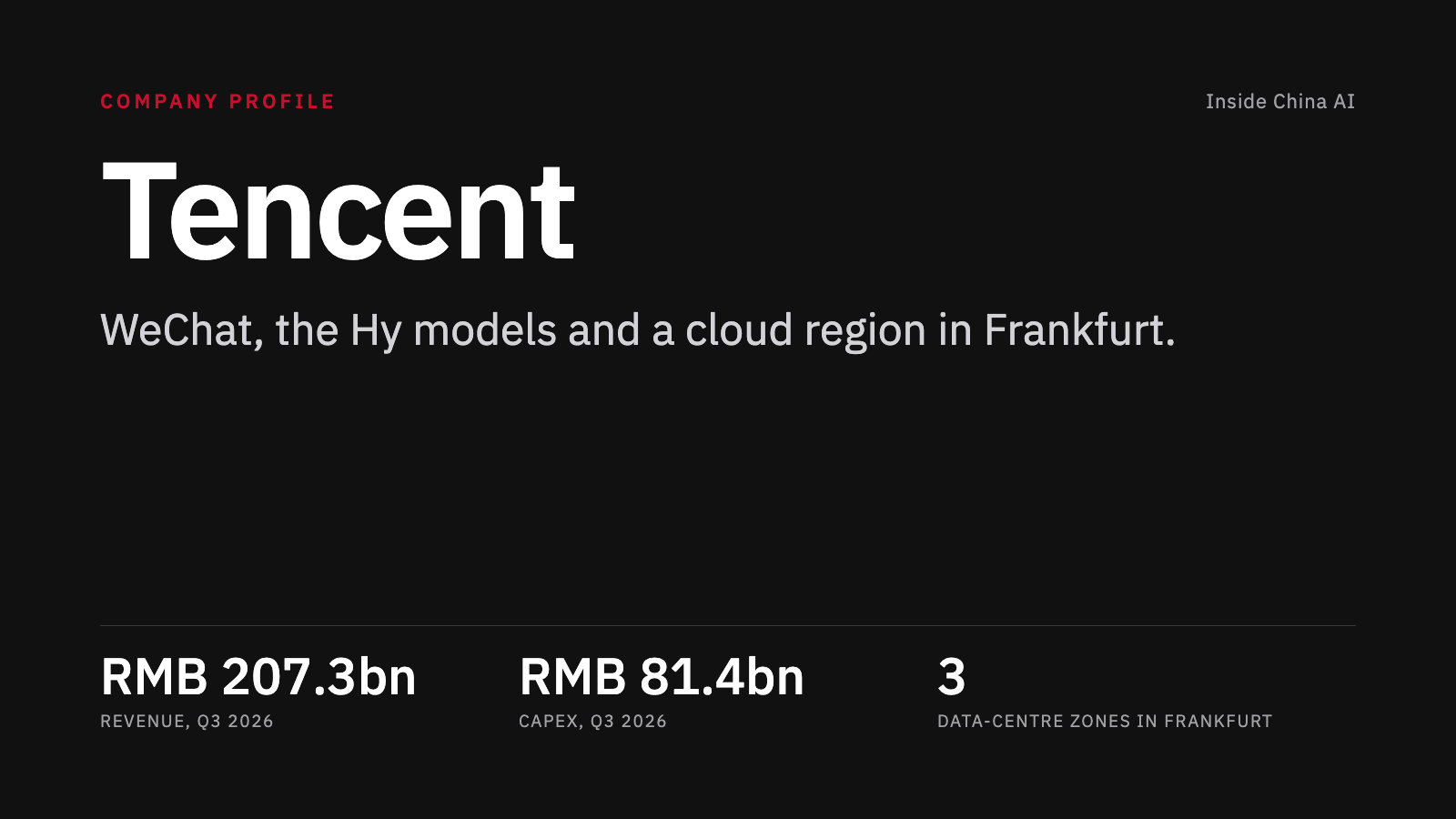
Tencent is pouring money into AI — capital expenditure in the third quarter of 2026 rose to RMB 81.4 billion, more than six times the figure a year earlier — and, unlike most of the labs in this series, it is already in Europe. Tencent Cloud runs a region in Frankfurt with three data-centre zones, a Paris-based general manager for Europe and named European customers such as Maxon, the German maker of the 3D software Cinema 4D. Its open-weight models Hy3 and the Hy4 preview are released under the Apache 2.0 licence, and the new Hy4 under a Tencent licence without territorial limits, so Europeans may use them; earlier Tencent model licences explicitly excluded the EU. What has not changed: Tencent remains on the Pentagon’s list of “Chinese military companies”, a label it calls a mistake.
What changed in 2026
Tencent describes itself as building “a new, AI-empowered Tencent”, in Pony Ma’s words in the second-quarter results (Tencent). The numbers show the cost. In the third quarter of 2026, reported on 18 November, revenue rose 8 per cent to RMB 207.3 billion and cloud services revenue by 35 per cent, but capital expenditure reached RMB 81.4 billion, up from RMB 52.8 billion in the second quarter and RMB 13.0 billion a year earlier; significant prepayments for compute pushed free cash flow to minus RMB 69.1 billion (Tencent, HKEX filing). Tencent now reports non-IFRS operating profit with and without its “new AI products” — the Hy models, the Yuanbao assistant, the coding tool CodeBuddy, the office agent WorkBuddy and Xiaowei, an agent inside WeChat whose availability Tencent says it has expanded. The difference, RMB 83.3 billion against RMB 68.1 billion in the third quarter, implies these products lost about RMB 15.2 billion in three months, up from about RMB 10.5 billion in the second quarter (our calculation from Tencent’s quarterly figures).
The organisation has been rebuilt around that bet. Yao Shunyu, a former OpenAI researcher, became chief AI scientist in December 2025, reporting to president Martin Lau (Caixin); Tencent’s AI Lab, founded in 2016, was disbanded in March 2026 except for its industry-academia collaboration centre (Caixin). The model family once called Hunyuan is now “Hy” (Tencent). Not every product survived: QClaw, the WeChat-controlled version of the OpenClaw agent that Pony Ma counted among the “encouraging early signs” in March (Tencent), shuts down on 24 December 2026; users can move their data to WorkBuddy (TMTPost).
What they build
Tencent’s model Hy3, released in full on 6 July 2026, has 295 billion parameters, 21 billion of them active per token (Hugging Face); a larger Hy4 preview with 770 billion parameters followed in August, and Hy4 launched on 4 November with vision and computer-use capabilities, its weights promised “shortly” (TechNode). By 21 November 2026 they were on Hugging Face: 770 billion parameters, 49 billion of them active per token, under the Tencent Hy License (Hugging Face). Around the models sit WeChat, with 1.45 billion monthly users, the Yuanbao assistant, the coding tool CodeBuddy and WorkBuddy, which Pony Ma called “the most widely used productivity AI agent service in China” in May (Tencent) and which, Tencent said in November, has “over 10 million DAU” — company claims (HKEX filing), and Tencent Cloud, which sells access to Hy and to other Chinese open models such as DeepSeek, GLM, Kimi and MiniMax through a service called TokenHub (diginomica).
Key numbers
- Listing Hong Kong (00700); chairman and CEO Pony Ma (Ma Huateng), president Martin Lau
- Q3 2026 Revenue RMB 207.3 billion (+8%); capex RMB 81.4 billion (Q2: RMB 52.8 billion; Q3 2025: RMB 13.0 billion); free cash flow −RMB 69.1 billion; net debt RMB 13.7 billion at 30 September (HKEX filing)
- AI losses About RMB 15.2 billion in Q3 2026 for new AI products, after about RMB 10.5 billion in Q2 (our calculation from Tencent’s figures)
- Models Hy3 (295B parameters, Apache 2.0, July 2026); Hy4-preview (770B, Apache 2.0, August 2026); Hy4 (770B, 49B active, Tencent Hy License, November 2026)
- Users WeChat/Weixin 1.449 billion monthly users (30 September 2026). No current official Yuanbao figure.
- AI leadership Chief AI scientist Yao Shunyu (since December 2025)
The European angle
- Physical presence Yes. Tencent Cloud’s only European region is in Frankfurt, now with three availability zones; the third was announced at MWC Barcelona on 2 March 2026 (Tencent Cloud). Its general manager for Europe, Fred Sun, is based in Paris; asked about a UK data centre, he answered “Not yet”, saying the focus is several regions inside the European Economic Area (diginomica). WeChat’s EU entity is Tencent International Service Europe B.V. in Amsterdam (WeChat).
- European customers Tencent names Maxon in Germany, which is integrating Tencent’s HY 3D model engine into Cinema 4D, with availability planned for late 2026, the German start-up 3D AI Studio and Lithuania’s CGTrader, along with Turkey’s iyzico (DataCentreNews). The Romanian e-commerce platform eMAG has moved workloads to Tencent Cloud, Fred Sun says (diginomica). These are company statements.
- Can Europeans use Tencent’s models? It depends on the model. Hy3 and the Hy4 preview are under Apache 2.0, without territorial limits (licence). Hy4 itself comes under the Tencent Hy License, which is derived from Apache 2.0 and names no excluded territories, but requires a separate licence from Tencent for companies that offer the model as a service and have worldwide revenue above US$50 million, or for services above 100 million monthly users (licence). But the Hy3 preview from April, the 3D world model HY-World 2.0 and older Hunyuan models still state that the licence “DOES NOT APPLY IN THE EUROPEAN UNION, UNITED KINGDOM AND SOUTH KOREA” (licence). And Tencent’s own model API, TokenHub, lists its access points in Singapore, Guangzhou and Silicon Valley — none in Frankfurt (Tencent Cloud documentation).
- Regulatory exposure Tencent has not signed the EU’s voluntary Code of Practice for general-purpose AI models; no Chinese company has, according to the Commission’s list as last updated on 7 October 2026 (European Commission). The privacy group noyb has a complaint pending against WeChat’s EU entity with the Dutch data-protection authority over access to personal data, filed on 17 July 2025 (noyb). In the United States, Tencent has been on the Defense Department’s 1260H list since January 2025 and remained on it after the June 2026 update (The Next Web); Tencent called the listing “a mistake” and says it is not a defence contractor or supplier to the military (TechNode). The 1260H list is not a sanctions list. As of 17 November 2026 we found no lawsuit by Tencent against the listing.
- Investments The largest recent European deal by Tencent that we found is not in AI: €1.16 billion for 26.32 per cent of Ubisoft’s Vantage Studios, completed on 21 November 2025 (Ubisoft).
- What a European buyer would actually encounter A hyperscaler with a German data centre, European staff and open models that most European users may run without a separate licence — but whose AI API still runs outside the EU and whose US listing may weigh on procurement decisions.
What we could not verify
- How large Tencent Cloud’s European business is. No revenue or customer numbers for Europe are published; a report of “high double-digit growth” was not accessible to us.
- Yuanbao’s current user numbers. Tencent’s last figure is from February 2026; the third-quarter filing gives none; third-party measurements were far lower.
- The current title of Ling Ge, who represented Tencent at Web Summit Lisbon, beyond a single conference preview naming her chief investment and strategy officer for EMEA.
The open question for European customers: when will they be able to call Hy models from inside the EU, and which of its models may they legally use?

Comments are closed