Graphic: Inside China AI
Timekettle: The Shenzhen Translation-Earbud Maker That Sells Into Europe Without a European Base
Company profile · 26 November 2026.
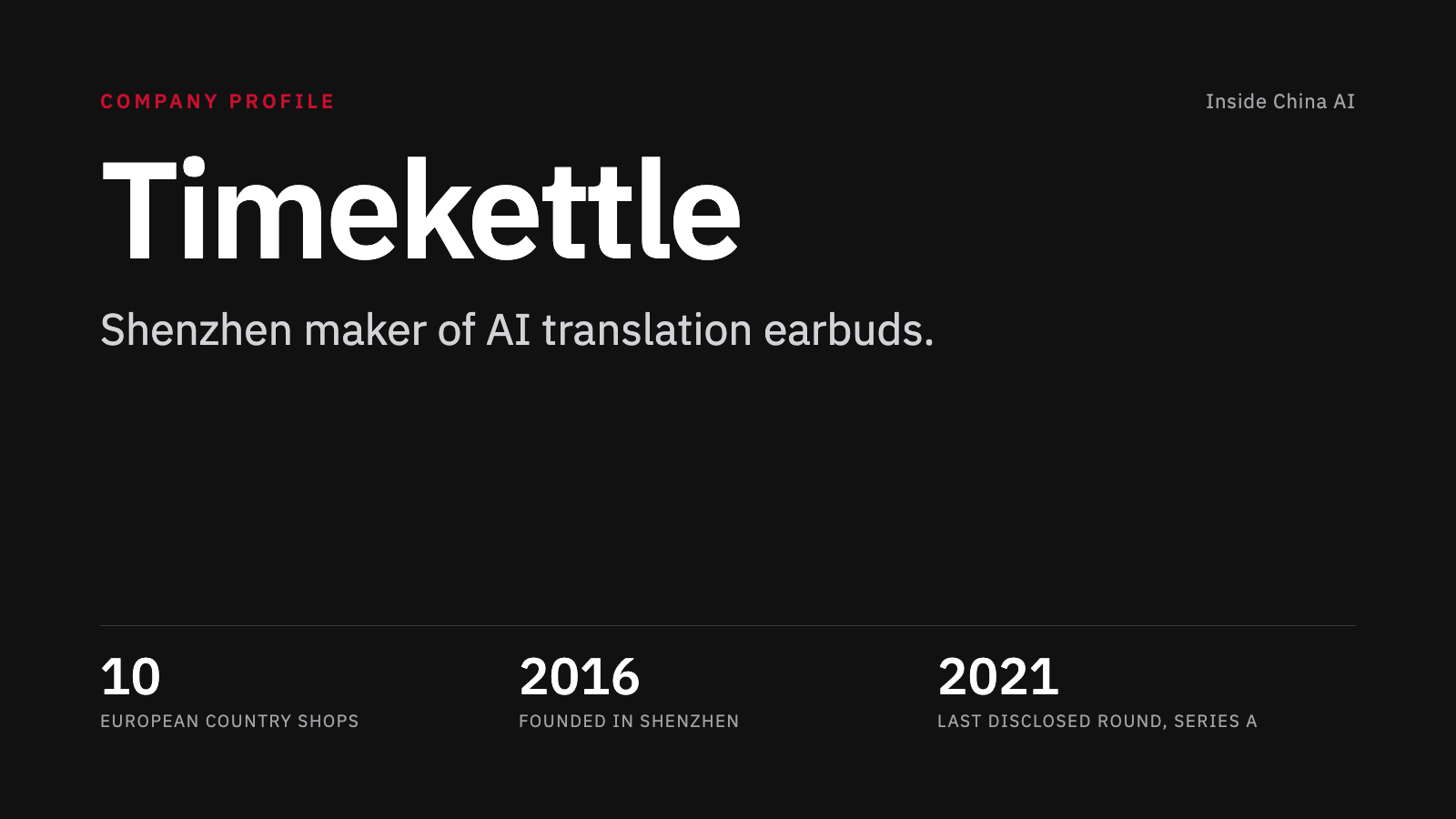
Timekettle (时空壶) makes earbuds and meeting devices that interpret conversations in real time, and it sells them in euros, pounds and francs through its own online shops for ten European countries. The AI behind them is a mix: the company builds the speech capture, the routing and an LLM layer for summaries, while the translation itself draws on engines from other companies; in April 2025 the Chinese outlet 36Kr, which interviewed the company’s marketing chief, named Google and Microsoft among them. For European buyers, that matters twice over. The products are aimed at business meetings, classrooms and clinics, where accuracy and confidentiality count. And we found no European company or warehouse behind the shops; orders ship from Hong Kong.
Origins and backing
Timekettle was founded in 2016 in Shenzhen’s University Town, the company says (Timekettle). The operating company, Shenzhen Timekettle Technologies Co., Ltd. (深圳时空壶技术有限公司), was registered on 8 December 2016; its legal representative and largest shareholder, with 53.94 per cent according to a registry extract published by 36Kr, is the founder Tian Li (田力) (36Kr company database). In Timekettle’s press releases of 2026 he appears as “Leal Tian, Founder and CEO” (Timekettle via PR Newswire, 8 September 2026). According to 36Kr, he had worked as an engineer at Huawei before founding the company with university classmates (36Kr, 17 April 2025).
The company is private and has raised modest sums. 36Kr’s database lists an angel round in March 2018 worth several million yuan, a Pre-A round in August 2019 at the ten-million-yuan level and a Series A in December 2021 worth tens of millions of yuan (36Kr company database). Early backers included the Beijing translation company New Tranx (Marbridge Daily, 20 March 2018). Who led the Series A is reported differently: the database names the venture firm Oriental Fortune Capital (东方富海), while Asia Financial, citing 36Kr, reported in January 2022 that the China SME Development Fund had invested at least $3 million (Asia Financial, 28 January 2022). We found no later funding round and no valuation.
Timekettle does not publish accounts. According to 36Kr, which based its report of 17 April 2025 on an interview with the company’s chief marketing officer, revenue exceeded 200 million yuan in 2024 and nearly 60 per cent came through Amazon (36Kr, 17 April 2025). The figures are not audited.
What they build
The products are wearables and small devices for spoken translation: the W4 Plus, W4 Pro and LiveTalk earbuds, the T1 handheld translator and the X1 Meeting hub. The W4 Pro lists at $449 and the LiveTalk at $129 on the company’s US store as of November 2026 (Timekettle). The idea is that two people each wear one earbud and talk without passing a phone back and forth. The X1 Meeting, which Timekettle dates to May 2026 on its website and to June 2026 in a press release, lets up to 50 participants join a meeting in up to five languages, and the company says transcripts are stored locally on the device (Timekettle via PR Newswire).
The software layer is called Babel OS. In its own words, Babel OS 3.0 “integrates technologies including speech recognition, semantic understanding, neural machine translation, Large Language Models (LLMs), and real-time communication technologies” (PR Newswire). What Timekettle documents as its own work is the part around the translation: directional voice pickup, sentence segmentation, two-way Bluetooth audio, offline models for selected language pairs and, since September 2026, LLM features in the W4 Plus such as domain-specific translation, conversation memory and live summaries. The company said at IFA 2026 that it “has begun to explore” this LLM layer (Timekettle via PR Newswire, 9 September 2026).
The translation itself is largely bought in. Timekettle’s technology page says: “We combine the world’s leading translation engines into one seamless system” (Timekettle). According to 36Kr’s report of 17 April 2025, based on an interview with the company’s marketing chief, everyday conversation runs on six major translation engines, Google’s and Microsoft’s among them, while the company builds its own terminology databases for medical and legal use (36Kr, 17 April 2025). In January 2026 Timekettle introduced an “engine selector” that picks the engine for each language pair; it attributed this to “Timekettle’s advanced Large Language Model” and machine-learning layers trained on “millions of linguistic samples” (Timekettle via PR Newswire, 5 January 2026). It has published no model name, model card or benchmark, so whether that model is trained in-house or adapted from another provider is not known.
Timekettle is also starting to license the stack. Babel OS 3.0 runs the live translation on the iO smart glasses that the Chinese maker RayNeo launched on 21 August 2026, according to Timekettle (Timekettle blog, 28 August 2026). A developer portal offers a software kit for Android and iOS that “combines automatic speech recognition, machine translation, large language model translation, and text-to-speech output” (Timekettle Developer).
Key numbers
- Founded 2016, Shenzhen; founder and CEO Tian Li (Leal Tian)
- Ownership Private; founder holds 53.94% per a registry extract published by 36Kr
- Funding Angel (2018), Pre-A (2019), Series A (December 2021, tens of millions of yuan); no later round or valuation found
- Revenue More than 200 million yuan in 2024, according to 36Kr (17 April 2025), citing the company; not audited
- AI Babel OS 3.0: own speech capture, engine routing, offline edge models and LLM features; translation partly via third-party engines (Google and Microsoft among them, according to 36Kr, 17 April 2025, citing the company)
- Languages 52 languages and 106 accents, the company says (Timekettle, November 2026)
- Europe Own online shops for 10 European countries, shipped from Hong Kong; one listed retail partner in Milan; trade fairs in Berlin and Barcelona
The European angle
- Physical presence None found. Timekettle lists addresses in Shenzhen, Chino (California) and Hong Kong, none in Europe (Timekettle). We found no company registered under the name in the UK (Companies House, 26 November 2026) and no European subsidiary in other sources.
- Sales Timekettle sells directly through country versions of its shop for Germany, France, Spain, Italy, the UK, Switzerland, Austria, Liechtenstein, Belgium and Luxembourg, plus a separate German store. Its shipping policy states: “For customers outside the U.S., orders are shipped from our Hong Kong warehouse”; standard delivery to Germany takes eight to twelve business days (Timekettle shipping policy). The only European shop on Timekettle’s list of retail locations is Webidoo, a technology store in Milan (Timekettle).
- Trade fairs Timekettle exhibited at IFA in Berlin in 2025 (PR Newswire) and again from 4 to 8 September 2026, in Hall 3.2 (PR Newswire), and made its first appearance at Mobile World Congress in Barcelona from 2 to 5 March 2026 (PR Newswire).
- Data A company blog post claims “GDPR-level data security standards” for Babel OS 3.0 (Timekettle blog), but we found no document saying where European users’ audio is processed. For business customers of the developer platform, the terms default to Hong Kong law where no other law is agreed (developer terms of service, 2 July 2026), and server location depends on the configuration chosen; the platform says it does not use end-user content “to train generalized AI models” (developer privacy policy, 26 June 2026).
- Lists Timekettle is not named on the EU’s consolidated financial sanctions list, the US Consolidated Screening List, which includes the Entity List, or the Pentagon’s 1260H list, according to our name check of 25 November 2026.
- What a European buyer would actually encounter A polished consumer product bought online in euros and shipped from Hong Kong, whose translations may come from several engines, with no European address among those the company lists.
What we could not verify
- Which engines translate today, beyond Google and Microsoft named by 36Kr in April 2025, and whether Timekettle’s “Large Language Model” is its own.
- Where European users’ speech is processed and stored.
- Who led the 2021 Series A, and whether there has been any funding since.
- European retail beyond Timekettle’s own shops: listings at large electronics retailers could not be opened, and we could not confirm that the Milan store still carries the products.
The open question for Europe: when a company sells interpretation devices into European meetings, classrooms and clinics, where are the conversations they carry processed?

Comments are closed