Graphic: Inside China AI
UCloud: Shanghai’s “Neutral” Cloud Turns to AI Compute — and Lists Frankfurt and London on Its Map
Company profile · 26 November 2026.
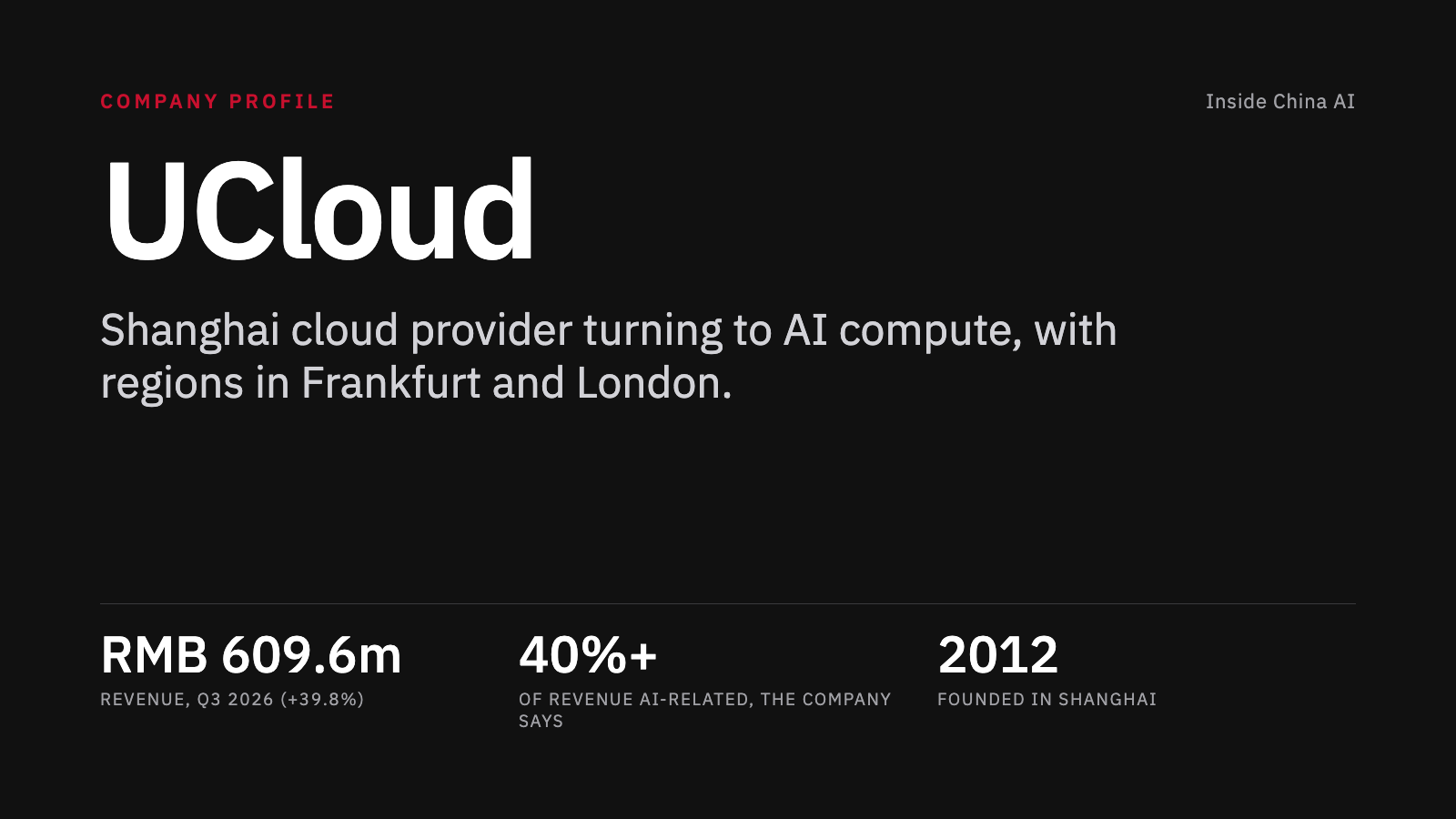
UCloud (优刻得) is one of the few independent public-cloud providers in China that do not belong to a large internet group. It rents out GPU servers, runs two AI computing centres of its own and resells access to Chinese large models — and AI-related business made up more than 40 per cent of its revenue in the first nine months of 2026, the company says (Q3 2026 report). For Europe it matters in two ways: its international site lists cloud regions in Frankfurt and London (UCloud), and its main overseas pitch is to follow Chinese companies, including AI firms, as they expand abroad.
Origins and backing
UCloud was founded in Shanghai in 2012; its co-founder Ji Xinhua (季昕华) still leads it as chairman and chief executive (company profile; H1 2026 report). In January 2020 it became the first company with weighted voting rights to list on the A-share market, on Shanghai’s STAR Market under the code 688158 (Caixin). The structure still applies: each of Ji’s class A shares carries five votes, which gave him 11.03 per cent of the shares but 38.27 per cent of the votes at 30 June 2026 (H1 2026 report).
The two other co-founders, Mo Xianfeng (莫显峰) and Hua Kun (华琨), left the board in 2023, and their special-voting shares were converted into ordinary shares. On 1 December 2025 they completed the sale of 5.13 per cent of the company to a Shanghai private fund, Taiying Kaiyang No. 1, which held 5.09 per cent at 30 September 2026 (H1 2026 report; Q3 2026 report). The three founders remain the company’s joint actual controllers under an acting-in-concert agreement of 11 May 2018. The state-owned China Mobile Capital Holdings is the third-largest shareholder with 2.73 per cent (Q3 2026 report).
In March 2026 UCloud planned to raise up to RMB 1.5 billion in a private placement, all of it for two new AI data-centre buildings and AI servers at its existing site in Ulanqab, Inner Mongolia, a project budgeted at RMB 1.82 billion (placement plan). On 2 September 2026 the board decided to drop the placement and withdraw the application, citing the macroeconomic and capital-market environment and “the company’s actual situation” (announcement). Between the end of 2025 and 30 September 2026 construction in progress rose from RMB 149.2 million to RMB 542.5 million and long-term loans from RMB 200.6 million to RMB 442.6 million (Q3 2026 report).
What they build
UCloud reports four businesses: cloud computing, data-centre services (IDC and “AIDC”, AI data centres), cloud communications and other. In the first half of 2026 cloud computing brought in RMB 583.8 million and data-centre services RMB 284.4 million of total revenue of RMB 981.6 million (H1 2026 report). The AI side rests on three layers:
- Compute. GPU cloud servers and two self-built AI computing centres, in Ulanqab and in Qingpu near Shanghai. The international product page lists Nvidia instances from RTX 40 and 50 series cards to A100 and A800 (UCloud). UCloud also says it has built “self-controllable” clusters with Chinese chip makers; in August 2026 it added servers with Hygon’s Tianxi AI accelerators to its public cloud, according to TechNode, citing Yicai (TechNode).
- Platforms. “Kongming” (孔明) schedules mixed GPU fleets; AstraFlow (星图) is an AI development platform that merges the earlier model-service platform UModelVerse with a sandbox for agents. Its model-as-a-service offer bundles access to mainstream Chinese large models, and the international site advertises one API key for “OpenAI, Google, DeepSeek, Qwen, and 200+ AI models” (UCloud). UCloud’s 2026 filings do not mention a foundation model of its own; its platforms serve and fine-tune models from other developers.
- Private cloud. UCloudStack, pitched as a VMware replacement, and UToken, a platform for companies to manage and meter their internal model use. In late January 2026 UCloud offered ready-made images for the OpenClaw agent and says it was the first provider to do so (H1 2026 report).
The company describes its customers as leading AI model companies, small and mid-sized internet firms, state-backed clouds, overseas telecoms operators and AI hardware companies, for example makers of AI glasses (H1 2026 report); the filings do not name its main AI customers.
Key numbers
- Listing SSE STAR Market 688158, since January 2020; weighted voting rights (5 votes per class A share)
- Revenue RMB 609.6 million in Q3 2026 (+39.8%); RMB 1,591.2 million January–September 2026 (+29.7%) (Q3 report)
- Profit Net profit attributable to shareholders RMB 16.8 million in Q3 2026, after a restated loss of RMB 67.5 million a year earlier; RMB 24.8 million for nine months, or RMB 1.1 million excluding one-off items (Q3 report)
- Margin Gross margin 28.3% in Q3 2026, up 3.9 points
- AI share More than 40% of revenue January–September 2026 is “AI-related”, the company says
- Balance sheet Total assets RMB 4.25 billion; accumulated deficit RMB 2.04 billion (30 September 2026)
- Footprint 36 availability zones in 28 regions; revenue from outside mainland China RMB 194.7 million in H1 2026, about a fifth of the total (H1 report)
The European angle
- Operations Yes. UCloud’s international site names two European regions, Germany (Frankfurt) and the United Kingdom (London) (UCloud). The H1 2026 report shows Frankfurt as a working region: network products such as PrivateLink were released there, and a first phase of overseas network build-out was completed in Frankfurt, Los Angeles, Hong Kong, Singapore and Taipei (H1 2026 report). The same report also names Moscow among the regions where network features were launched, and UCloud’s Chinese developer documentation lists availability zones in Frankfurt, London and Moscow (UCloud docs); the international site does not show Moscow. UCloud does not say who operates the buildings behind its European regions.
- No European company The list of subsidiaries in the H1 2026 report contains only Chinese companies, a Hong Kong company and a US company in Delaware. International customers contract with UCloud Information Technology (HK) Limited, whose privacy policy says personal data “may be stored and processed in your region or multiple countries” (privacy policy). We found no reference to the GDPR in it.
- Who it serves abroad The filings describe the overseas business mainly as infrastructure for Chinese companies going abroad, plus a “sovereign AI” offer that lets overseas customers keep AI compute and data in their own country. The new regions opened in 2026 are outside Europe: Ho Chi Minh City, São Paulo, Denver, Karachi, Almaty and Tashkent (H1 2026 report). We found no named European customer or partner.
- Supply chain UCloud itself names US restrictions on high-end GPU sales to China as a risk to its supply chain (H1 2026 report). Hygon, whose AI accelerators UCloud has added to its cloud, has been on the US Entity List, an export-control list, since 24 June 2019 (listed as Higon and, for its Chengdu chip-design unit, Hygon); the listing concerns Hygon, not UCloud (Federal Register). UCloud itself had no name match on the EU sanctions list, the US Consolidated Screening List or the Pentagon’s 1260H list when we checked on 26 November 2026.
- Governance In June 2026 UCloud corrected its H1 and Q3 2025 reports: it had lost its board seat at its affiliate Haima Cloud, which it also calls an important debtor, on 23 June 2025 but changed the accounting only from 25 September 2025. The full-year 2025 figures were not affected, and the company apologised to investors (correction notice).
- What a European user would actually encounter A Hong Kong-contracted cloud with servers in Frankfurt and London that is built above all for Chinese companies operating abroad — not, so far, a provider selling AI compute to European companies.
What we could not verify
- Whether UCloud offers GPU instances in Frankfurt or London, and which; its GPU page does not list regions.
- Who operates the European facilities, for example which colocation provider hosts the Frankfurt and London regions.
- European revenue and customers; UCloud only reports revenue from outside mainland China as one figure.
- How large the Hygon deployment is; neither UCloud nor Hygon disclosed its scale.
The open question for Europe: will UCloud’s Frankfurt and London regions stay a service for Chinese companies abroad — or will it start selling Chinese-model AI compute to European customers?

Comments are closed