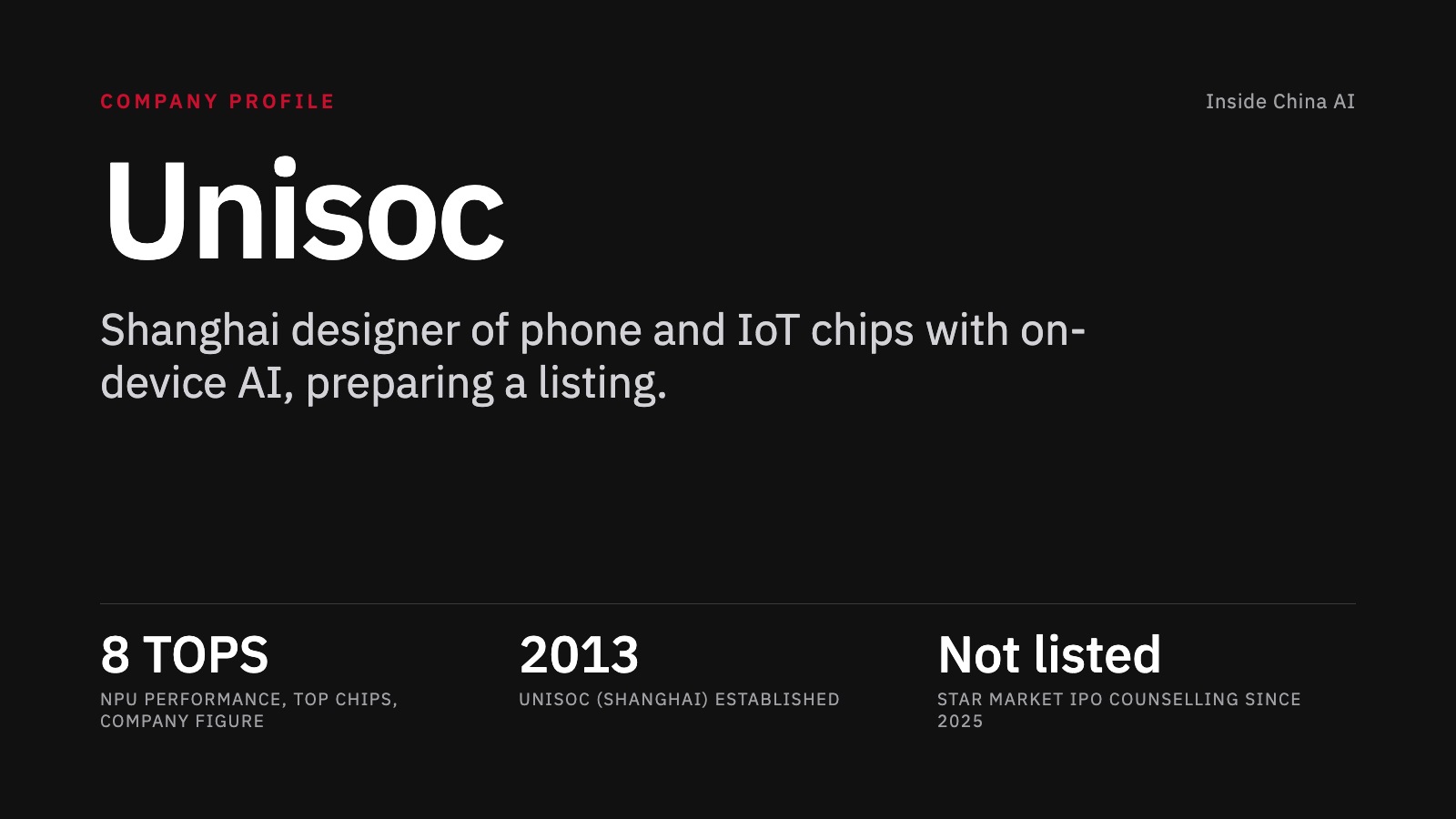
Graphic: Inside China AI
Unisoc: Unigroup’s Phone and IoT Chip Designer Builds On-Device AI Into Its Chips as It Prepares a Shanghai Listing
Company profile · 23 November 2026.
Unisoc designs the processors and modems inside phones, tablets, watches, IoT modules and car cockpits. The company names Motorola, Samsung, Honor and ZTE among its customers, and in Europe the Finnish phone maker HMD lists a Unisoc processor in its own specifications. Its newer chips carry neural processing units for on-device AI, and in May 2026 it presented an “edge AI” platform called N9. Unisoc itself is not on the US Entity List, but the two investment firms that led the 2022 takeover of its parent, Tsinghua Unigroup, have been on it since 2 December 2024. For Europe, Unisoc matters as a supplier: its chips sit in entry-level and mid-range devices sold here, it says it holds certifications from European carriers, and it is preparing a listing on Shanghai’s STAR Market that would, for the first time, put audited figures on the table.
Origins and backing
Unisoc grew out of two Chinese chip designers that Tsinghua Unigroup took off US stock markets: Spreadtrum, whose roughly $1.7 billion take-private was completed on 23 December 2013 (joint announcement), and RDA Microelectronics, acquired for $907 million in July 2014 (joint announcement, SEC filing). On 26 September 2014 Intel agreed to invest up to RMB 9 billion for about 20 per cent of the Unigroup holding that would own both (Intel). The current legal entity, UNISOC (Shanghai) Technologies, was established on 26 August 2013 with registered capital of RMB 5.532 billion, according to its IPO counselling filing as reported by C114. It is headquartered in Shanghai’s Pudong district (Unisoc) and, the company says, has 19 R&D centres and 8 sales and customer support centres worldwide, without naming their locations (Unisoc).
The parent went through a court-supervised restructuring. A consortium led by Beijing Zhilu Asset Management (Wise Road Capital) and Beijing Jianguang Asset Management (JAC Capital) set up the holding company Beijing Zhiguangxin, which paid RMB 54.9 billion in cash for 100 per cent of the restructured Tsinghua Unigroup. The disclosure filed by Zhiguangxin, signed on 11 July 2022, states that Unigroup thereby moved from Tsinghua Holdings to a parent with no actual controller (Zhiguangxin filing, SZSE). Under the structure set out in that filing, with registration still pending, funds with Wise Road as sole general partner were to hold 47.13 per cent of Zhiguangxin and funds with JAC as general partner 27.32 per cent; the filing says Zhiguangxin has no controlling shareholder and that the two groups do not act in concert. The most recent figure we found is for JAC alone: as of 13 January 2026, partnerships with JAC as executive partner held 13.75 per cent of Zhiguangxin, according to the 2025 annual report of the listed Unigroup company Guoxin Micro, which also states that no single shareholder holds more than half of Zhiguangxin and that it has no actual controller (Guoxin Micro annual report, SZSE). The group has called itself “New Unigroup” since a change of name in July 2024 (Guoxin Micro), and Unisoc describes itself as “a core enterprise under the new Tsinghua Unigroup” (Unisoc).
Unisoc’s controlling shareholder is the New Unigroup company Beijing Unisoc Investment Management, with 32.22 per cent according to the June 2025 counselling filing as reported by C114 (C114). According to C114, which does not say what date the figures refer to, the next shareholders are China’s National IC Industry Investment Fund (“Big Fund”) with 12.76 per cent and Intel (China) with 10.85 per cent, followed by the Shanghai IC fund and Big Fund II with 3.42 per cent each (C114, 18 April 2026); we could not check these figures against a filing. In 2020 Unisoc itself had named the Big Fund (15.27 per cent) and Intel (China) (12.98 per cent) as its next-largest shareholders after the Unigroup holding (company release). Unisoc is chaired by Ma Daojie, a former China Telecom and Lenovo executive who is also vice chairman of Guoxin Micro and, according to its annual report, has chaired Unisoc since 20 July 2023; its CEO since 2022 is Ren Qiwei, who earned his doctorate at Delft University of Technology and worked for Philips Semiconductors in the Netherlands (Unisoc).
The listing plan has a history. In July 2020 Unisoc said its IPO was “on track for a 2021 listing on the SSE STAR Market” (company release); that listing did not take place. The current attempt began when Unisoc registered for IPO counselling with the Shanghai office of the China Securities Regulatory Commission, with Guotai Haitong and China Securities as advisers and an agreement signed on 25 June 2025 (C114). The third counselling report covers January to March 2026 and says a formal STAR Market application will follow once the counselling has passed review (C114). C114 wrote at the time that the counselling was close to being signed off. As of 23 November 2026 we found no report that this had happened and no report of a filing with the Shanghai Stock Exchange.
What they build
Unisoc supplies “mobile communication chipsets, IoT chipsets, intelligent cockpit chipsets, smart display chipsets and Wi-Fi chipsets”, the company says (Unisoc). Its smartphone line runs from 4G chips for basic phones to 5G system-on-chips built on a 6-nanometre process; Unisoc names vivo, Transsion, realme, Motorola, Nokia, Samsung, Honor and ZTE among the brands using its chips (Unisoc). The T8300, a 5G chip for “mainstream global users”, adds satellite messaging over 5G NR NTN (Unisoc).
Unisoc’s AI work is in hardware and software tooling, not in its own models. Several chips carry a neural processing unit: the T9100 phone chip with “NPU computing power reaching 8 TOPS” (Unisoc), its tablet platforms with up to 8 TOPS and support for TensorFlow, ONNX and PyTorch (Unisoc), and the A7870 cockpit chip with 8 TOPS (Unisoc). The company says its “on-device AI solution”, a software stack and heterogeneous computing platform, is adapted to mainstream Chinese and foreign large models; it does not name them (Unisoc, MWC 2026). At the AWE consumer electronics fair in Shanghai in March 2026 it showed tablets summarising text and translating speech in flight mode, using only on-device computing (Unisoc).
On 7 May 2026, at New Unigroup’s innovation summit in Beijing, Unisoc presented the N9 series, a 4-nanometre platform with Arm v9.2 CPU cores aimed at “edge AI” in phones, tablets, car cockpits and gateways, along with an “Agentic AI” technical framework and an agent application called UniClaw (C114). No computing figure or availability date was given. In cars, the A7870 cockpit chip is in commercial use at SAIC, SAIC Maxus, FAW Jiefang and MG in India, and a successor, the A8880, promises eight times the NPU performance; Unisoc says its on-device work concentrates on models with 4 billion and 7 billion parameters (C114, 27 April 2026). The company also says its chips have won factory-fit contracts with SAIC and Ford, without naming models or markets (Unisoc).
Key numbers
- Legal entity UNISOC (Shanghai) Technologies, established 26 August 2013; registered capital RMB 5.532 billion
- Owner New Unigroup company Beijing Unisoc Investment Management, 32.22% (June 2025 filing, as reported); Big Fund 12.76%, Intel (China) 10.85% (as reported by C114, April 2026)
- Parent’s parent Beijing Zhiguangxin, owner of 100% of Tsinghua Unigroup since July 2022 (RMB 54.9 billion); no controlling shareholder or actual controller, according to filings
- Listing not listed; STAR Market IPO counselling since June 2025, third report January–March 2026, no exchange filing found by 23 November 2026
- Revenue no audited figure published; 2024 sales of RMB 14.5 billion reported as a company figure
- AI hardware NPUs of up to 8 TOPS in the T9100, A7870 and tablet platforms; N9 edge-AI platform (4 nm) presented 7 May 2026
- Europe customer HMD (Espoo); certification from Deutsche Telekom (2021), Orange and Vodafone named by the company; no current European entity found
The European angle
- Customers Unisoc said in March 2025 that its 5G chips are used by brands including Motorola, ZTE and HMD and are in mass production for Europe and other regions (Unisoc). HMD Global, based in Espoo, Finland, lists the Unisoc T606 as the processor of its HMD Pulse on its Finnish and British websites (HMD Finland, HMD UK). In October 2025 Unisoc said its chips power HMD’s Nokia feature phones, including the Nokia 3310 and Nokia 105, and that the two companies would deepen their collaboration in markets including Europe (company release).
- Carriers Deutsche Telekom certified Unisoc’s 8910DM IoT platform for its European networks, including Germany, the Netherlands, Poland, Austria and the Czech Republic, according to a company release of 3 December 2021 (Unisoc release). Unisoc says its chips are certified by more than 270 operators, naming Orange and Vodafone (Unisoc).
- Presence Unisoc exhibited its 5G, IoT and satellite products at MWC Barcelona in March 2025 (Unisoc). Its Finnish research company, Spreadtrum Finland Oy, was registered in 2014 and ceased on 29 January 2019 (Finnish trade register). We found no current European subsidiary or office.
- Lists Unisoc, Tsinghua Unigroup and Zhiguangxin do not appear on the US Entity List, the Pentagon’s 1260H list of “Chinese military companies” or the Treasury’s CMIC list, nor in the EU’s financial sanctions files (checked 23 November 2026). The US Commerce Department added “JAC Capital” (alias Beijing Jianguang Asset Management Co., Ltd.) and “Wise Road Capital” (aliases include Beijing Zhilu Asset Management Co., Ltd.) to the Entity List effective 2 December 2024 (89 FR 96837), with a licence requirement for all items subject to US export rules, citing their “involvement in aiding China’s government’s efforts to acquire entities with sensitive semiconductor manufacturing capability” (Federal Register). The notice does not mention Unigroup or Unisoc, and Unisoc itself is not listed. The link runs through ownership: funds with the two firms as general partners were to hold 47.13 and 27.32 per cent of Zhiguangxin under the structure filed in July 2022, and JAC-managed funds held 13.75 per cent in January 2026 (see above). We have not assessed whether the listing has any legal consequences for Unisoc.
- What a European buyer would actually encounter A Chinese chip inside an affordable phone, tablet, watch or IoT module from a brand they know, with on-device AI features that increasingly run on Unisoc’s own NPU.
What we could not verify
- Revenue and profit. Unisoc has published no audited accounts. Chinese trade press reports 2024 sales of more than RMB 14.5 billion as a company figure, not from a filing (C114); a STAR Market prospectus would be the first filed figure.
- The state of the IPO after the third counselling report, and whether the counselling review has been completed. The regulator’s counselling disclosures and the exchange’s project database could not be queried directly.
- The current ownership of Zhiguangxin: the stake of Wise Road-managed funds after July 2022, and the dates of the Big Fund and Intel shareholdings in Unisoc.
- Where the 19 R&D and 8 sales centres are, and whether any of them is in Europe today.
- The N9 platform’s AI performance and launch date, and whether the Ford contract concerns cars sold in Europe.
The open question for Europe: what will Unisoc’s first prospectus reveal about its customers here, and about who ultimately controls the company?

Comments are closed