Graphic: Inside China AI
VectorBuilder: A Guangzhou Gene-Delivery Supplier With Companies in Germany and the UK
Company profile · 28 November 2026.
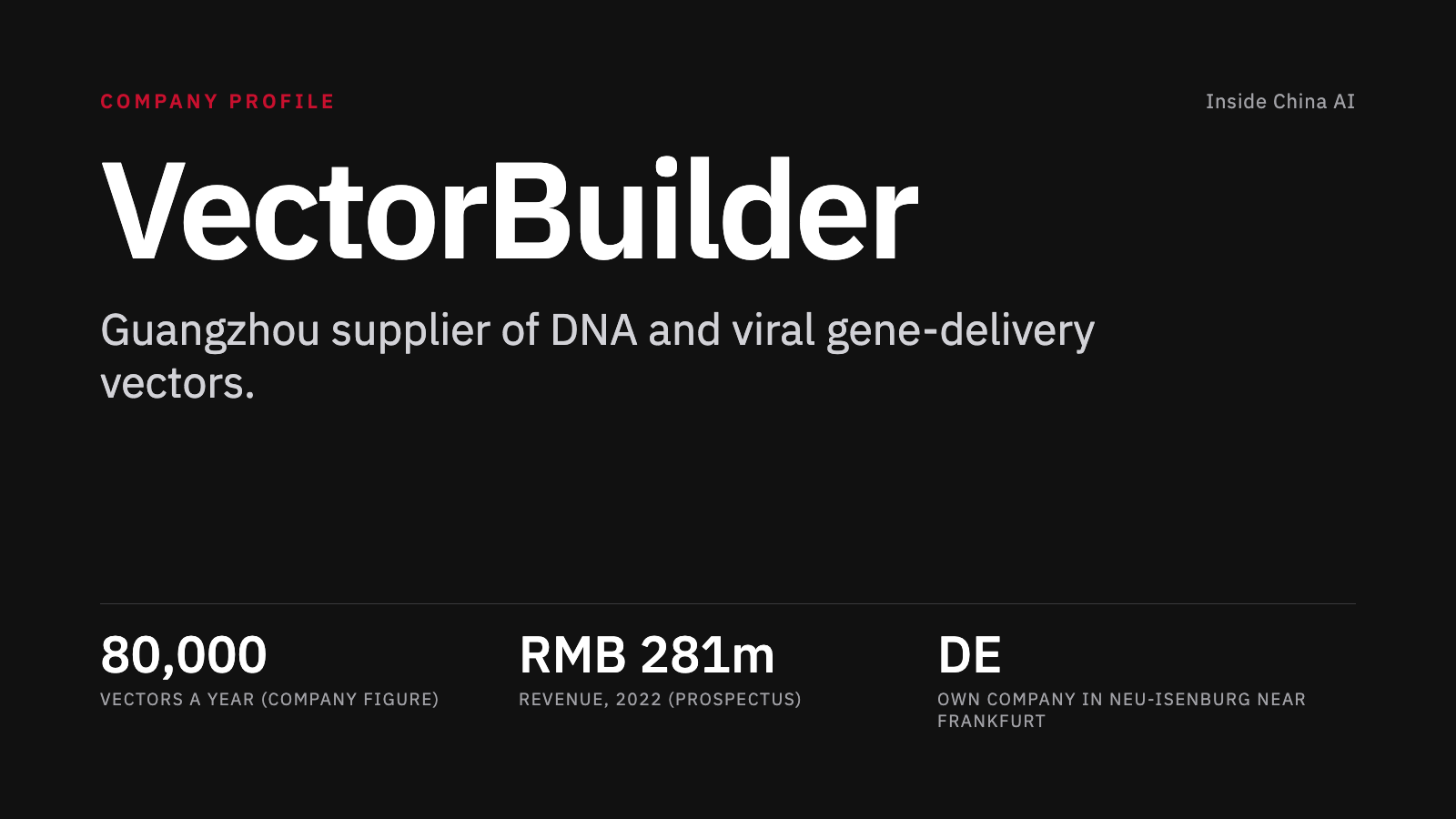
VectorBuilder sells the plumbing of genetic medicine: the DNA vectors and viral shells that carry a gene into a cell. Researchers order them online, and the company says it builds more than 80,000 a year. Its DeepCap platform, the company says, uses machine learning to design new AAV capsids, and those capsids are now under option to a British eye-therapy developer in a deal the joint release says is “expected to be worth in excess of $1bn”. In December 2024 it was contracted to make the plasmid DNA for a Hungarian company’s Phase 3 HIV vaccine trial. Its manufacturing and its Chinese operating company sit in Guangzhou; in Europe it has a German company, a British one and an Edinburgh office — and no factory. For European biotech firms the questions are concrete: which group company they sign with, where the material is made, and what happens to their sequence data.
Origins and backing
The company says it was “initially established in 2014 to commercialize its novel e-commerce platform that enabled researchers to design and order custom vectors online” (VectorBuilder, 1 November 2022). Its founder and chief scientist is Bruce Lahn, a Harvard graduate with a PhD from MIT, previously a chaired professor at the University of Chicago and an investigator at the Howard Hughes Medical Institute (VectorBuilder, company release, 26 November 2024). Kristofer Mussar is chief operating officer and, at the same time, managing director of the German company VectorBuilder GmbH, which the team page says he opened about a year after the group’s inception. Jason Ye is chief technology officer and runs GMP manufacturing.
Where the group is “based” depends on which document one reads. The contact page lists a “US Headquarters” in Chicago, a “Japan Headquarters” in Yokohama and a “London Headquarters”, while the Guangzhou site appears simply as “VectorBuilder China” at 3 Juquan Road, Science City (VectorBuilder). The privacy notice names “VectorBuilder Inc., 1010 W 35th Street, Suite 515, Chicago” as the data controller and says data may be processed “in the United States, where VectorBuilder is headquartered” (privacy notice). The Chinese operating company, issuer of the group’s Chinese-language releases, is the Guangzhou joint-stock company 云舟生物科技(广州)股份有限公司 (company release, 18 August 2026) — and Guangzhou is where the manufacturing sits and where the listing attempt was made.
Funding has been modest by Chinese AI standards. The company announced $57 million on 1 November 2022, co-led by Legend Capital; Chinese and trade coverage describes the same round as a Series C of RMB 410 million (EqualOcean, 11 October 2022; FiercePharma, 25 October 2022). In July 2023 it said a further injection had brought the total raised “to just over $76 million” and taken it to “unicorn status with over $1 billion valuation” (VectorBuilder, 26 July 2023), without naming the investors in that round.
The company is not listed. On 22 February 2024 the financial daily 每日经济新闻 reported that the company had answered the Shanghai exchange’s first round of questions on a STAR Market application and planned to raise RMB 1.326 billion; according to its prospectus, as reported by 每日经济新闻, revenue was RMB 99.6 million in 2020, RMB 164 million in 2021 and RMB 281 million in 2022, with more than 90 per cent earned outside China (每日经济新闻, 22 February 2024). The news service 财联社 gives the same export share from the prospectus and names Europe, the Americas, Japan and Korea as the main markets (财联社, 8 May 2026). The review ended on 13 June 2024: citing the exchange’s disclosure of that day, 中国基金报 reported that “因保荐人申请撤销保荐,上交所决定终止对其科创板IPO的审核” — the sponsor applied to withdraw its sponsorship and the exchange terminated the review (中国基金报, 13 June 2024). No new listing attempt has been announced in any source we read.
What they build
The core product is a catalogue plus a configurator. The company says it is “the world’s largest provider of custom vectors for both viral and non-viral gene delivery”, building “over 80,000 vectors a year” from more than 1,000 backbones, with over 80 per cent of orders assembled from parts already in stock (VectorBuilder). Around that sit contract research, preclinical testing including studies in non-human primates, and contract manufacturing: GMP plasmid DNA “with up to 5 g scale” and viral vectors “with up to 1,500 L scale”.
The AI is in one specific place: capsid design. An AAV capsid is the protein shell that decides which tissue a gene therapy reaches. The company’s own description of the field’s problem, in a release of 18 August 2026, is that capsids “engineered for improved tissue targeting or potency can prove difficult to manufacture at scale, while gains in biological performance often come with compromises in yield, product quality or dosing”. VectorBuilder’s DeepCap platform claims “Machine learning-powered identification of AAV capsid regions that modulate tissue tropism while maintaining packaging efficiency, trained on large-scale datasets derived from VectorBuilder’s AAV Superbank project”, plus an “AI-aided deep search of sequence space” (VectorBuilder). The Superbank behind it was announced on 6 July 2022 as a $30 million project combining library construction “with AI deep learning”, its sequences to be free for non-profit use and licensed for commercial use (VectorBuilder). The named outputs are capsids for the eye (C-PR4, C-PR5), for cardiac and skeletal muscle (VB.Mu1) and for the central nervous system (VB.CBr1), validated in mice and macaques according to the company’s own data. On 18 August 2026 it said capsids from DeepCap would be further optimised by Lir Therapeutics using that firm’s nAAVigator AI platform (VectorBuilder).
A second technology line is not AI at all but plasmid design: MiniVec, a miniaturised backbone that the company says does without antibiotic resistance genes and chemical selection during manufacturing. On 5 May 2026 the company announced that MiniVec “has been granted a European patent”, covering “the underlying plasmid system design and associated production approaches” (VectorBuilder); it gave no patent number, and we found no register entry. MiniVec is also the basis of a June 2026 partnership with the US cell-engineering firm MaxCyte on electroporation-based delivery (VectorBuilder, 23 June 2026).
Key numbers
- Founded 2014, by Bruce Lahn, who is chief scientist; Chinese operating company 云舟生物科技(广州)股份有限公司 in Guangzhou
- Revenue RMB 99.6 million (2020), RMB 164 million (2021), RMB 281 million (2022), from the STAR Market prospectus as reported by 每日经济新闻 on 22 February 2024; no later figure published
- Export share More than 90 per cent of revenue from outside China, mainly Europe, the US, Japan and South Korea (prospectus, as reported)
- Funding $57 million announced November 2022, co-led by Legend Capital; total “just over $76 million” and a valuation “over $1 billion”, according to the company in July 2023
- Listing None. A STAR Market application with a planned raise of RMB 1.326 billion was terminated on 13 June 2024 after the sponsor applied to withdraw, per the exchange’s disclosure as reported by 中国基金报
- Sites Guangzhou (operations and manufacturing), where a $500 million campus with 30 production suites and about 100,000 m² was announced on 11 April 2022, completion and output not published; a $50 million Chicago centre announced on 27 May 2026, initial operations expected 2027
- AI DeepCap capsid platform (machine learning plus AI-aided sequence search); AAV Superbank, a $30 million screening project announced July 2022
- Lists No name hit on the EU financial sanctions list, the US Consolidated Screening List or the US 1260H list, checked 27 November 2026
The European angle
- Own companies VectorBuilder GmbH in Neu-Isenburg near Frankfurt, run by the group’s chief operating officer, and VectorBuilder Ltd. in London at Scale Space White City, plus an office at Edinburgh Technopole in Penicuik (contact page). The Edinburgh office was announced on 23 May 2023, the company calling the UK “one of its strongest customer bases”; no laboratory was mentioned (VectorBuilder, Midlothian Science Zone).
- A named European customer Genetic Immunity, described in the joint release as “a Hungarian clinical-stage biotechnology company”, announced on 3 December 2024 that VectorBuilder “will provide” process development, process characterisation and GMP manufacturing services for the plasmid DNA of its Phase 3 HIV vaccine trial, including “end-to-end production of the plasmid DNA required for the clinical trial and future commercial manufacturing”; whether production has since begun is not published (3 December 2024).
- The capsid deal On 6 January 2026 the Norwich-based developer Ikarovec Ltd and VectorBuilder announced “an exclusive worldwide option agreement for VectorBuilder’s novel AAV capsid technology” for Ikarovec’s intermediate-AMD candidate IKAR-003, to allow injection into the eye in a doctor’s office. The release says “the proposed deal is expected to be worth in excess of $1bn” — an expectation of the two parties, not a payment (joint release). The release ties the capsids to the company’s AI platform: “By utilizing our AI-powered DeepCap platform that integrates rational design with ultradeep search of AAV sequence space, we were able to engineer best-in-class ocular capsids”, Bruce Lahn is quoted as saying there. It is the clearest European case so far of capsids from that platform being optioned out rather than sold as a service.
- European partners A strategic cooperation agreement with Sartorius of Germany on gene vector and mRNA bioprocess solutions, announced on 26 November 2024 (joint release), and a worldwide partnership with Univercells Technologies of Belgium on viral-vector production processes at the Guangzhou plant, announced on 6 July 2021 and of unclear current standing (joint release).
- No European production Nothing we read shows a European plant, GMP suite or laboratory. The April 2022 campus announcement said further sites were “planned in the US, Europe and Japan”; of those, only Chicago has since been announced (27 May 2026). European customers’ material is made in Guangzhou, or from 2027 at the earliest in Chicago.
- What a European buyer contracts with The terms state: “By placing the order, the customer contracts VectorBuilder to deliver services/products as listed in the corresponding order”, with separate agreements such as an MSA taking precedence; the page names no governing law or arbitration venue (terms and conditions). On data, the company names the Chicago entity as controller, lists “EU Representative: VectorBuilder GmbH, Martin-Behaim-Str. 15, 63263 Neu-Isenburg, Germany” and “UK Representative: VectorBuilder Ltd., 58 Wood Lane, London, W12 7RZ”, and says transfers out of the EEA or UK rely on “the European Commission’s Standard Contractual Clauses (SCCs) and, for UK transfers, the UK International Data Transfer Agreement (UK IDTA)” (privacy notice).
- Lists The company does not appear on the EU financial sanctions list, the US Consolidated Screening List (including the Entity List) or the US Department of Defense 1260H list, on our check of the published lists on 27 November 2026.
What we could not verify
- Why the sponsor withdrew from the STAR Market application, and whether a new listing attempt is being prepared. The exchange’s decision document itself was not available to us.
- Whether the Guangzhou campus is finished and producing. We found the April 2022 announcement, but no completion date and no output figure.
- Headcount, group-wide and in Europe, and revenue after 2022, including its split by European country.
- The European MiniVec patent: no patent number was published with the announcement, and we found no register entry.
- Whether the German and British companies do laboratory work or only sales, support and representation.
- Customer counts. The company’s own figures — “over 50,000 customers from over 4,000 organizations” in 2022, “4,500+ clients across 90+ countries” in 2025 — are not comparable.
The open question for Europe: a gene therapy approved in Europe depends on where its vector is made and on whose patent its capsid sits — and for the European programmes documented here, both answers currently point to Guangzhou.

Comments are closed