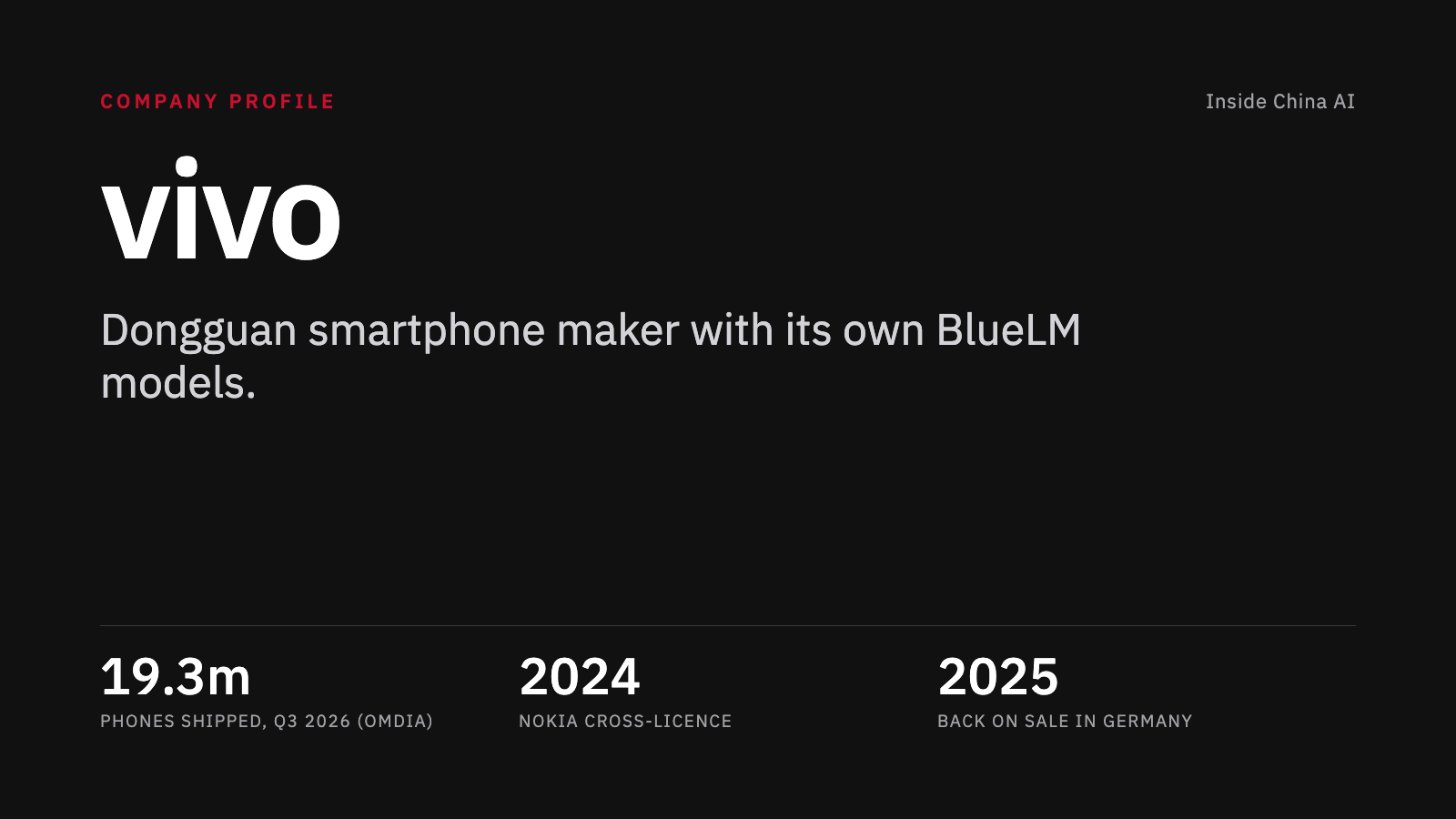
Graphic: Inside China AI
vivo: Back in Germany After the Nokia Dispute, With Its Own BlueLM Models at Home
Company profile · 26 November 2026.
vivo is one of China’s largest smartphone makers and builds its own family of large language models, BlueLM, which drives the AI assistant on its Chinese phones. In Germany it stopped selling in June 2023 after Nokia enforced a court injunction over mobile-standard patents; the two settled in February 2024, and since November 2025 vivo again sells its flagships there, through the official vivo online shop and Amazon. For Europe the picture is mixed: vivo now sells its latest phones in a group of mainly southern and central European markets, paused its entry into the Netherlands in 2022, shows only support pages on its UK website, and does not say which AI models run on the phones it sells here.
Origins and backing
vivo Mobile Communication Co., Ltd. is based in Chang’an Town, Dongguan, in Guangdong province (vivo). Its founder and chief executive is Shen Wei (vivo); Hu Baishan is executive vice president and chief operating officer (vivo and Euronics, 16 October 2025). The company does not give a founding year on the pages we checked. It is not listed and publishes no revenue, profit or shareholder figures.
The company says it has research centres in Shenzhen, Dongguan, Nanjing, Beijing, Hangzhou, Shanghai and Xi’an, a manufacturing network, including plants it authorises, able to make “nearly 200 million smartphones” a year, and a sales network in more than 60 countries and regions (vivo, 4 March 2026). The user figure is the company’s own and has risen: the same March 2026 release speaks of “more than 500 million users worldwide”; in its report on vivo’s developer conference of 16 September 2026, China News Service put vivo’s global users at nearly 600 million (China News Service). In March 2025 vivo announced a robotics lab and showed its first mixed-reality headset, vivo Vision (vivo).
The phone business is under pressure. In mainland China, vivo (including its iQOO brand) held 15.3 per cent of shipments in the third quarter of 2026, fourth place, with volumes down 24.9 per cent year on year, according to preliminary IDC data (IDC). Worldwide, the research firm Omdia counted 19.3 million vivo phones in that quarter, 33 per cent fewer than a year earlier (Light Reading). IDC attributes the industry-wide fall partly to sharply higher memory prices.
What they build
vivo makes smartphones — the flagship X series, the mid-range V and the budget Y series — plus foldables, tablets, earbuds and watches, and its own Android-based system, OriginOS. It groups its in-house technology into a “Blue Technology Matrix” of BlueImage, BlueLM, BlueOS, BlueChip and BlueVolt (vivo).
BlueLM (蓝心大模型) is vivo’s own model family, presented at its developer conference on 1 November 2023 (Pandaily). A 7-billion-parameter version is published on Hugging Face; vivo describes it as “independently developed by the vivo AI Lab” and trained on 2.6 trillion tokens, mainly Chinese and English, with weights “open for academic research and commercial use” (Hugging Face). In November 2024 researchers from the vivo AI Lab, together with the MMLab of the Chinese University of Hong Kong, described BlueLM-V-3B, a multimodal model designed to run on the phone itself (arXiv).
At the 2026 developer conference vivo presented a model line-up built around the individual user: BlueLM-RealTime for speech, BlueLM-Nano on the device for “real-time perception and personal memory”, and cloud models for tasks across devices and apps. A layer it calls Blue Harness turns more than 6,000 “atomic skills” of the operating system into tools that agents can call, the company says. A 30-billion-parameter mixture-of-experts model meant to run on the phone is still in pre-research (China News Service). On Chinese phones these models power the assistant 蓝心小V, whose Pro mode “remembers your habits and preferences” and completes complex tasks step by step, vivo says (vivo China).
Outside China the AI looks different. vivo’s global OriginOS page presents the Jovi assistant on phone and PC, and says its recorder transcription is “built on the same speech technology that powers Microsoft Teams cloud services, combined with advanced Google Gemini” (vivo). Jovi is “available only on select devices and in select countries or regions”. BlueLM is not mentioned on that page.
Cameras are the other pillar. Since December 2020 vivo has had a long-term imaging partnership with the German optics group ZEISS, including a joint “vivo ZEISS Imaging Lab” (vivo).
Key numbers
- Headquarters Dongguan, Guangdong; founder and CEO Shen Wei
- Ownership Not listed; no financial statements or shareholders published
- Shipments 19.3 million smartphones worldwide in Q3 2026, down 33 per cent (Omdia estimate); 15.3 per cent of mainland China’s market, fourth (IDC, preliminary)
- Scale Nearly 600 million users (September 2026) and capacity for nearly 200 million phones a year, according to the company
- AI Own BlueLM family (RealTime, Nano, cloud models); BlueLM-7B open weights; on-device BlueLM-V-3B; Gemini and Microsoft speech technology in global OriginOS features
- Europe European headquarters set up in Düsseldorf in 2019, office in Madrid opened in 2024; Spanish company vivo Mobile Communication Iberia S.L. named in the German shop’s privacy policy (November 2026); current models on vivo’s sites for Germany, Austria, Spain, Portugal, Poland, Italy, Czech Republic and Hungary; Netherlands entry paused in 2022; UK site shows only support pages (26 November 2026)
The European angle
- Entry vivo set up its European headquarters in Düsseldorf in November 2019 and launched on 20 October 2020 in France, Germany, Italy, Poland, Spain and the UK, followed by Austria, the Czech Republic, Romania and Serbia (vivo). In April 2024 it opened a second European office in Madrid, which “will operate alongside vivo’s existing Dusseldorf location” (vivo).
- The Nokia dispute After licensing talks failed, Nokia sued vivo in Germany over patents essential to mobile standards. On 6 April 2023 the Regional Court of Mannheim found that vivo infringed three Nokia patents (beck-aktuell); according to JUVE Patent, these were standard-essential patents and the court granted an injunction, while further Nokia suits in Munich and a vivo counterclaim in Düsseldorf were pending (JUVE Patent). In a German statement, rendered in English by JUVE Patent, vivo said it had “noted the decision of the Mannheim Regional Court with disappointment” and had prepared to suspend sales through its official German channels “if necessary”. Nokia enforced the injunction in June 2023, and vivo removed its products from the German market (JUVE Patent). On 5 February 2024 the two signed a multi-year cross-licence: vivo pays royalties “along with catch-up payments to cover the dispute period”, and the agreement “resolves all pending patent litigation between the parties, in all jurisdictions”, Nokia said (Nokia; vivo).
- The return to Germany vivo came back slowly. In February 2025 it offered selected models such as the X200 on Amazon (heise); in November 2025 it reopened its German website and launched the X300 series there through its own site and Amazon (heise). The X500 Pro and X500 Pro Max were presented for Europe on 27 October 2026 (9to5Google) and are sold in Germany, Austria and other European countries through vivo’s shop, some carriers and Amazon (Notebookcheck). On 26 November 2026 the German vivo shop listed the X500 Pro at €1,399 and the X500 Pro Max from €1,599 (vivo Official Store).
- Who sells vivo’s German and Austrian websites link to the vivo Official Store, which according to its legal notice is operated by VBF Tech Austria GmbH in Vienna; the notice says the products shown are offered by that company (legal notice). vivo’s Spanish and Portuguese websites link to stores run by 360 Mobile, S.L., near Madrid (terms of sale), and its Polish website to the retailer Neonet. In October 2025 vivo and Euronics Group, the European electronics retail association, expanded their partnership, placing vivo in Euronics’ “exclusive supplier circle” (Euronics). The German shop’s privacy policy also names vivo Mobile Communication Iberia S.L. in Spain as a separate controller for consumer research (privacy policy).
- Where vivo has stepped back In the Netherlands, vivo told Androidworld in October 2022, three months after launching, that it was pausing its market entry for the time being and would keep providing after-sales support and warranty repairs (Androidworld, 17 October 2022). On 26 November 2026 vivo’s British, Dutch and Bulgarian websites showed only support pages, while its sites for Austria, the Czech Republic, Hungary, Italy, Poland, Portugal and Spain showed current models.
- AI in Europe European buyers get OriginOS with Jovi and features built on Google Gemini and Microsoft speech technology, the company says. vivo does not say whether any BlueLM model runs on European devices, or where European AI requests are processed.
- Lists vivo does not appear on the EU’s consolidated financial sanctions list, the US Consolidated Screening List or the Pentagon’s 1260H list, according to our name check on 15 November 2026 (EU list dated 23 October 2026).
- What a European buyer would actually encounter A premium Chinese phone with ZEISS cameras, sold mainly online and through retail partners, with a Viennese company as shop operator — and an AI layer whose advertised features build on Google and Microsoft technology, while vivo does not say whether its own models are involved.
What we could not verify
- Revenue, profit and ownership. vivo publishes no accounts and does not name its shareholders.
- The founding year. vivo gives none on the pages we checked; Shen Wei writes of “over thirty years” of the company’s work.
- Which models run in Europe. Whether Jovi or other AI features on European phones use BlueLM, and where that data is processed.
- vivo’s EU data controller for its phones and accounts. Its privacy centre could not be read without a browser.
- The state of the European offices. We found no vivo Europe release datelined Düsseldorf after July 2024 and no current vivo statement on the Düsseldorf headquarters or the Madrid office, and no current information on the Czech and Romanian offices described in 2021.
- The UK. Whether vivo has formally paused or ended its UK business; we found no vivo statement on it.
- The sellers’ ownership. Whether VBF Tech Austria GmbH and 360 Mobile, S.L. belong to the vivo group.
- Other markets. vivo’s sites for France, Romania, Slovakia, Greece, Croatia, Slovenia and Serbia still show models from around 2021; we could not establish whether vivo still sells there.
- European sales figures and market shares.
The open question for Europe: if vivo’s agents start acting on European users’ apps and files, will they run on vivo’s own BlueLM models — and where will that data be processed?

Comments are closed