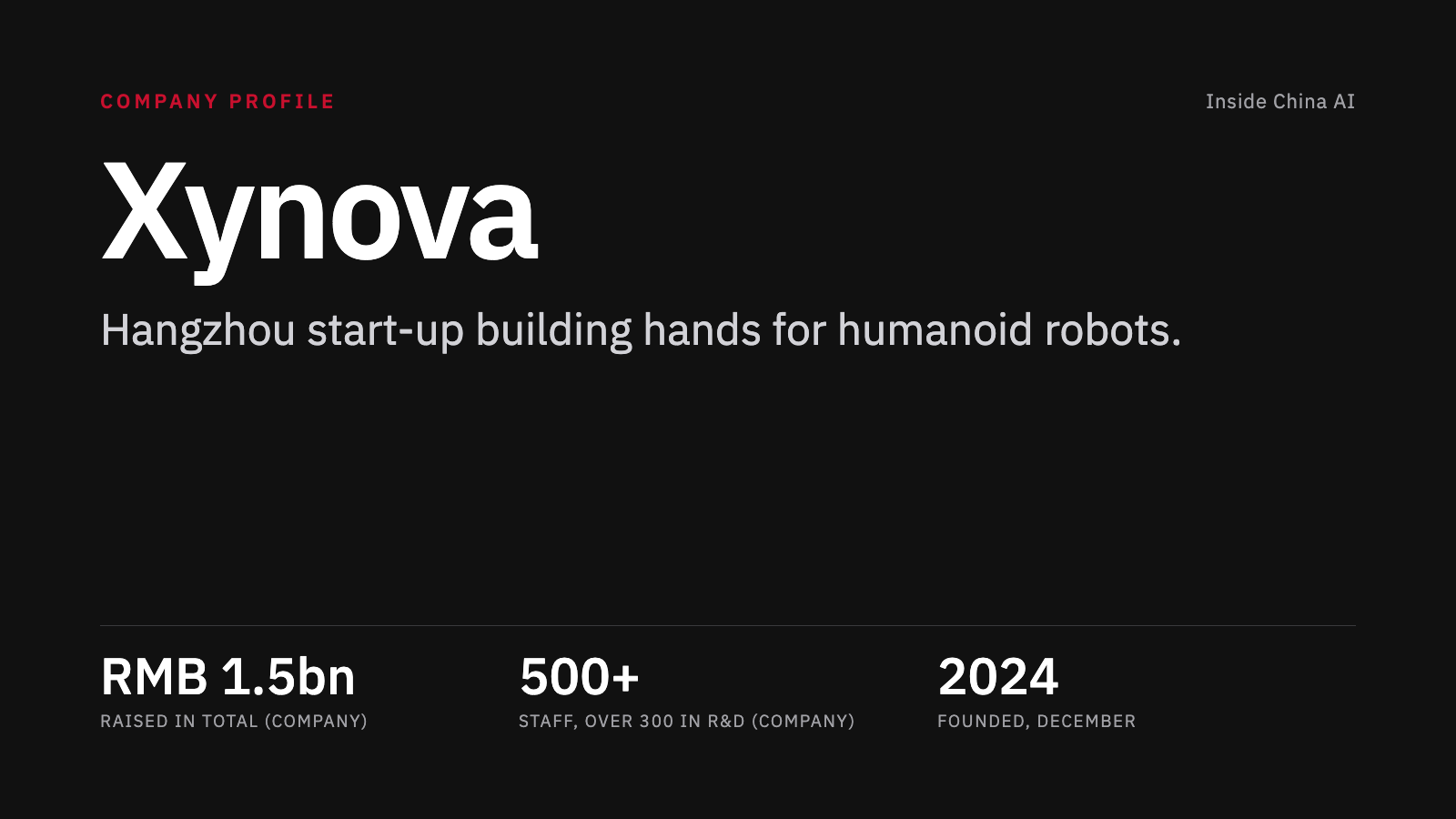
Graphic: Inside China AI
Xynova: The Hangzhou Start-up Building Hands for China’s Humanoid Robots
Company profile · 28 November 2026.
Xynova is a Hangzhou company, founded in December 2024, that makes dexterous robot hands and the small actuators that move them, and sells them, it says, to humanoid makers, data-collection operations and research customers rather than building robots of its own. In less than two years it has raised about 1.5 billion yuan from investors that include CATL, Xiaomi, JD.com, Meituan and Li Auto, and it says its valuation now exceeds $1 billion. For Europe, Xynova matters as a possible supplier of one of the hardest parts of a humanoid robot. So far, however, its European presence consists of trade-fair and conference appearances and a stated intention to find customers here; we found no European company, office, distributor or named customer.
Origins and backing
Xynova — 曦诺未来, legally Hangzhou Xynova Technology Co., Ltd. (杭州曦诺未来科技有限公司) — was established in Hangzhou’s Yuhang district in December 2024 (Xynova). It now gives its address in Hangzhou’s Xihu district. The founding team had five or six people, according to the city news site Hangzhou News (Hangzhou News); the company now reports more than 500 employees, over 300 of them in research and development, on its English website (Xynova) and “nearly 500” on its Chinese one (Xynova).
Its founder and chief executive is Xia Yuxuan, a former investor with a background in physics and computer science, according to Yicai (Yicai) and Hangzhou News (Hangzhou News). In an interview with 21st Century Business Herald published on 10 July 2026 (21st Century Business Herald), Xia Yuxuan said the company’s goal was annual production of 10,000 hands by the end of 2026, but that he did not like to stress the number because mass production did not mean that the market had accepted a product.
The money came quickly. By August 2026 Xynova had closed four funding rounds totalling about 1.5 billion yuan, according to Hangzhou News (Hangzhou News). In July 2026 Xynova closed a Series A+ of 500 million yuan, led by Meituan with NIO Capital and China Merchants Capital investing and Xiaomi adding again (Hangzhou News; Yicai). The company says that round put its post-money valuation above $1 billion (Xynova) and that it has raised 1.5 billion yuan, about $220 million, in total, from investors including CATL, Xiaomi, JD.com and Meituan (Xynova). Yicai and 21st Century Business Herald both name CATL, Xiaomi, JD.com and Li Auto among its industrial investors. Xynova has not published revenue, profit or the size of individual shareholdings.
What they build
Xynova describes itself as a “full-stack provider of general-purpose dexterous manipulation solutions” whose in-house capabilities “span motors, electronic controls, reducers and lead screws” (Xynova). In other words, it is a component maker for humanoid robots, not a robot maker. Its range, as of 27 November 2026:
- Flex 1, a tendon-driven hand with 25 degrees of freedom, released in August 2025, which the company calls mass-produced (Xynova).
- Flex 2, launched online on 13 May 2026 (Hangzhou News) and shown in person for the first time at the ICRA robotics conference in Vienna in June 2026 (Yicai). It combines tendon drive, with the actuators in the forearm, and direct drive in the palm (Hangzhou News). The company says the hand weighs 400 grams, has 23 degrees of freedom, a fingertip force of 20 newtons and a “vertical payload of 20 kg” (Xynova).
- Prima 1, released in August 2026, a fully direct-drive research hand with 22 degrees of freedom, with visuo-tactile sensing in all five fingers (Xynova). The Consumer Technology Association lists it as a CES 2027 Innovation Awards honoree in the Artificial Intelligence category (CES).
- Actuators: rotary joint modules, released in April 2025 (Xynova), and micro linear actuators such as the PRM10 series with up to 200 newtons of thrust; the company says its linear range covers 60 to 8,000 newtons, “meeting the needs of all major joints” of a humanoid (Xynova).
Xynova’s AI is about control rather than large models. The company says Prima 1 is designed as an open research platform for imitation learning, teleoperation and transferring policies from simulation to the real robot, with SDK access to its control functions and operating data (Xynova via PR Newswire). Xia told 21st Century Business Herald that the company would build small models, including for motion control, on the software side. We found no foundation model, model card or released weights from Xynova. Its strategy, as described to Yicai, is to sell hands together with software and data, so that customers can use the data they collect to train grasping models.
Production is in Hangzhou. The company says a 5,400-square-metre manufacturing facility there “supports production and customer delivery” (Xynova); Hangzhou News reported on 8 August 2026 that the new plant was in operation. The company’s stated target is capacity for 10,000 hands and 200,000 micro linear actuators a year by the end of 2026 (Yicai).
Key numbers
- Founded December 2024, Hangzhou; founder and CEO Xia Yuxuan
- Funding About 1.5 billion yuan (about $220 million) in total, the company says (Xynova); Series A+ of 500 million yuan in July 2026, led by Meituan (Hangzhou News)
- Valuation Above $1 billion after the Series A+, the company says (Xynova)
- Staff More than 500, over 300 of them in R&D, the company says (Xynova)
- Capacity 5,400-square-metre plant in Hangzhou; target of 10,000 hands and 200,000 micro linear actuators a year by end-2026 (Yicai)
- Customers Three groups, according to Yicai: humanoid makers, data-collection factories and research customers. No named customer found
- AI Control algorithms and SDKs for its hands; no own foundation model found
The European angle
- Stated intention “While continuing to deepen its presence in China, Xynova is actively expanding relationships with customers, universities and ecosystem partners across Europe and the United States,” the company wrote on 20 October 2026 (Xynova).
- Appearances Flex 2 had its first in-person showing at ICRA in Vienna in June 2026, where founder Xia Yuxuan was invited to speak, according to Yicai (Yicai). Xynova exhibited Prima 1 and Flex 2 at Web Summit in Lisbon from 10 to 12 November 2026, which the company called Prima 1’s European debut (Xynova).
- Sales channel None found. Xynova publishes no European distributor or reseller and no prices; enquiries go to a general company e-mail address.
- Physical presence None found: no European company, office, service centre or plant.
- Regulatory exposure Xynova is not on the US Entity List, the Treasury’s list of Chinese military-industrial complex companies (CMIC), the Pentagon’s 1260H list or the EU’s consolidated financial sanctions list, according to our check of the published lists on 27 November 2026 under its English and Chinese names.
- What a European buyer would actually encounter A hand-and-actuator supplier with major Chinese industrial backers and a production line in Hangzhou, which wants research and commercial partners in Europe but has not yet named one.
What we could not verify
- Any named customer, in China or Europe.
- Actual output and deliveries. The 10,000-hand figure is a capacity target for the end of 2026, not a reported volume.
- Flex 2 specifications. Launch coverage in May 2026 gave different payload and repeatability figures from those now on the company’s product page; we use the company’s current figures.
- Headcount. The English and Chinese company pages differ (more than 500 and nearly 500); Hangzhou News reported nearly 300 in May 2026.
- Prices and whether the hands are sold in Europe through any channel.
- CE marking or EU declarations of conformity for Xynova’s hands and actuators.
The open question for Europe: will a company that wants to supply the hands for the world’s humanoid robots find its first customers here among research labs, or wait until European robot makers need hands in volume?

Comments are closed