Graphic: Inside China AI
Yidu Tech: China’s Hospital-Data AI Company, Whose Business Abroad Runs Through Brunei
Company profile · 28 November 2026.
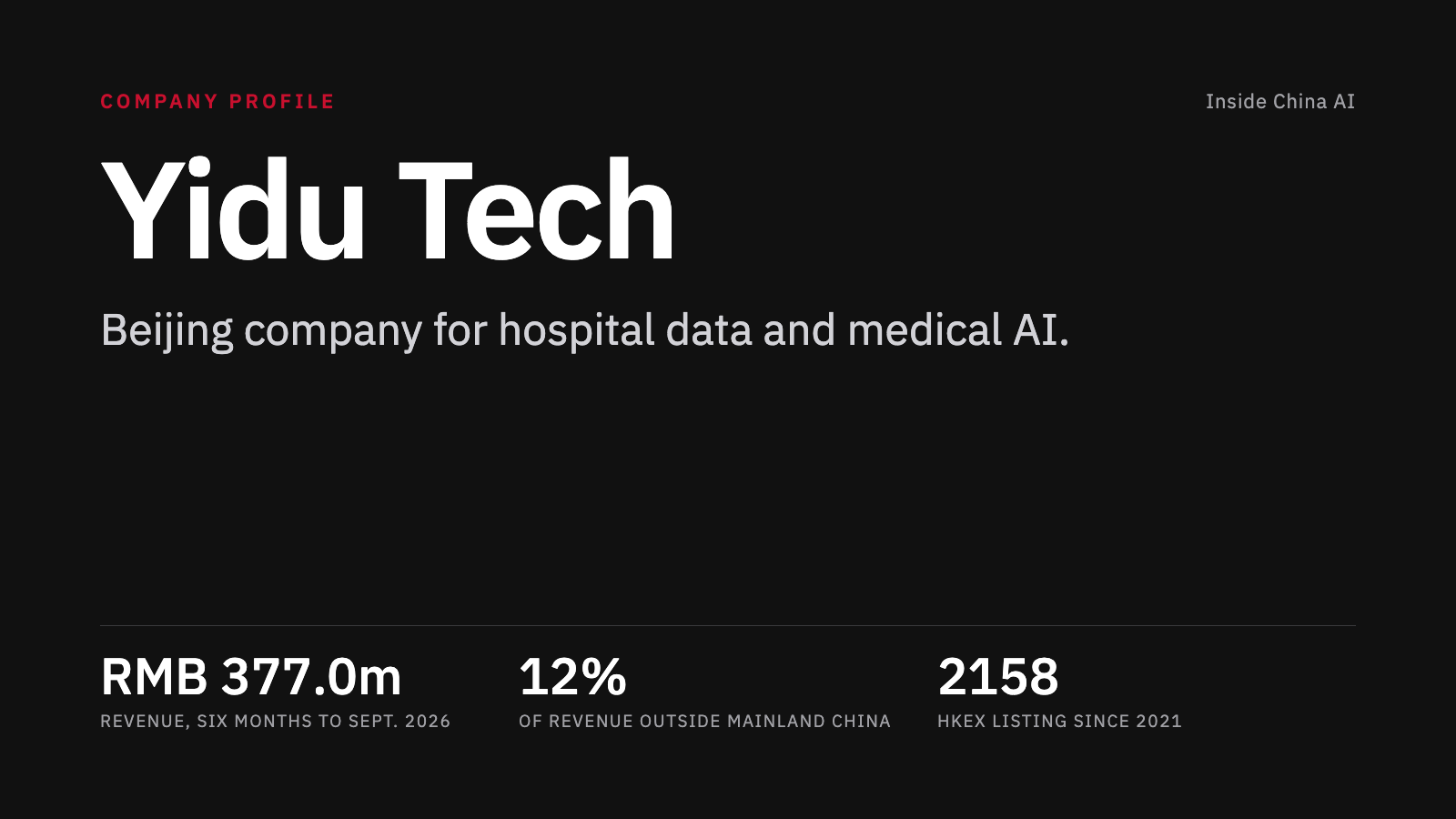
Yidu Tech (医渡科技) builds data platforms, medical AI models and clinical agents for Chinese hospitals, health authorities, drug makers and city health-insurance schemes. In the half-year to 30 September 2026 it reported revenue of RMB 377.0 million and a profit of RMB 61.3 million, and the company says 16 of the world’s top 20 multinational pharmaceutical companies are its customers (interim results). For Europe, Yidu is an example of a Chinese AI company built on hospital data — and of how such a company goes abroad: its business outside China runs through EVYD, a subsidiary that operates Brunei’s national digital health platform. We found no European office, entity or named European customer.
Origins and backing
Yidu says it was founded in 2014 (Yidu Tech); its holding company, Yidu Tech Inc., was incorporated in the Cayman Islands on 9 December 2014 and runs its Chinese business through subsidiaries and “consolidated affiliated entities” (interim results). Headquarters are in Chaoyang District, Beijing. The shares have been listed on the Main Board of the Hong Kong Stock Exchange (2158) since 15 January 2021; net proceeds of the offering were about RMB 3,825 million (annual results FY2026).
The company is led by its founder Gong Yingying (宮盈盈), executive director and chairlady, and by co-founder Xu Jiming (徐濟銘), executive director and chief executive, according to the board list of 11 November 2026 (HKEX) and the company’s website. The annual report names Gong Yingying and Sweet Panda Limited, which she wholly owns, as the controlling shareholders. At 31 March 2026 Gong Yingying was interested in 44.69 per cent of the shares, including 37.18 per cent held through Sweet Panda Limited; the annual report lists no other substantial shareholder (Annual Report 2026).
Yidu’s financial year ends on 31 March. In the year to 31 March 2026 it turned its first annual profit, RMB 78.8 million on revenue of RMB 819.3 million, and proposed a final dividend of HK$0.04 per share (annual results FY2026).
What they build
At the centre is YiduCore, which the company calls its “AI Medical Brain” (Yidu Tech). In its interim report of 22 November 2026, Yidu says it “continued to strengthen the training and iteration of large models in the vertical healthcare domain”, released version 6.0 of its data hub EYWA and achieved “full-chain adaptation of domestic and international high-end chips” (interim results). It does not name its models, their size or any base model they build on.
The products on top are agents for doctors and hospitals: Dr. Copilot, a clinical assistant for the consultation workflow; Yidu Smart Evidence (called Yidu Evidence on the company’s website), an evidence-based question-and-answer and literature tool launched on 10 March 2026 (Yidu Tech); and tools for hospital management and clinical research. The company says it has developed “over 400 specialist-task agents” and, with Chinese hospitals, agents for liver disease, weight management and traditional Chinese medicine.
Commercially, Yidu reports three segments (interim results):
- AI for Medical — data platforms and AI for hospitals and health authorities. The company says it serves 141 hospitals and 53 regulators and policymakers in China, and in the half-year to 30 September 2026 won tenders such as a big-data platform for the First Affiliated Hospital of Chongqing Medical University.
- AI for Life Sciences — clinical-trial, real-world-evidence and other services for drug makers, which now also include sales of pharmaceutical products (RMB 105.3 million in the half-year). The segment’s gross margin fell from 21.0 to 15.4 per cent, which the company attributes to “the increased proportion of pharmaceutical sales”.
- AI for Care — operation of city health-insurance schemes. Yidu says it has been the main operating platform for Beijing Hui Min Bao for six years (over 19 million insured) and for Shenzhen Hui Min Bao for four years (over 6 million insured).
On 1 June 2026 Yidu announced a non-binding memorandum to buy an unnamed online doctors’ platform for about RMB 400 million; the target had about 3.5 million practising doctors among its users, the company said (HKEX). Up to 27 November 2026 no definitive agreement had been announced.
Key numbers
- Listing Hong Kong Stock Exchange (2158), since 15 January 2021; controlling shareholder Gong Yingying interested in 44.69% (31 March 2026)
- Revenue RMB 377.0 million in the six months to 30 September 2026 (+5.3%); RMB 819.3 million in the year to 31 March 2026 (+14.6%)
- Profit RMB 61.3 million in the half-year (loss of RMB 15.8 million a year earlier), with “other gains — net” of RMB 81.7 million and other income of RMB 60.8 million in the income statement; RMB 78.8 million in the year to 31 March 2026
- Cash RMB 2,162.3 million in cash, deposits and similar items at 30 September 2026
- Customers 141 hospitals, 53 regulators and policymakers, 16 of the top 20 multinational drug makers (company figures)
- Staff 745 at 30 September 2026, 386 of them in product development and technology
- Outside China about 12% of half-year revenue from customers outside the Chinese mainland; in the year to 31 March 2026, Brunei RMB 97.9 million (12%), rest of the world RMB 3.1 million
Sources: interim results, 22 November 2026; annual results, 30 June 2026; Annual Report 2026.
The European angle
- Physical presence None found. The group operates in “the PRC, Brunei and Singapore”, according to its interim report (interim results); its annual report lists staff in Singapore, Brunei and the United States among overseas locations, and no European entity among its major subsidiaries (Annual Report 2026).
- How Yidu goes abroad Through EVYD Technology, with companies in Brunei and Singapore, in which the group held 65.43 per cent at 31 March 2026 (Annual Report 2026). In December 2022 Yidu sold a 20 per cent stake in EVYD’s holding company to an investment company beneficially owned by the Brunei Investment Agency, a government-owned corporation that manages Brunei’s General Reserve Fund (HKEX). EVYD co-developed BruHealth, Brunei’s national digital health platform, which Yidu says covers more than 85 per cent of the population. Brunei brought in RMB 97.9 million, 12 per cent of group revenue, in the year to 31 March 2026.
- Davos At the World Economic Forum in Davos in January 2026, the Novartis Foundation, Brunei’s Ministry of Health and EVYD launched a national AI-supported cardiovascular prevention programme in Brunei, with EVYD providing data integration and analytics; Gong Yingying took part in a Davos dialogue on AI in public health, the company says (Yidu Tech). In June 2026 the Borneo Bulletin reported early milestones of the programme, “delivered in collaboration with the Novartis Foundation and EVYD Technology” (The Star/Borneo Bulletin, 6 June 2026). The programme runs in Brunei; it is not business in Europe.
- Drug makers Yidu counts 16 of the top 20 multinational pharmaceutical companies as customers and says it won real-world-study orders from “multiple internationally renowned pharmaceutical companies” in the half-year, but names none of them (interim results). Its website gives a different figure, 17 of 20 (Yidu Tech). The work described in the filings is for the Chinese market.
- Plans The annual results say Yidu wants to build “replicable regional benchmarks in key countries and regions” abroad (annual results FY2026). Europe is not named.
- Lists Yidu Tech, Yidu Cloud and EVYD returned no name match on the EU consolidated financial sanctions list, the US Consolidated Screening List (including the Entity List) or the US Department of Defense 1260H list (our check of 27 November 2026; a name match, not a legal review).
- What a European partner would actually encounter A listed Chinese company that says it has worked with hospital data for more than a decade, and whose one tested export model — a national health platform run with a state partner — is in South-East Asia, not in Europe.
What we could not verify
- Which AI models run inside YiduCore and its agents — whether Yidu trains its own base models or adapts third-party ones.
- Which multinational drug makers are customers, and whether any of the work is delivered in Europe.
- What lies behind “other gains” of RMB 81.7 million in the half-year; the results announcement gives no breakdown.
- Whether the planned purchase of the online doctors’ platform will go ahead.
The open question for Europe: will the Brunei model — a national health platform run with a sovereign partner — be offered to European health systems, and under which data rules?

Comments are closed