Graphic: Inside China AI
Yutong: The Zhengzhou Bus Maker Whose Electric Buses Run Across Europe
Company profile · 26 November 2026.
Yutong Bus is the Chinese manufacturer whose electric buses now run for public transport operators from Oslo to Athens and from Nottingham to Como. In 2025 it earned more from buses sold abroad than at home (2025 annual report), and Britain, Norway, the Netherlands and Italy head its own list of export markets. Its autonomous and driver-assistance technology is still largely a domestic story; in Europe the debate is about something more basic — the software connection between a new Yutong bus and its maker. Tests commissioned by Oslo’s transport authority Ruter showed that this connection could, in theory, be used to stop a bus. Ruter itself says the issue lies with connected technology, not with the manufacturer or country of origin. A Danish risk assessment found no basis for treating Chinese buses as less cyber-secure than others, and the British Transport Secretary wrote to Parliament’s Transport Committee in May 2026: “I am assured that this is a managed risk for this manufacturer” (letter to the Transport Committee).
Origins and backing
Yutong traces its origins to the Zhengzhou Bus Repair Factory, founded in 1963, the company says (Yutong history). Yutong Bus Co., Ltd. (宇通客车) has been listed on the Shanghai Stock Exchange (600066) since May 1997 (2025 annual report). It is based in Zhengzhou in Henan province and had 19,575 employees at the end of 2025, 4,180 of them in research and development (annual report).
Yutong is privately controlled, not state-owned. Zhengzhou Yutong Group held 37.70 per cent of the shares on 30 September 2026, and a Yutong Group subsidiary another 3.95 per cent; investors trading through Hong Kong’s Stock Connect held 11.03 per cent (Q3 2026 report). The filing classifies Yutong Group as a domestic non-state legal person. According to the annual report, the company’s actual controller is its chairman, Tang Yuxiang, through a management company in which Tang holds 52 per cent and which steers the partnership that owns 85 per cent of Yutong Group (annual report). Tang has chaired the company since 2001 and was re-elected on 27 April 2026; Li Panpan was reappointed general manager and chief financial officer the same day (board resolution).
What they build
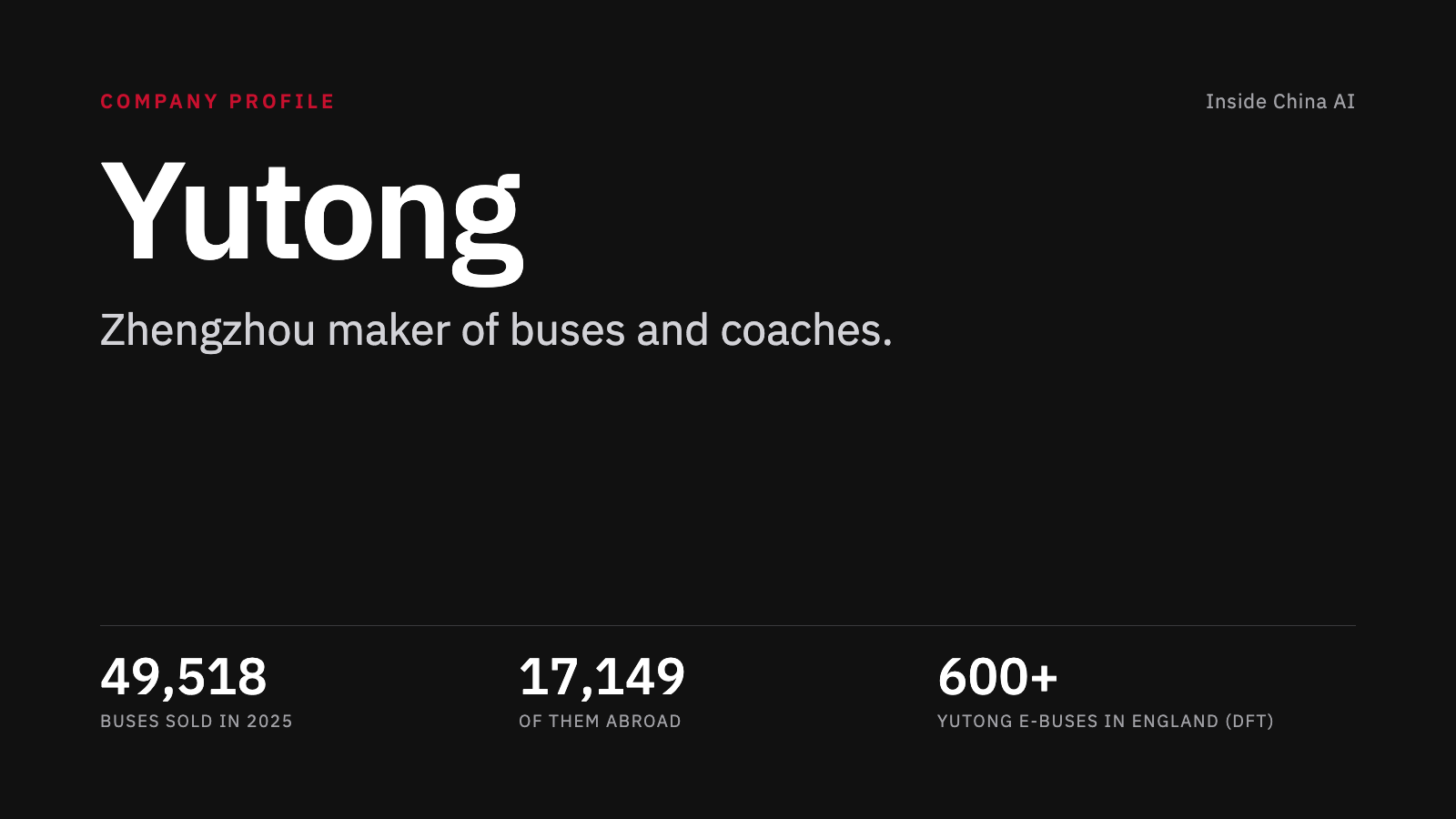
Yutong makes buses and coaches from 5 to 18 metres: city buses, intercity buses, long-distance coaches, school buses, airport apron buses and what it calls intelligent-driving micro-circulation buses (2026 interim report). In 2025 it sold 49,518 vehicles, 18,356 of them new-energy buses, almost all battery-electric (annual report). It ranks first in China for large and medium buses, the company says.
The AI side is mainly about driving. According to the 2025 annual report, Yutong’s L4 automated micro-buses for open roads and its L3 buses for bus rapid transit are in regular operation in 26 Chinese cities, and have been “sold or demonstrated” in Qatar, the United Arab Emirates, Singapore, France and Spain; the report does not name the European sites (annual report). Yutong first put four L4 buses on public roads in Zhengzhou in 2019, the company says (Yutong history). For export markets it released products that meet the EU’s General Safety Regulation, while L2 driver assistance was developed for China and a second-generation L3 function is in small-batch rollout, the company says.
Software sits around the vehicle. Yutong’s LINK+ telematics system served more than 120,000 buses worldwide at the end of 2025 (annual report). In the first half of 2026 it launched a “Xiaoyu AI assistant” for fleet management and says it is exploring applications of large models (interim report). Yutong has not published a foundation model of its own.
Key numbers
- Listing Shanghai Stock Exchange, 600066, since May 1997; Yutong Group and a subsidiary held 41.65 per cent at the end of 2025 (annual report)
- Q3 2026 Revenue RMB 9.10bn (−11.1%); net profit attributable to shareholders RMB 1.32bn (−3.0%); profit before tax RMB 1.44bn (−11.4%); unaudited (Q3 report)
- January–September 2026 Revenue RMB 25.82bn (−2.1%); net profit attributable to shareholders RMB 3.18bn (−3.3%), up 18.5 per cent excluding one-off items; profit before tax RMB 3.59bn (−6.9%) (Q3 report)
- Sales 33,885 buses January–October 2026, down 7.4 per cent (sales report of 3 November 2026)
- 2025 Revenue RMB 41.43bn (+11.3%), net profit attributable to shareholders RMB 5.55bn (+34.9%); R&D spending RMB 1.81bn, 4.36 per cent of revenue (annual report)
- Exports 17,149 buses sold abroad in 2025 (+22.5%); overseas revenue RMB 21.11bn against RMB 15.40bn in China; more than 138,000 buses exported in total by June 2026 (annual report, interim report)
- AI L4 micro-buses and L3 BRT buses in 26 Chinese cities; Xiaoyu AI assistant for fleet management; no own foundation model
The European angle
- Market entry Yutong obtained EU whole-vehicle type approval and entered the European market in 2004; it says it has delivered 7,898 buses to Europe and covers 27 countries (Yutong Europe). The page is undated.
- Own presence Yutong France SAS in Paris is a wholly owned subsidiary (interim report). The company runs its own parts warehouses in France and Norway and its own service station in Norway, according to the same report. On 8 September 2026 it opened its first full service centre in Europe in Stokke, Norway, with a 2,300-square-metre parts warehouse (Yutong). Yutong also names regional heads for “Central and Northern Europe” and “Southern Europe”; we could not identify the legal entities behind them.
- United Kingdom The Department for Transport listed Yutong buses in service or on order in projects it funded in England as of November 2025: First Bus 329, Stagecoach 215, Nottingham City Transport 62, Kinchbus 21, White Bus 10 and Leicester City Council 6 — partial data, England only (written answer of 17 November 2025). Yutong’s UK dealer is Pelican Bus and Coach, which registered the 2,000th UK Yutong in May 2025 (Yutong).
- Norway Ruter, the transport authority for Oslo and Akershus, has Yutong buses in its fleet; the 2025 Yutong bus it tested is operated for Ruter by ConnectBus (Ruter test report).
- Other named customers According to Yutong: ASF Autolinee took over 23 electric buses for Como, Italy, in September 2024 (Yutong); Yutong built 240 electric buses for the Athens network run by OSY (Yutong); MZK Jelenia Góra in Poland runs 36 Yutong zero-emission buses, sold through Busnex Poland (Yutong, 29 October 2026); the Danish operator Vikingbus has run a T12E electric coach since 2022 (Yutong); the Dutch coach companies Transvision and Kupers Touringcars use its electric coaches (Yutong).
- Production None in Europe. Yutong builds its buses in China; local kit assembly runs in Kazakhstan, Pakistan, Ethiopia, Malaysia and other countries outside the EU (interim report).
- The remote-access question Ruter had a brand-new Yutong bus and a three-year-old bus from another manufacturer tested in an isolated facility inside a mountain and published the results on 28 October 2025. The Yutong bus receives software updates over the air, and “there is access to the control system for battery and power supply via mobile network through a Romanian SIM card. In theory, therefore, this bus can be stopped or rendered inoperable by the manufacturer,” Ruter writes; the cameras are not connected to the internet (Ruter). Ruter stresses that the issue relates to connected technology, “not to the manufacturer or country of origin”, says Yutong’s comments on the report did not change its main findings, and is introducing a delay for update signals so that it can inspect updates before they reach the bus. Because there is “only one way out and to the bus’s critical functionality”, the bus is easy to isolate, Ruter writes; the test report itself concludes that the findings were “better than feared” (“bedre enn fryktet”) (Ruter test report). Vulnerabilities in a Chinese update platform used by Yutong were reported and fixed, according to Ruter. We found no statement on the test on Yutong’s own website.
- Denmark and the UK In Denmark, the transport authority Movia had EY assess electric buses from seven manufacturers; on 16 September 2026 it said there was no basis “for at betragte kinesiske busser som mindre cybersikre end busser fra andre producenter” (to regard Chinese buses as less cyber-secure than buses from other manufacturers), and that it will write tighter requirements into existing contracts and future tenders, including the option to limit or deactivate connected functions where technically possible, lawful and proportionate, for example by removing a bus’s SIM card; the release names no manufacturer (Movia). In the UK, the transport minister Lord Hendy told the House of Lords on 8 January 2026 that remote software updates had “been the practice for years, but it is a concern and that is why we are looking at it” (Hansard). In a letter to the Transport Committee dated 22 May 2026 and published on 3 June, Transport Secretary Heidi Alexander wrote that just over 600 of England’s roughly 5,000 electric buses are made by Yutong. After talks with Norwegian counterparts, the trade association CPT and the Vehicle Certification Agency, the letter says: “I am assured that this is a managed risk for this manufacturer”; officials assess the buses’ software update protocols as “in line with HMG’s security expectations” (Transport Committee).
- Lists Our name check of 15 November 2026 found no entry for Yutong on the EU consolidated sanctions list, the US Consolidated Screening List or the US Department of Defense 1260H list.
- What a European buyer would actually encounter An established supplier of electric buses with named customers in at least seven European countries and its own service centre in Norway — and a connected vehicle whose update channel European operators now want to control themselves.
What we could not verify
- A public statement by Yutong on the Ruter findings: we found no statement on Yutong’s own website.
- Yutong’s European revenue and unit sales, which its filings do not break out, and the date of its figure of 7,898 buses delivered to Europe.
- The legal entities behind Yutong Central and Northern Europe and Yutong Southern Europe.
- Where in France and Spain Yutong’s automated micro-buses were sold or demonstrated.
The open question for Europe: as Yutong adds more driver assistance and automation to its buses, who will control the software updates — the maker in Zhengzhou or the operators in Europe?

Comments are closed