Graphic: Inside China AI
ZTE: A Chinese Network Supplier Pivots to AI Computing While the EU Questions Its Place in European Networks
Company profile · 23 November 2026.
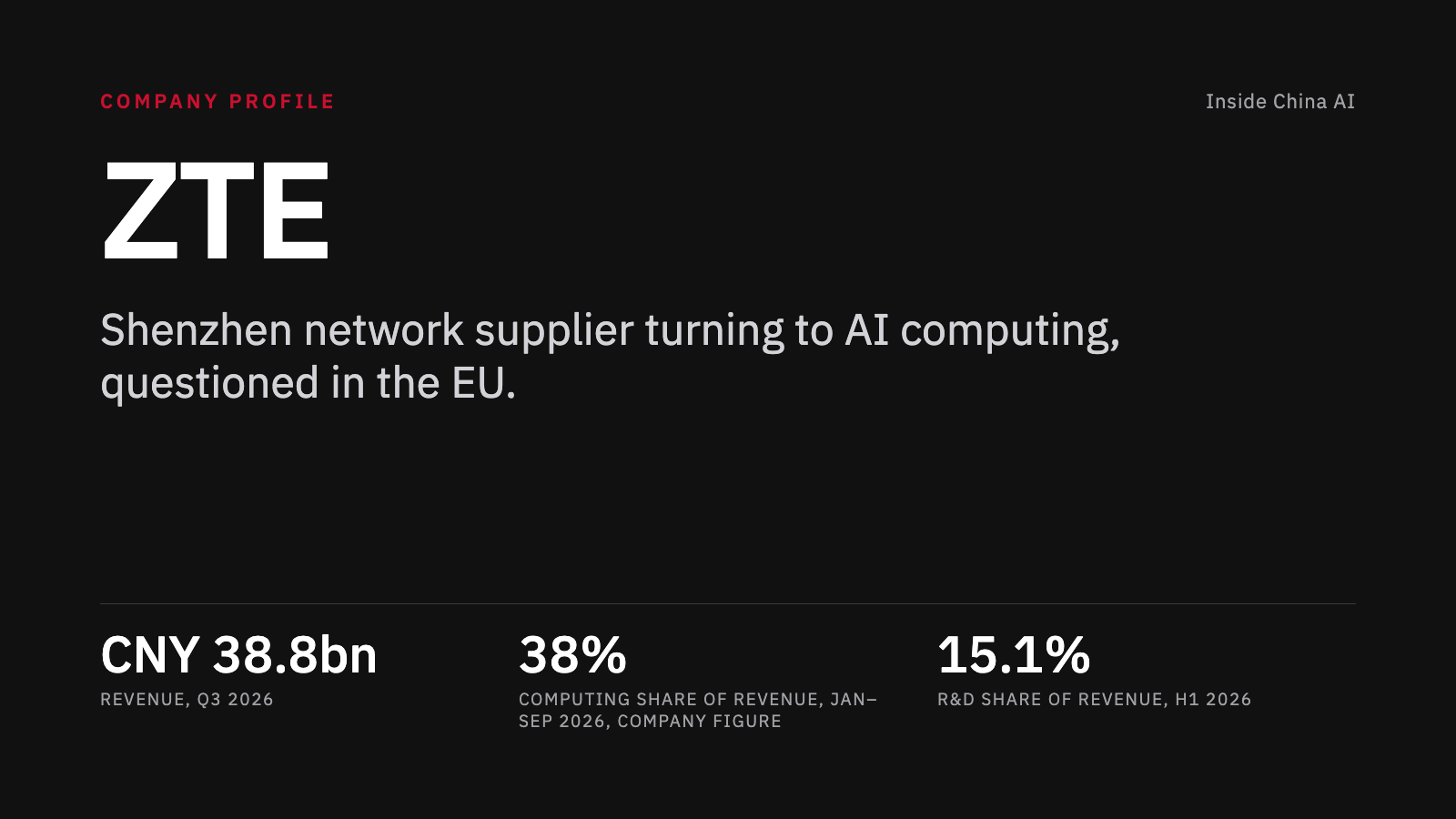
ZTE is the Shenzhen telecom equipment maker that builds mobile, fixed and optical networks for operators in more than 160 countries and regions, the company says. Since 2025 it has been reshaping itself around AI computing: servers, “SuperPod” clusters, data-centre equipment and its own chips. In the first nine months of 2026 computing made up 38 per cent of its revenue, according to ZTE. In Europe it lists offices in 14 EU countries and names operators as customers. Yet the European Commission has called ZTE, together with Huawei, a supplier of “materially higher risks” (European Commission, 15 June 2023). Germany’s three mobile operators must stop using critical ZTE components in their 5G core networks by the end of 2026 (Bundestag), and in January 2026 the Commission proposed a law that would make the removal of “high-risk” suppliers from mobile networks mandatory across the EU (European Commission, 20 January 2026).
Origins and backing
ZTE traces itself to Shenzhen ZTE Semiconductor, established on 7 February 1985. ZTE Corporation was formed and listed in Shenzhen in 1997 and added a Hong Kong listing in 2004 (ZTE). Its headquarters is in Shenzhen’s Nanshan district.
Its largest shareholder is ZTE Holdings (中兴新通讯), with 20.09 per cent at 30 September 2026 (Q3 report). ZTE Holdings in turn belongs to four shareholders: the Xi’an Microelectronics Technology Institute (34 per cent), Shenzhen Aerospace Guangyu Industrial (14.5 per cent), Shenzhen Zhongxing WXT Equipment (49 per cent) and Zhuhai Guoxing Ruike (2.5 per cent). Because none of them controls ZTE Holdings, ZTE says it has no actual controller (bond prospectus, November 2026). Fang Rong chairs the board as a non-executive director. Xu Ziyang, the only executive director, runs the company as president, a role ZTE’s English website calls chief executive. ZTE had 62,568 employees on 30 June 2026 (interim report).
What they build
The core business is still networks: 5G radio, core networks, optical transport and fixed broadband for operators, along with home routers, set-top boxes and nubia smartphones. That carrier business is shrinking in China. Worldwide, revenue from operator networks fell 9.41 per cent in the first half of 2026, mainly on lower wireless sales, and its gross margin dropped by 14.88 percentage points (interim report). ZTE points to “lower communications infrastructure investment by domestic carriers” (ZTE, 26 October 2026).
Growth comes from computing. In April 2025 ZTE launched an upgraded “Connectivity + Computing” strategy (ZTE). It now sells AI servers, storage, data-centre systems and Nebula (星云) switches for AI clusters. Its OEX SuperPod holds up to 128 GPUs in one system and combines CPUs, GPUs and DPUs from different chipmakers, the company says. ZTE’s figures for how far it scales differ: its interim report of 22 August 2026 says up to 16,000 cards (interim report), while its results release of 26 October 2026 says clusters scale “to the 100,000-GPU scale” (ZTE). ZTE says its computing products have gained share with Chinese internet companies, banks, power utilities and the public sector. Citing IDC, it said in March 2026 that it ranks fourth in China and eighth in the world in server shipments (ZTE).
ZTE designs chips through its wholly owned unit Sanechips (中兴微电子), and says it has done chip design since 1996. Its interim report lists self-developed processors, a DPU, switching chips, broadband chips and an 800G coherent DSP, all shipped to operators and internet companies, plus car chips in commercial use or selected for models from FAW, SAIC and GAC (interim report). In China it plans to accelerate the “large-scale” use of its own computing chips with its SuperPods. The filings do not name an AI accelerator of its own, and we found none.
In AI models, ZTE says it has developed the “ZTE Nebula large model”, a family that includes a foundation model and models for software development, telecoms and industry (interim report). The Nebula Telecom Large Model, launched on 1 July 2024, is meant to automate network operations for operators (ZTE). We found no open weights, parameter counts or independent benchmarks. On devices, ZTE’s nubia NaviX Ultra phone runs ByteDance‘s Doubao assistant.
Key numbers
- Q3 2026 Revenue CNY 38.81 billion (+33.99%); net profit attributable to shareholders CNY 1.31 billion (+394.46%), of which about CNY 0.71 billion came from non-recurring items, mainly gains on financial assets (Q3 report, SZSE, 27 October 2026)
- January–September 2026 Revenue CNY 116.84 billion (+16.23%); net profit CNY 4.06 billion (−23.71%); excluding non-recurring items CNY 2.81 billion (−27.46%). Inventory rose 56.61% from the end of 2025 to CNY 73.63 billion
- Computing 38% of revenue in January–September 2026, up more than 70%, the company says (ZTE); 24.6% of 2025 revenue of CNY 133.90 billion (ZTE)
- International CNY 27.87 billion in H1 2026 (+33.13%), 35.72% of revenue (interim report)
- R&D CNY 11.75 billion in H1 2026, 15.06% of revenue
- Listing and owner Shenzhen (000063) and Hong Kong (0763); ZTE Holdings 20.09%, no actual controller
- US measures Entity List 2016–2017; denial order April–July 2018; on the FCC Covered List since 12 March 2021; not on the Entity List, the 1260H list or the CMIC list (our check, 23 November 2026)
The European angle
- Physical presence Yes. ZTE lists its own companies in Germany (ZTE Deutschland GmbH, Düsseldorf), Spain (ZTE España in Alcobendas and a managed-services company in Zamudio, Bizkaia), the Netherlands (ZTE Netherlands B.V., The Hague), Belgium, the Czech Republic, France, Greece, Poland and the United Kingdom, offices in Rome, Milan and Vienna, and addresses in 14 EU countries in all (ZTE sales outlets). Europe is one of the four core regions of its operator business (interim report). A unit called the ZTE Europe Research Institute was deregistered in 2024 (bond prospectus).
- Customers ZTE names European operators. On 6 February 2025 it signed a multi-year agreement with the Italian fixed-wireless provider EOLO to supply 5G millimetre-wave radio equipment and customer devices (ZTE). In Germany, ZTE and the fibre provider DNS:NET announced a partnership on 15 October 2025 to bring ZTE’s XGS-PON Wi-Fi 7 gateways to DNS:NET’s customers, the company says (ZTE), and in February 2024 it reported a solar and fuel-cell power system at a Telefónica Germany site (ZTE).
- AI computing in Europe ZTE showed its servers and “Europe-oriented intelligent computing solutions” at CloudFest in Rust, Germany, in March 2026 (ZTE). It named no European customer for its servers or AI clusters. ZTE says its optical transport range passed the “Substantial” assessment of the EU’s EUCC cybersecurity certification scheme in July 2026 (ZTE).
- High-risk supplier debate In its communication of 15 June 2023, the Commission said national decisions to restrict or exclude Huawei and ZTE from 5G “are justified and compliant with the 5G Toolbox”, and that it would avoid exposing its own communications to mobile networks using them (European Commission). On 20 January 2026 it proposed a revised Cybersecurity Act that would enable “the mandatory derisking” of mobile networks from “high-risk third-country suppliers”. The proposal names no company and still needs Parliament and Council (European Commission). On 4 May 2026 a Commission spokesperson told reporters in Brussels that the Commission recommended member states not use Huawei and ZTE equipment in operators’ connectivity infrastructure, Reuters reported (Reuters via AsiaOne, 5 May 2026). We found no Commission document setting out this recommendation; it is not legally binding.
- National rules Under contracts with the federal government, Telekom, Vodafone and Telefónica in Germany may use no critical Huawei or ZTE components in their 5G core networks after the end of 2026. By the end of 2029 they must also replace critical Huawei and ZTE network-management functions in their access and transport networks (Bundestag, 1 April 2026). Sweden’s telecom regulator PTS barred Huawei and ZTE products from new central 5G functions, which it defined to include radio access, transmission and core networks, on 20 October 2020 and set 1 January 2025 as the deadline to remove existing ones (Reuters via Al Jazeera).
- US record The US added ZTE to the Entity List on 8 March 2016 (Federal Register). In March 2017 ZTE pleaded guilty and agreed to combined penalties of about $1.19 billion for conspiring to violate the US embargo against Iran and for shipping equipment to North Korea (Federal Register). ZTE Corporation was then removed from the Entity List on 29 March 2017 (Federal Register). On 15 April 2018 the Commerce Department activated a seven-year denial order that had been suspended under the 2017 settlement. Under a superseding settlement of 8 June 2018, ZTE paid $1 billion and placed a further $400 million in escrow, suspended for a ten-year probationary period that runs to June 2028, and the denial order was lifted on 13 July 2018 (Federal Register). A new ten-year denial order remains suspended during that period and can be activated if ZTE breaches the settlement (interim report). Since 12 March 2021 ZTE’s telecom equipment has been on the FCC’s Covered List of communications equipment that the US regards as a national-security risk (FCC).
- Regulatory exposure today In our check of the published lists on 23 November 2026, ZTE Corporation was not on the US Entity List; the only ZTE entry is its Iranian affiliate ZTE Parsian, listed since 2016. ZTE was also not on the Pentagon’s 1260H list of “Chinese military companies” or on the Treasury’s list of Chinese military-industrial companies (CMIC). In our check of 15 November 2026 it was not on the EU’s financial sanctions list.
- What a European buyer would actually encounter An established network supplier with local companies, which now also sells AI servers and data-centre systems. In mobile networks, Brussels and Berlin are pushing for its equipment to be removed.
What we could not verify
- Any European customer for ZTE’s AI servers, SuperPods or data-centre systems.
- Which European mobile operators still run ZTE radio or core equipment today, and how far the German phase-out has progressed.
- Who ultimately stands behind ZTE Holdings’ two largest institutional owners. We did not check that ownership.
- Whether the Nebula models are offered in Europe, and how large they are.
- ZTE’s current research sites and staff in Europe.
The open question for Europe: if Brussels makes the phase-out of “high-risk” suppliers binding, will that stop at mobile networks, or also cover the AI servers and data-centre equipment ZTE now wants to sell?

Comments are closed