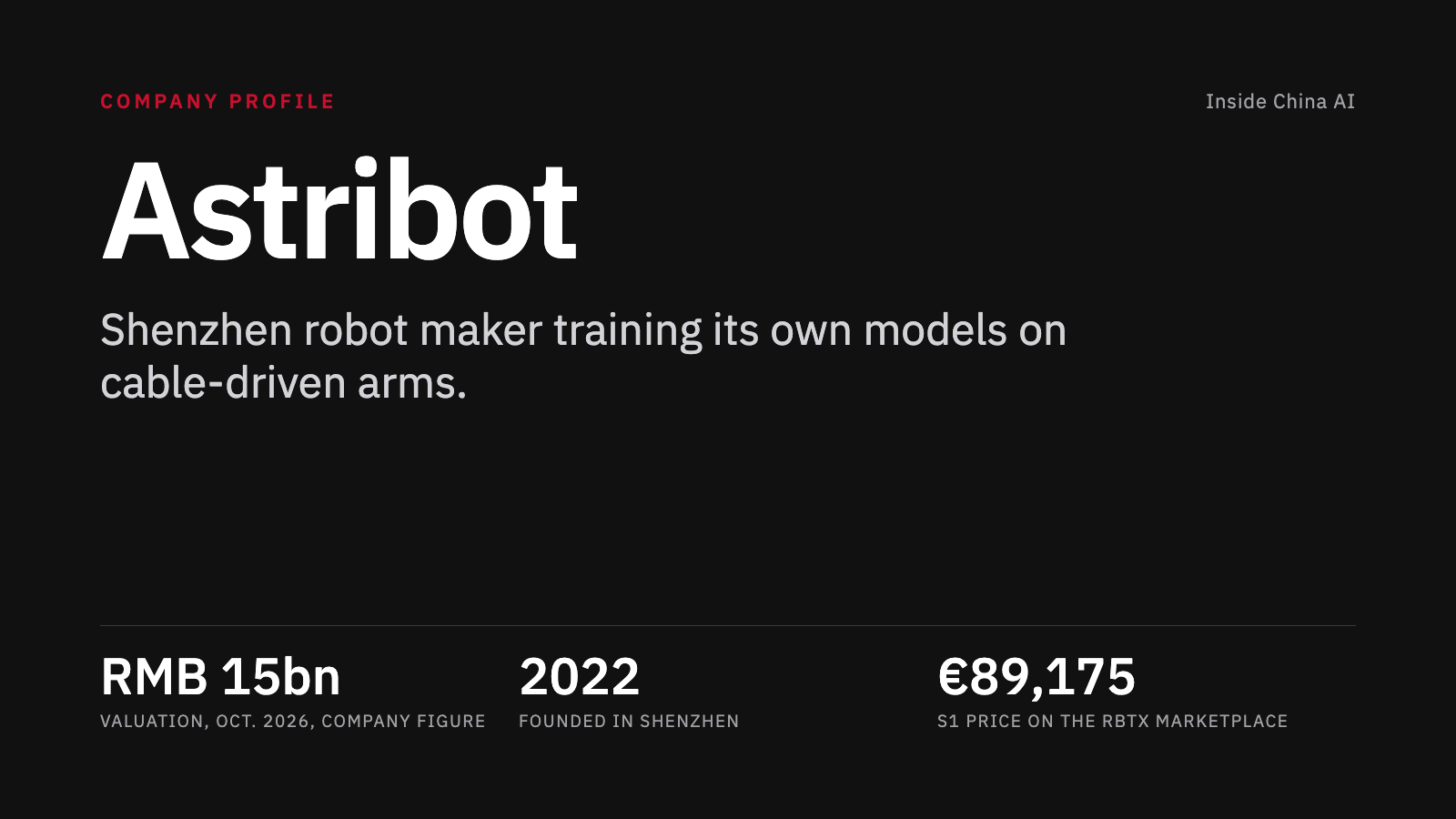
Graphic: Inside China AI
Astribot: The Shenzhen Robot Maker That Trains Its Own Models on Cable-Driven Arms
Company profile · 28 November 2026.
Astribot (星尘智能) is a Shenzhen start-up, founded in December 2022, that builds wheeled two-arm robots driven by cables instead of geared joints, and the AI models that control them. In October 2026 it raised 1 billion yuan at a valuation of 15 billion yuan, the company says, its fourth round since March. In July 2026 it launched Lumo-2, the second generation of its own model for robot control. In Europe, Astribot sells through one named channel: its S1 robot is offered on RBTX, the robotics marketplace of the Cologne-based component maker igus, where Astribot has its own partner page. It also exhibited at a robotics conference in Vienna in June 2026. We found no European company, office or named customer.
Origins and backing
Astribot says it was founded in Shenzhen in December 2022 (Astribot); its website calls the company Astribot Co., Ltd. and gives an address in the Shenzhen Bay Innovation and Technology Center in Nanshan district (Astribot). Its founder and chief executive, Lai Jie, was the first employee and architect of Tencent‘s robotics laboratory and led the team behind Baidu‘s Xiaodu robot, according to the Shanghai-based financial daily Science and Technology Innovation Board Daily (cls.cn) and 36Kr (36Kr). Its co-founder and chief financial officer is Alex Fang (Astribot via PR Newswire).
The money came quickly. In April 2025 Astribot announced that it had completed Series A and A+ rounds of several hundred million yuan, led by Jinqiu Fund and Ant Group; in November 2025 Guoke Investment and Ant Group co-led a Series A++ of several hundred million yuan, with Jinqiu investing again (cls.cn, TMTPost). In June 2026 36Kr reported that a Series B, raised in three rounds within three months, had brought in more than 1 billion yuan at a valuation above 10 billion yuan (36Kr, Caixin).
The latest round followed in October 2026. According to the company, it raised 1 billion yuan at a valuation of 15 billion yuan, its fourth round since March 2026. The lead investor was Shenzhen Toposcend Capital (投控东海), which the company calls an affiliate of Shenzhen Investment Holdings; Hongtai Aplus, the Ninghai Xingtaihe Fund managed by Guanghua Sunshine and Soliton Capital joined, and the existing investor Xianmu invested again (Astribot via PR Newswire, 3 November 2026; Chinese version: PR Newswire). Chinese financial media called it a Series B+ (Science and Technology Innovation Board Daily via Eastmoney, 14 October 2026). The company says the money will go into model development, staff, commercial roll-out and production capacity. It publishes no revenue, profit or delivery totals.
What they build
Astribot calls its approach “Design for AI”: robot body, operating system and models are developed together (Astribot). The company describes a stack of three layers: the cable-driven robot, an embodied operating system called Astribot OS, and its Lumo models (Astribot via PR Newswire). Instead of reducers in every joint, its arms are moved by cables. The company says it is the first and only company to mass-produce cable-driven AI robots, and its CFO estimates that its robots cost about a third of what others in the industry pay to build theirs; neither claim can be checked independently.
- S1, the flagship, is a wheeled robot with a human-like upper body and two arms with seven degrees of freedom each, a payload of 5 kilograms per arm and a stated repeatability of ±0.1 millimetres; the company compares its figures with those of an adult man (Astribot). The robot was shown in videos of household tasks in August 2024 (heise online). The company says the S series began securing orders at the thousand-unit scale in September 2025.
- T1, a lighter model, has been shipping since June 2026 from 89,900 yuan, the company says; it puts the combined production capacity of both series at about 10,000 units (Astribot via PR Newswire). The T1 was first shown in North America at the IROS conference in Pittsburgh at the turn of September and October 2026, with US prices from $18,000 (Robotics & Automation News).
The AI is Astribot’s own, built on open Chinese base models. Lumo-1, described in a paper of 9 December 2025 (arXiv), is a vision-language-action model that links “vision, language, and physical action”. It starts from Alibaba’s open Qwen2.5-VL-7B model, is trained in three stages on vision-language data, robot data from several robot types and data collected on the S1, and is then refined with reinforcement learning (Astribot). Lumo-2, launched in July 2026, is what the company calls a “latent world-action model”: rather than writing out its plans as text, it predicts future physical states in a compact internal representation and derives actions from them, and it can learn from videos of humans as well as from robot data (Astribot, arXiv). Its language-vision part is compared with a 4-billion-parameter Qwen-3.5 base model. Around the models sit research frameworks, each with a paper: Philia, a runtime that lets several robots act as one long-term assistant (Astribot); SmoothRL, an online reinforcement-learning framework released in September 2026 (Astribot); and CoMind, which lets robots share what they see with each other (Astribot). We found no released model weights on Hugging Face and no public code repository under the company’s name.
The company names three groups of users: research and education, commercial services and industry. Since November 2025 it has run its own robot retail kiosks, “Robot MART”, in six Chinese cities including Beijing, Shanghai and Guangzhou, and it works with the amusement-ride maker Jinma Rides, the mobile-robot company SEER Robotics and the software group ThunderSoft, the company says (Astribot via PR Newswire). For 2027 it plans larger deliveries and is exploring AI robots for individual consumers.
Key numbers
- Founded December 2022, Shenzhen; founder and CEO Lai Jie
- Funding 1 billion yuan in October 2026 at a valuation of 15 billion yuan, the fourth round since March 2026, the company says (Astribot via PR Newswire); Series B of more than 1 billion yuan reported in June 2026 (36Kr)
- Investors named Ant Group, Jinqiu Fund, Guoke Investment (2025 rounds); Shenzhen Toposcend Capital, an affiliate of Shenzhen Investment Holdings (lead, October 2026)
- Orders Thousand-unit-scale orders for the S series since September 2025, the company says; no delivery totals published
- Capacity About 10,000 units a year across both series, the company says
- Prices T1 from 89,900 yuan in China; S1 offered at €89,175 excluding VAT and shipping on RBTX, the igus marketplace (RBTX, 28 November 2026)
- AI Own robot models Lumo-1 (December 2025) and Lumo-2 (July 2026), built on open Qwen base models; no open weights found
The European angle
- Sales channel The S1 is listed on RBTX, the online marketplace for low-cost robotics run by igus of Cologne, at €89,175 excluding VAT and shipping, with a stated usual delivery time of three weeks, and Astribot has its own partner page there (RBTX, both checked on 28 November 2026). igus is a sales channel here, not a customer. Neither page says whether igus is an authorised distributor; we found no other European dealer.
- Trade fairs Astribot exhibited at ICRA 2026, the IEEE’s large robotics conference, in Vienna from 1 to 5 June 2026, at booth 049 (ICRA 2026).
- Physical presence None found: no European company, office, service centre or plant. The website lists only the Shenzhen headquarters.
- Customers We found no named European customer, neither a company nor a university.
- Data The website’s privacy policy, last updated on 20 July 2026, says: “Personal information collected and generated by us within the People’s Republic of China will be stored within the People’s Republic of China.” It does not mention the GDPR (Astribot).
- Regulatory exposure Astribot is not on the US Entity List, the Treasury’s list of Chinese military-industrial complex companies, the Pentagon’s 1260H list or the EU’s consolidated sanctions list, according to our check of the published lists on 28 November 2026.
- What a European buyer would actually encounter A research and service robot that can be ordered through a German marketplace, controlled by models its maker trains itself — and a manufacturer for which we found no European company or service centre.
What we could not verify
- Deliveries, revenue and profit. The company speaks of thousand-unit orders and progress on hardware margins but publishes no figures.
- The sequence of 2026 rounds. The company counts four rounds since March 2026; amounts are public only for the June Series B and the October round, and Chinese media label the rounds differently.
- Whether igus sells the S1 under an agreement with Astribot, and whether any robot has been delivered to a European buyer.
- CE marking and EU declarations of conformity for the S1 and T1.
- The company’s cost and durability claims, including a third-party life test of more than six years cited by its CFO.
The open question for Europe: will a robot maker that builds its own hardware, operating system and models move beyond a catalogue listing and a conference booth — and who in Europe would service its robots?

Comments are closed