Graphic: Inside China AI
Robotera: Tsinghua’s Humanoid Spin-off Puts Robots Into China’s Parcel Centres
Company profile · 28 November 2026.
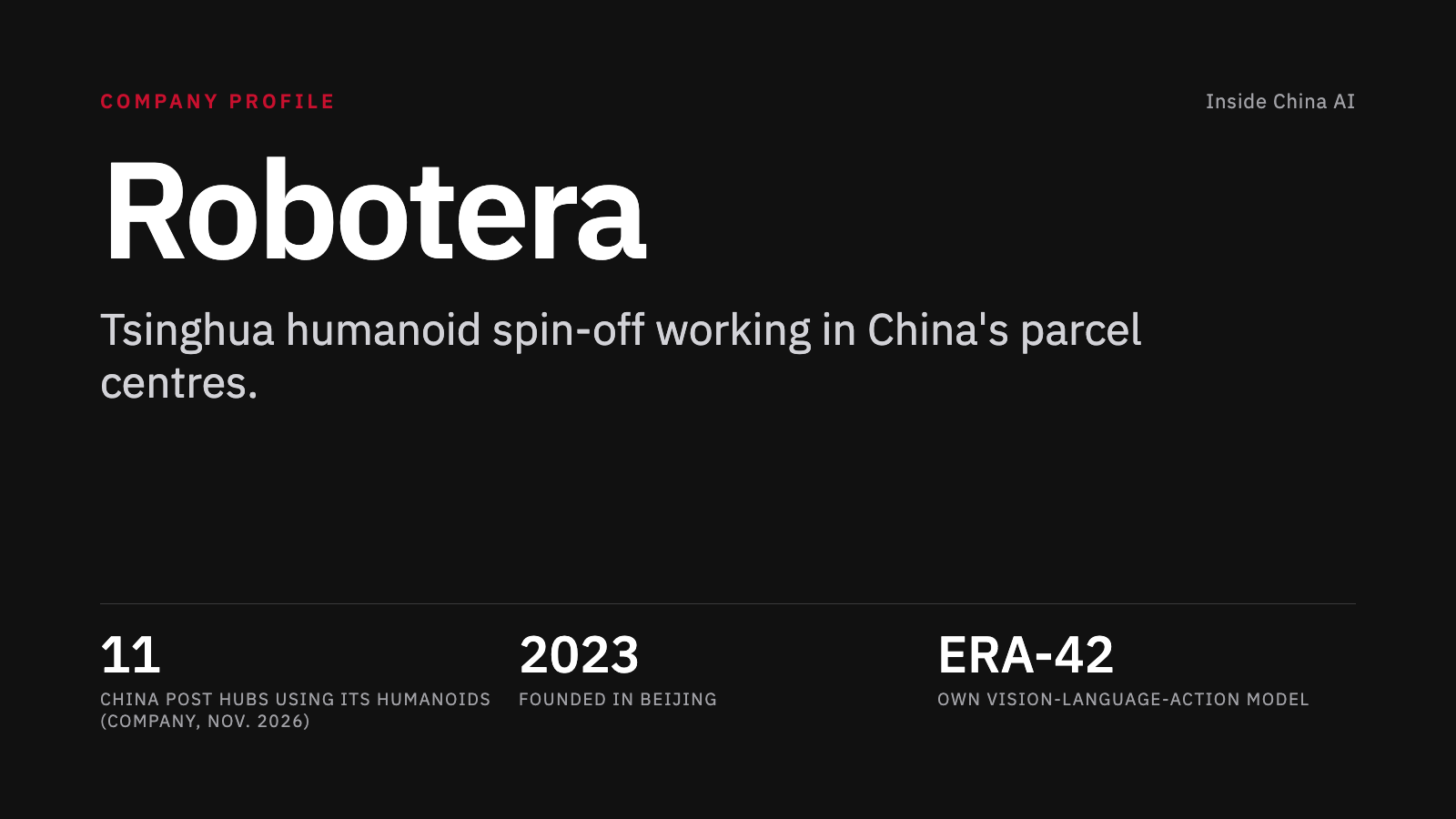
Robotera — 星动纪元 — is a Beijing robot maker founded in August 2023 by a Tsinghua University professor, and the only embodied-AI company in which Tsinghua holds a stake, the company says. It builds full-size humanoids, a wheeled service robot and direct-drive robot hands, trains its own robot-control models, and has raised several billion yuan since November 2025 from carmakers, logistics groups and state funds. Its most visible commercial use so far is Chinese logistics: the company says its robots sort parcels in more than ten logistics centres with China Post and SF Express. For Europe, Robotera matters mainly as a supplier of research hardware and models — its dexterous hand is sold through a European online retailer and its code is public — while its European footprint remains thin: a booth at a robotics conference in Vienna, no named European customer and no company of its own.
Origins and backing
Robotera was founded in August 2023 and describes itself as “the only embodied intelligence company backed by Tsinghua University”; the Chinese version of its website says Tsinghua holds shares (Robotera). The business magazine 36Kr reported on 6 July 2026 that the company was set up under Tsinghua’s technology-transfer policy and is the only embodied-AI company in which the university holds a direct stake (36Kr). The legal entity is Beijing Xingdongjiyuan Technology Co., Ltd. (Robotera release, 17 November 2026), based in Tsinghua Science Park in Beijing’s Haidian district (Robotera).
The founder and chief executive, Chen Jianyu, did his PhD at the University of California, Berkeley, is a tenured associate professor at Tsinghua’s Institute for Interdisciplinary Information Sciences and runs its Intelligent Systems and Robotics Laboratory (Tsinghua IIIS). Before Robotera, the company says, he worked on autonomous driving at Waymo and Denso (Robotera). The company names Yue Xi as co-founder (Robotera release, 19 November 2026).
The early money came from industry. According to the company’s own milestone list, Lenovo and Century Golden Resources backed the angel round in 2023, Alibaba, Clearvue Partners and Yuanjing Capital the pre-A round in October 2024, and Haier and CDH a Series A of nearly 500 million yuan in July 2025 (Robotera). Since then the rounds have grown quickly:
- a Series A+ of nearly 1 billion yuan, completed on 20 November 2025 and led by Geely Capital with BAIC Capital (Robotera release, 27 November 2025);
- a strategic round of 1 billion yuan which, the company says, pushed its valuation past 10 billion yuan, with Singtel Innov8 and Korea’s Woori Venture Partners among the new investors and Tsinghua Holding Tiancheng adding to its stake (Robotera release, 23 March 2026; Caixin);
- more than $200 million led by SF Group, with HSG, IDG Capital, Hillhouse, CICC Capital, Dongfeng Asset Investment and funds affiliated with China Unicom (Caixin, 27 April 2026; Robotera release, 8 May 2026);
- a further 1 billion yuan announced on 6 July 2026, led by a fund of China Chengtong, a state capital operator under the central government’s asset regulator, with several provincial and municipal state investors (36Kr; Science and Technology Innovation Board Daily, 7 July 2026). The company has not announced this round in its English releases.
The company has not published a valuation since March 2026, nor revenue or profit figures.
What they build
Robotera calls its approach full-stack: hardware and software developed in-house. The company says more than 95 per cent of core components are its own (Robotera release, 8 May 2026). The range:
- L7, a full-size bipedal humanoid launched in July 2025: 1.71 metres, 55 degrees of freedom including the hand, 20 kilograms dual-arm payload, with an x86 computer plus an NVIDIA Orin module (Robotera); the company says it also comes in an upper-body configuration (Robotera release, 8 January 2026). The upper-body humanoid M7 is the model the company shows sorting parcels (Robotera release, 19 November 2026).
- Q5, a wheeled service humanoid launched in June 2025, with 44 degrees of freedom according to the company (Robotera release, 8 January 2026), which the company pitches for education, customer service and shopping-centre guidance (Robotera).
- XHAND, a family of five-finger hands. The XHAND 1, released in August 2024, is fully direct-drive with 12 active degrees of freedom and tactile sensors in the fingertips (Robotera). The company says it shipped more than 1,000 hands in 2025, half of them abroad (Robotera release, 23 March 2026). On 16 November 2026 it launched the XHAND 1 Pro-U, whose 16-degree-of-freedom design follows the DexUMI exoskeleton of NVIDIA’s GEAR Lab; the company says the hand featured in a GR00T 2 demonstration at the Conference on Robot Learning, and offered a first batch of 40 units (Robotera release, 16 November 2026).
The AI side is research-heavy. Robotera presents ERA-42 as a single vision-language-action model that works across robot bodies and drives the L7’s full 55 degrees of freedom (Robotera). Behind it sits a line of papers from Chen’s group and the company, among them Video Prediction Policy (ICML 2025) and the world model Ctrl-World (October 2025). We found no public weights for ERA-42 itself. What is public sits in the company’s GitHub account: Humanoid-Gym, a reinforcement-learning framework for humanoid walking with more than 2,100 stars, the code of Video Prediction Policy and its successor VPP2, and a baseline for collecting data and training models on the M7 (GitHub, as of 28 November 2026). The company says VPP2 ranked first on RoboDojo, a manipulation benchmark run by the University of Hong Kong’s MMLab, with an average success rate of 32.26 per cent (Robotera release, 9 October 2026).
Commercially, the company points to logistics. It says its robots have worked at China Post’s Guangzhou Postal District Center since a pilot began in March 2026 and now operate in 11 postal hubs in eight cities in Guangdong, inducting more than 1,500 parcels an hour on average (Robotera release, 17 November 2026). Together with SF Express, the company says, it developed a cross-border logistics inspection solution that is deployed at customs, with single orders above 50 million yuan (Robotera release, 23 March 2026). We found no statement from China Post or SF that confirms these figures.
Key numbers
- Founded August 2023, Beijing; founder and CEO Chen Jianyu
- Funding Series A+ of nearly 1 billion yuan (November 2025), 1 billion yuan (March 2026), more than $200 million (April 2026), 1 billion yuan (July 2026, 36Kr)
- Valuation Above 10 billion yuan after the March 2026 round, the company says (Robotera)
- Orders Cumulative orders above 500 million yuan by March 2026, half from international clients, the company says (Robotera)
- Deliveries More than 600 units in total by January 2026 (Robotera); “thousand-unit deliveries” started in the second quarter of 2026 (Robotera); not independently verified
- AI ERA-42 vision-language-action model; open code for Humanoid-Gym, VPP and VPP2
- Revenue and profit Not published
The European angle
- Trade fairs Robotera exhibited at ICRA 2026, the robotics conference held in Vienna from 1 to 5 June 2026, at booth 118 (ICRA 2026 hall plan).
- Named users None confirmed. Extend Robotics, a teleoperation company based in Reading, England (Extend Robotics), lists the XHAND 1 as a supported hand for its control system (Extend Robotics user guide); this documents compatibility, not a purchase.
- Sales channel The EU storefront of the robotics retailer RobotShop lists the XHAND 1 at €16,500 as a special order (RobotShop, as of 28 November 2026). Robotera names no authorised European distributor.
- Physical presence None found: no European company, office, service centre or plant.
- Data The privacy policy on Robotera’s website does not mention the GDPR (Robotera).
- Regulatory exposure Robotera is not on the US Entity List, the Treasury’s list of Chinese military-industrial complex companies, the Pentagon’s 1260H list, the FCC Covered List or the EU’s consolidated sanctions list, according to our check of the published lists on 28 November 2026. Its investors include Chinese state funds and the investment arms of the carmakers Geely, BAIC and Dongfeng. The L7 uses an NVIDIA Orin module.
- What a European buyer would actually encounter A dexterous hand and open research code already used in labs, a humanoid range built for Chinese logistics — and a manufacturer that so far deals with Europe from Beijing.
What we could not verify
- The customer claims. Robotera says nine of the world’s ten largest listed tech companies are clients (March 2026); its website says all of the top five by market value (Robotera). It does not name them.
- Deployment figures for China Post and SF, which come only from Robotera.
- CE marking and EU declarations of conformity for the L7, Q5, M7 and XHAND.
- The valuation after the April and July 2026 rounds, and any revenue.
The open question for Europe: will a company whose hands and models are already in research labs bring its parcel-sorting humanoids to European logistics — and will it set up here to do so?

Comments are closed