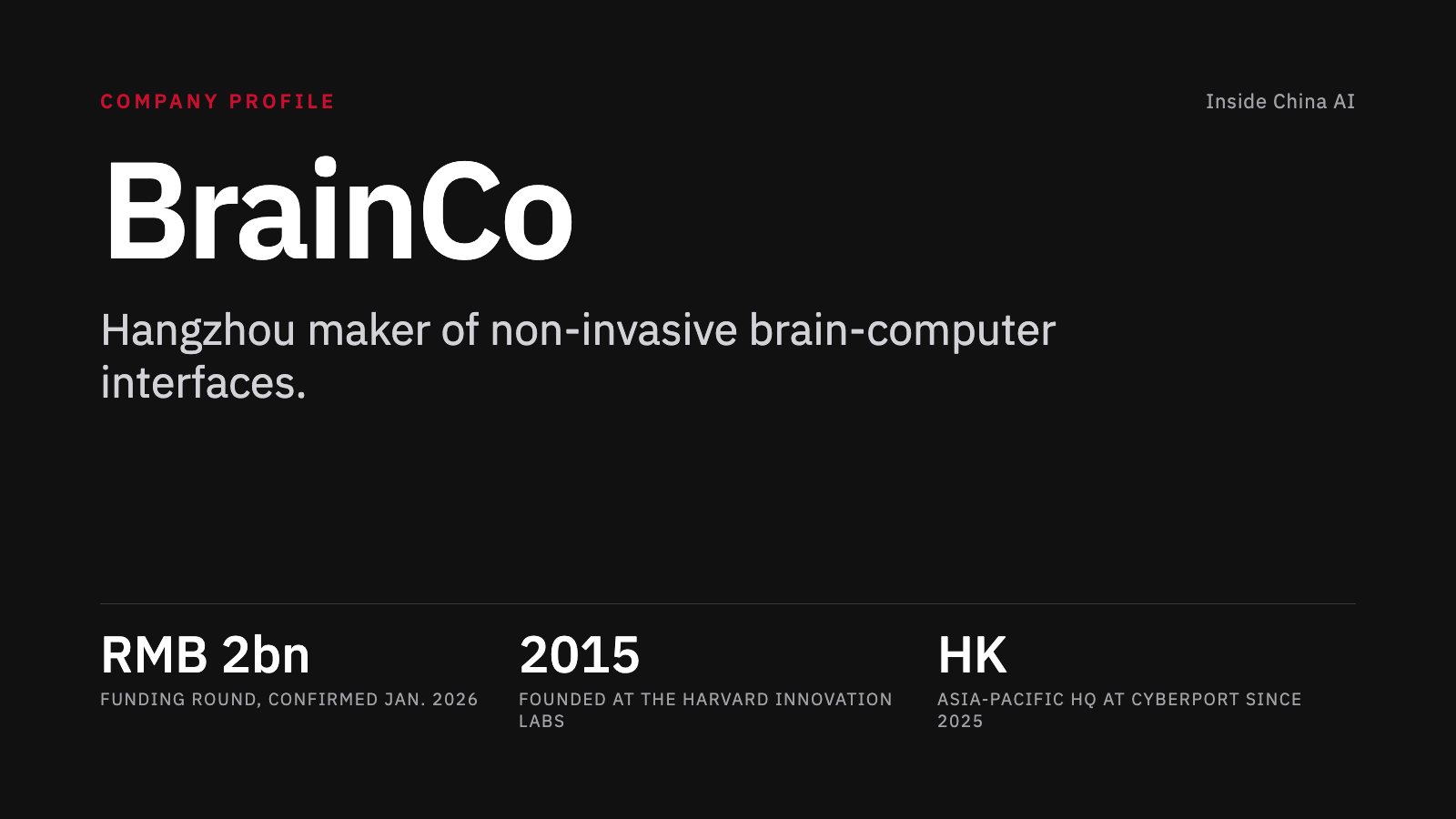
Graphic: Inside China AI
BrainCo: A Hangzhou Maker of Non-Invasive Brain-Computer Interfaces, From Prosthetic Hands to Robot Hands
Company profile · 28 November 2026.
BrainCo (强脑科技) builds brain-computer interfaces that are worn rather than implanted: EEG headbands for focus and sleep, prosthetic hands and legs controlled through muscle and nerve signals, and, increasingly, dexterous hands for humanoid robots. The company started at Harvard in 2015, moved its operating base to Hangzhou in 2018 and is now “one of China’s most active players in brain-computer interface technology”, a field that Chinese policymakers have singled out as strategically important (China Daily). For Europe, BrainCo matters for two reasons: its robot hands are becoming a component supplier for the humanoid industry, and its consumer devices handle neural data, which has already drawn scrutiny from US lawmakers. In Europe itself, we found little more than a trade-fair appearance.
Origins and backing
BrainCo was founded in 2015 and “born out of the Harvard Innovation Labs”, according to CNBC and China Daily. Its founder and chief executive is Han Bicheng (韩璧丞), as a Hong Kong Polytechnic University press release of 30 September 2025 states. In 2018 Han accepted an invitation from the Hangzhou city government and moved the core team back to China, CCTV reported in May 2025. The operating company is Zhejiang Qiangnao Technology Co., Ltd (浙江强脑科技有限公司) in Hangzhou’s Yuhang district, which is the applicant on the company’s US medical-device clearance (FDA database).
The English website still presents a US face: BrainCo “thrives in the Greater Boston area”, the company says, and its contact page gives an office in Somerville, Massachusetts. On 28 September 2025 BrainCo opened an Asia-Pacific headquarters and research centre at Hong Kong’s Cyberport (The Standard); on 30 September it signed a memorandum with PolyU on a joint brain-computer interface research centre (PolyU). The company does not publish how the Chinese, US and Hong Kong entities are connected.
In January 2026 the company confirmed to China Daily that it had completed a private funding round of about 2 billion yuan ($280 million), led by IDG Capital and Walden International, with Lens Technology and Will Semiconductor as strategic investors; CNBC reported the same lead investors. BrainCo calls itself a “unicorn” on its website but has not published a valuation, its revenue or its shareholder structure. It is counted among Hangzhou’s “six little dragons”, a group of prominent local technology start-ups (CNBC).
What they build
BrainCo works only with non-invasive technology: sensors on the scalp or skin rather than implants. Its Chinese website groups the business into rehabilitation, health, education and embodied intelligence.
- Prosthetics. The best-known product is a bionic prosthetic hand that, the company says, integrates brain-computer interface technology and “AI algorithms”, alongside a prosthetic knee whose control algorithms come from its interface research. The hand was cleared by the US Food and Drug Administration on 9 September 2022 as the “Dexus Prosthetics System” through the 510(k) route, under the device classification “Electrode, Cutaneous” (FDA database). BrainCo has fitted more than 10,000 people with disabilities with bionic prostheses, Guangming Online reported on 2 November 2026, when the prosthetic-hand project received a “Leading Technology Award” at the World Internet Conference in Wuzhen.
- Wellness and education wearables. On its English site BrainCo sells OxyZen (meditation and sleep), Easleep (“Brain-Machine interface sleep device”) and FocusCalm, an “EEG wearable and neurofeedback solution for athletes, wellness seekers and stressed employees”. In China it also offers attention and social-communication training systems for schools and children with autism.
- Robot hands. Revo 2, launched on 16 September 2025, is a dexterous hand for humanoid robots weighing 383 grams with 50 newtons of grip force, the company says (press release). Revo 3 is described on the company’s website as a “21-DoF dexterous hand with full-palm tactile and visuotactile sensing, built on an open ecosystem”.
- Brain-controlled robots. At the World Artificial Intelligence Conference in Shanghai in July 2026, BrainCo showed a platform that lets a user direct a robot with EEG signals, which it calls “neuro-embodied AI”; the whole process takes under 200 milliseconds, according to the company (The Robot Report).
The AI in BrainCo’s products is signal decoding: algorithms that translate EEG and muscle signals into scores or movements. We found no foundation model of its own. A senior executive told CNBC in July 2026 that licensing the platform to other companies is expected to become the largest source of revenue.
Key numbers
- Founded 2015 at the Harvard Innovation Labs; operating base in Hangzhou since 2018
- Legal entity in China Zhejiang Qiangnao Technology Co., Ltd (Hangzhou); office in Somerville, Massachusetts; Asia-Pacific headquarters at Hong Kong Cyberport since September 2025
- Founder and CEO Han Bicheng
- Latest funding about 2 billion yuan ($280 million), confirmed January 2026; led by IDG Capital and Walden International
- Listing private; no prospectus published as of 27 November 2026
- Regulatory US FDA 510(k) clearance for the prosthetic hand, 9 September 2022
- Users more than 10,000 people fitted with bionic prostheses (Guangming Online, 2 November 2026)
- Revenue not disclosed
The European angle
- Physical presence None found. BrainCo’s websites name offices in Hangzhou, Somerville and Hong Kong, but no European company, office or plant.
- Trade fairs BrainCo showed its prosthetic hand and its industrial dexterous hand at MWC Barcelona from 3 to 6 March 2025, the company says (press release). The release names booth visitors, not partners.
- Certification A Hangzhou city government news portal wrote in January 2026 that BrainCo’s products have received EU CE certification (ehangzhou.gov.cn). It does not say which products, and we could not find the certificate.
- Sales We found no European customer, clinic or distributor named by BrainCo. Revo hands appear in the catalogues of European online robotics shops, but BrainCo does not list them as partners.
- Neural data On 25 September 2025 the chair of the US House Energy and Commerce Committee and two of its subcommittee chairs asked the US Attorney General, the Federal Trade Commission and the Commerce Department to investigate “the potential national and economic security risks” posed by BrainCo’s US operations and its access to Americans’ personal information (committee press release). BrainCo says in an official statement that none of its products “transmit any raw biometric data from users (including athletes) to our servers” and that it does not provide user data “to any government, of any country”. Its FocusCalm privacy policy says computed meditation scores and training history are transmitted, and that profile data such as date of birth and email address is stored in BrainCo’s cloud servers.
- Lists BrainCo, Zhejiang Qiangnao Technology and 强脑科技 do not appear on the EU’s consolidated financial sanctions list, the US Consolidated Screening List (including the Entity List) or the US Defense Department’s 1260H list (our check of 27 November 2026).
- Policy context The Berlin-based Mercator Institute for China Studies names BrainCo among the “major beneficiaries” of China’s state support for brain-computer interfaces (MERICS, 3 June 2026).
- What a European buyer would actually encounter Most likely a Revo robot hand bought through a robotics reseller, or a BrainCo wearable ordered online, rather than the prosthetics on which the company has built its reputation in China.
What we could not verify
- A stock-market listing. Securities Times wrote on 10 May 2026 that BrainCo had reached “the door of the capital markets” (走到了资本市场门前); no prospectus has been published.
- Valuation, revenue and shareholders. BrainCo publishes none of them.
- CE marking and EU medical-device status of the prosthetic hand and leg.
- Any European customers, distributors or clinical partners.
- The outcome of the US House committee’s request of September 2025.
- How the Hangzhou, Somerville and Hong Kong entities are owned and connected.
The open question for Europe: will BrainCo’s first real foothold here be a medical device for patients, or a component inside someone else’s robot?

Comments are closed