Graphic: Inside China AI
PPIO: The Shanghai Cloud Serving China’s Open Models, With Compute Nodes in Britain, Iceland and Portugal
Company profile · 28 November 2026.
PPIO (派欧云) does not build AI models. It runs them. The Shanghai company rents scattered computing capacity, turns it into a cloud, and sells access to open models such as DeepSeek, Kimi, GLM and MiniMax through one API, plus sandboxes in which AI agents can execute code. Its Hong Kong listing application, filed on 10 June 2026 and still a draft, shows a fast-growing but loss-making business — and leased AI compute nodes in the United Kingdom, Iceland and Portugal. For Europe, PPIO is less a model maker to evaluate than a piece of plumbing to understand: an infrastructure layer through which Chinese open models reach developers, including outside China.
Origins and backing
PPIO was founded in Shanghai in May 2018 by Yao Xin and Wang Wenyu, who had built the video-streaming platform PPTV together (listing application, history section; directors section). Yao is chairman and chief executive, Wang is chief technology officer (PPIO). The operating company is 派欧云计算(上海)有限公司. The group that wants to list is PPLabs Technology Limited, a Cayman Islands holding company incorporated on 6 May 2019, which controls the Shanghai operating company through contractual arrangements rather than direct ownership — the structure often called a VIE (listing application, summary).
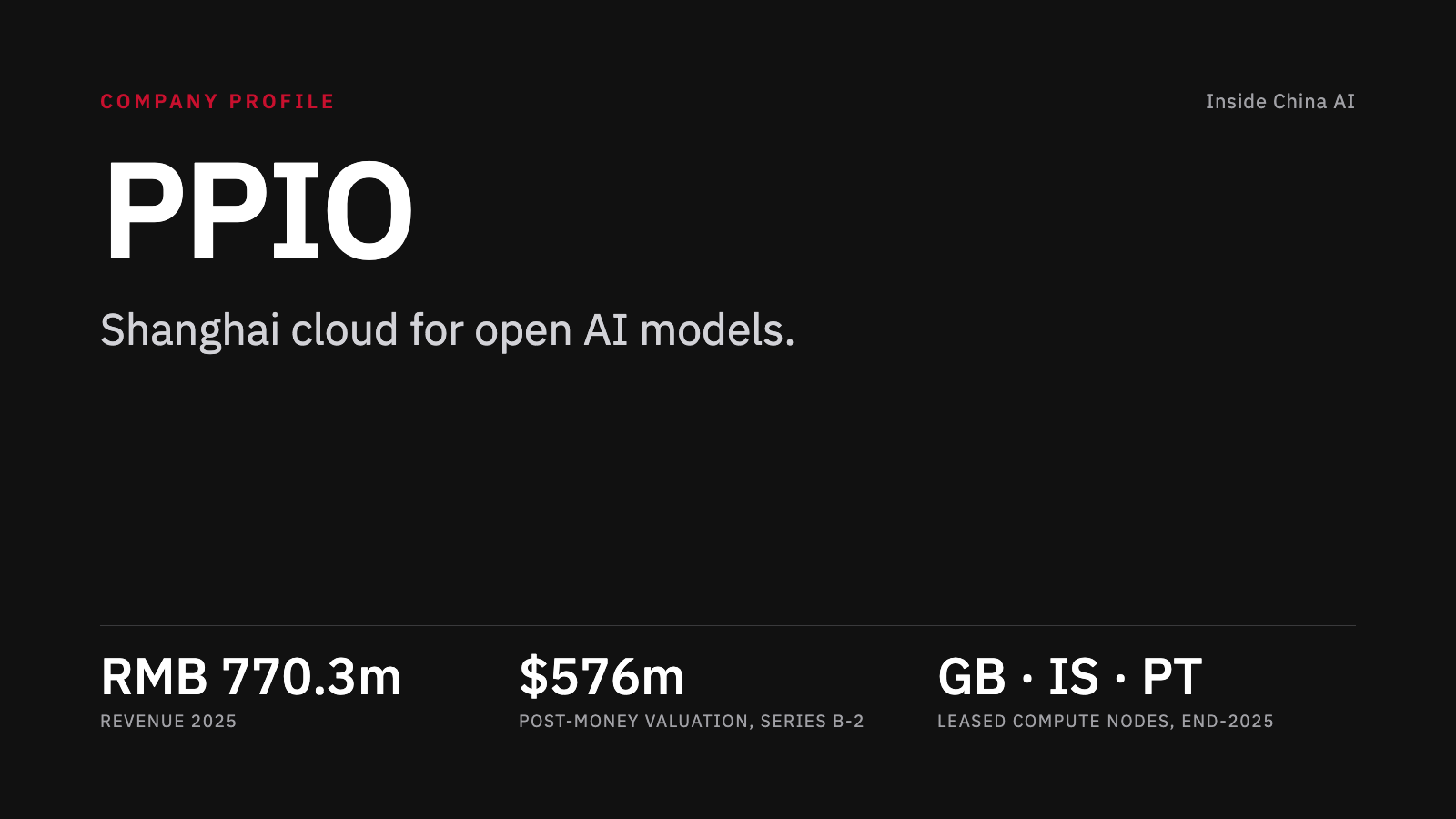
Yao Xin belongs to a group of controlling shareholders that, through four offshore holding companies, holds about 48% of the voting rights (listing application, controlling shareholders). The company names Lanchi Ventures, CCV Capital, Hua Capital, Panlin Capital and AlphaX Partners as investors in its 2021 Series A, and Harvest Oriental and LCV Pathfinder in its Series B of April 2025, which valued it at about $469 million after the money. A first tranche of a Series B-2 round brought in $35.2 million on 3 June 2026 (summary), at a post-money valuation of about $576 million (history section).
On 10 June 2026 PPLabs applied to list on the Main Board of the Hong Kong exchange, with ICBC International and Shenwan Hongyuan as joint sponsors. As of 27 November 2026 the application was still listed as active, with no post-hearing information pack published (HKEXnews). The application proof is a draft, marked by the company as “incomplete and subject to change”; all figures from it in this profile may change.
What they build
PPIO started with edge computing: it aggregates idle or under-used servers from third parties and uses them for content delivery and video processing close to users. In 2023 it added AI cloud services (summary). Substantially all its compute nodes are leased rather than owned, the company says (listing application, business section).
The AI business has three layers. At the bottom is GPU capacity. In the middle is a model API: direct access to open models, and hosting for customers who bring their own. PPIO’s homepage advertises one interface to DeepSeek, Kimi, GLM, MiniMax and other Chinese models, with stability of “up to 99.9%” (PPIO). The company says its own inference optimisation makes hosted models faster than a standard deployment; in one 2026 test of an unnamed “well-known large model” it claims 95% lower first-token latency than the SGLang inference engine (summary). On top sits what PPIO calls “agentic infra”: an agent sandbox launched in July 2025, a secure environment in which AI-generated code runs in isolation, and hosting consoles for agents called PPClaw and PPHermes (PPIO). Its homepage now describes PPIO as an “Agentic Cloud” provider; its GPU cloud service, including GPU container instances, is marked as “coming offline soon”.
The company says it ranked first among third-party providers of open-source models on OpenRouter in January 2026, and first on Hugging Face by monthly inference requests in December 2025 (business section). The application does not say under which brand those services were offered.
The numbers in the application describe rapid growth and continuing losses. Revenue rose from RMB 358.4 million in 2023 to RMB 770.3 million in 2025. The AI cloud business grew from RMB 10.4 million in 2024 to RMB 119.2 million in 2025, but still made a gross loss; edge cloud still brought in 84.5% of revenue. The largest customer accounted for 30.0% of 2025 revenue and the five largest for 79.0%; the application does not name them (summary). Average daily token consumption rose from 271 billion in December 2025 to 1,028 billion in April 2026, and the company expects another net loss for 2026.
Key numbers
- Founded May 2018, Shanghai, by Yao Xin (chairman, CEO) and Wang Wenyu (CTO)
- Revenue RMB 358.4m (2023), RMB 558.0m (2024), RMB 770.3m (2025); AI cloud RMB 119.2m in 2025 (summary)
- Result Loss of RMB 222.9m in 2025; adjusted net loss (company measure) RMB 104.6m; gross margin 9.4%
- Funding Latest round: first tranche of Series B-2, $35.2m on 3 June 2026 (summary), post-money valuation about $576m (history section)
- Listing Hong Kong Main Board application filed 10 June 2026 (draft application proof); still active, no hearing pack published as of 27 November 2026 (HKEXnews)
- Network More than 4,600 compute nodes in over 1,340 cities and counties (31 December 2025); 64 AI compute nodes at the end of 2025 and 77 on 30 April 2026 (business section)
- Usage 1,028 billion tokens a day (April 2026); more than 574,000 registered developers (30 April 2026); the company’s website now says more than 670,000 (PPIO)
- Staff 275 full-time employees (31 December 2025)
The European angle
- Compute in Europe At the end of 2025, two of PPIO’s AI compute nodes were in the United Kingdom and one each in Iceland and Portugal; 26 were in China and eight in the United States (business section). The application says substantially all of PPIO’s compute nodes are leased; it names neither the operators of the European sites nor the customers using them. In May 2025 the company said it had built “core nodes” in Europe and planned more in the Nordic countries (PPIO blog).
- Not a focus region The application lists North America, Southeast Asia and Japan as the regions where PPIO is expanding its AI compute. Europe is not among them, although the company’s website says its business covers “North America, Southeast Asia, Europe” and other overseas markets (PPIO).
- Who runs the overseas business PPIO launched an overseas platform in 2024. Its overseas AI cloud subsidiaries are in Singapore (incorporated January 2024) and the United States (November 2024); Hong Kong serves as the bridge for overseas business. The application lists no European subsidiary or office (history section).
- Data The company states that its domestic and overseas systems run on separate servers “with no data exchange between them”, and that data received in mainland China stays there. For overseas data-protection law, the application sets out legal advice on the United States and Singapore, under a heading on its “key overseas markets” (business section).
- Customers and partners We found no named European customer or partner.
- Lists PPIO, its Chinese name and its listing vehicle PPLabs are not on the EU’s consolidated financial sanctions list, the US Consolidated Screening List (which includes the Entity List) or the Pentagon’s 1260H list, according to our name check of the published lists on 27 November 2026. In its application the company names US chip export controls and the US rules on outbound investment in Chinese AI as risks (risk factors).
- What a European developer would actually encounter A low-cost route to Chinese open models and agent sandboxes, run by a company whose overseas entities sit in Singapore, the US and Hong Kong, on a network that already includes a few leased nodes in Europe.
What we could not verify
- The brand and contracting entity of PPIO’s international platform. The application does not name it, and we found no primary source linking PPIO to any other brand.
- Who uses the European nodes, and which data-centre operators host them.
- Figures after April 2026. PPIO is not listed and publishes no quarterly results.
- The identity of its largest customers, which the application anonymises.
The open question for Europe: will PPIO’s few leased nodes in Britain, Iceland and Portugal grow into a European region with its own entity — or stay a by-product of a network built for China, North America and Asia?

Comments are closed