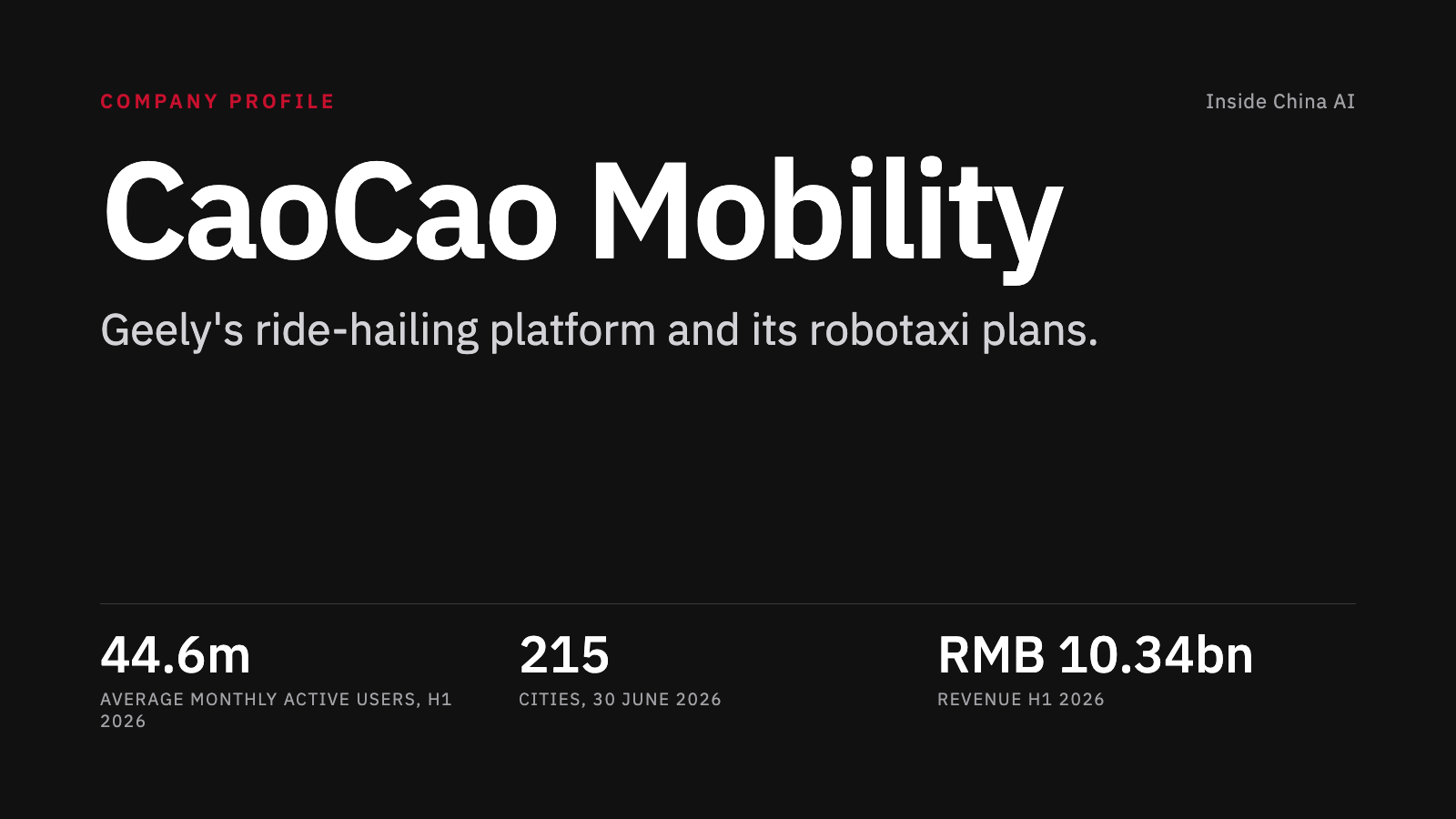
Graphic: Inside China AI
CaoCao Mobility: Geely’s Ride-Hailing Platform and Its Robotaxi Plans
Company profile · 28 November 2026.
CaoCao Mobility (曹操出行) is the ride-hailing platform of the Geely group, with an average of 44.6 million monthly active users in the first half of 2026 and a company plan for a cumulative 100,000 robotaxis by 2030. In June 2026 it agreed with the US autonomous-driving company May Mobility to “advance pilot programs in key markets including Europe”. For now that is a declared intention and the whole of its European story: no European company, office or employee, and no named country or pilot city. The company says it will own and operate the fleets; the driving software in Europe would come from its partner.
Origins and backing
CaoCao was established on 21 May 2015 as “a strategic initiative under the Geely Holding Group” (CaoCao), and describes itself in its latest results as “a ride hailing platform in China originally incubated by Geely Group” (HKEX interim results, 27 August 2026). The listed holding company, CaoCao Inc., is incorporated in the Cayman Islands and has traded on the Hong Kong main board under the code 2643 since 25 June 2025. The business in China runs through the onshore operating company Hangzhou Youxing Technology, established on 21 May 2015, which the listed company consolidates through contractual arrangements held by a wholly owned subsidiary in Suzhou; Geely Holding is a registered shareholder of the operating company (HKEX interim results). The investor-relations address is in Suzhou (CaoCao); the company’s press releases are datelined Hangzhou.
According to the same filing, the “ultimate controlling shareholder” is Li Shufu, whom it calls the founder of the group and who directly owns 82.23 per cent of Geely Holding. The chairman, Yang Jian, has been vice chairman of Geely Holding since December 2012; the chief executive, Gong Xin, previously held management roles at DiDi and Ant Group (CaoCao board page). Geely Holding also stands behind its financing. Asset-backed securities and some borrowings are guaranteed by Zhejiang Geely Holding Group, and the interim accounts note a total deficit of about RMB 4.16 billion at 30 June 2026 and current liabilities that exceed current assets by about RMB 3.79 billion. The accounts state that these circumstances “may cast significant doubt” on the group’s “capability of continuing as a going concern”. The directors nevertheless prepared them on a going-concern basis, citing among other things a related party’s confirmation of its “intention to provide financial support when needed” (HKEX interim results).
The Hong Kong listing raised net proceeds of about HK$1.72 billion, of which roughly 17 per cent is earmarked for technology and autonomous driving; a placing of 12 million shares at HK$32.46 on 4 February 2026 added about HK$383 million (HKEX interim results).
What they build
Ride-hailing first. Most of CaoCao’s revenue comes from mobility services, chiefly ride-hailing; it also sells vehicles to car partners, fleet operators and drivers. Its fleet is built around what it calls “purpose-built vehicles” from Geely brands, such as the Geely CaoCao 60, launched in 2023, which “served the Hangzhou Asian Games” (CaoCao). At 30 June 2026 its services covered 215 cities (HKEX interim results).
AI in operations. CaoCao does not publish an AI model of its own. Its AI sits in operations: the transaction engine “CaoCao Brain” has “continuously optimized its algorithms using AI technologies”, improving driver dispatch and the allocation of user subsidies, according to the interim report. On its website the company says the system increased gross transaction value by 14.9 per cent in its first year of operation, without naming the year (CaoCao). It is also connecting its service to AI assistants: on 9 September 2026 it launched an AI ride-hailing service with the Doubao assistant in Beijing, Hangzhou and Suzhou (CaoCao), and on 25 June 2026 it announced a partnership to set up an AI innovation centre with the Shanghai Artificial Intelligence Laboratory (CaoCao).
RoboX and robotaxis. On 18 June 2026 CaoCao announced a “full AI transformation” under the name RoboX and called itself “the most important commercial vehicle for RoboX under Geely Holding Group”. Its “Dual 100,000 Plan” aims for a cumulative 100,000 robotaxis and 100,000 robotic delivery vans (Robovans) by 2030; a software layer called CaoCao Robo OS is meant to link AI agents with vehicles (CaoCao). These are company targets. The current fleet is much smaller: 140 second-generation robotaxis “pre-installed with Geely’s most advanced autonomous driving components” at 30 June 2026 (HKEX interim results). On 27 July 2026 CaoCao started testing without a safety driver behind the wheel in Hangzhou’s Binjiang district, where, the company says, it runs around 100 robotaxis (CaoCao).
The next vehicle is Eva Cab, a purpose-built robotaxi with a “steering-wheel-free design” (CaoCao), shown at the Beijing auto show in April 2026 and scheduled for mass production in 2027. According to CaoCao’s announcement of 21 April 2026, it is built on Geely’s L4 architecture and integrates Geely’s “WAM world action model” (CaoCao) — the model Geely also cites for the assistant in Zeekr‘s cars (our Zeekr profile). On this account the driving technology comes from Geely, while CaoCao runs the fleet and the platform.
Key numbers
- Listing CaoCao Inc., Hong Kong (2643), since 25 June 2025; controlling shareholder Li Shufu
- Revenue RMB 10.34 billion in H1 2026 (+9.0%); gross margin 9.0%
- Net loss RMB 379.8 million in H1 2026 (H1 2025: RMB 460.3 million)
- Gross transaction value RMB 12.4 billion in H1 2026 (+13.6%)
- Users and drivers 44.6 million average monthly active users, 758,000 monthly active drivers (H1 2026)
- Coverage 215 cities at 30 June 2026
- Robotaxis 140 second-generation vehicles at 30 June 2026; target of a cumulative 100,000 by 2030 (company plan)
- R&D spending RMB 104.8 million in H1 2026
- Staff 1,221 full-time employees at 30 June 2026
All figures: HKEX interim results, 27 August 2026. CaoCao reports half-yearly; no third-quarter figures were published.
The European angle
- Physical presence None found. The interim report says all 1,221 employees are based in mainland China except eight in Hong Kong and one in Abu Dhabi (HKEX). We found no European subsidiary, office or licence.
- The May Mobility agreement In a release dated 25 June 2026, CaoCao said it would “conduct joint feasibility studies and commercial exploration of Robotaxi deployment, and advance pilot programs in key markets including Europe” with May Mobility, a US autonomous-driving company. CaoCao would act as “fleet owner and operator”; May Mobility would supply the autonomous-driving system (CaoCao release via GlobeNewswire). On its investor-relations site on 26 June 2026 CaoCao described the aim as “advancing pilot projects in Europe and other key markets” (CaoCao). Neither text names a European country. Reporting at the time spoke of “selected European markets” without naming them (just-auto, 25 June 2026). Up to 28 November 2026 we found no announcement of a European pilot city, approval or vehicle.
- Priorities elsewhere The interim report of 27 August 2026 names Hong Kong and the United Arab Emirates as the “initial priority markets” abroad and does not mention Europe. In Abu Dhabi CaoCao signed a cooperation agreement with the local partner K2 in June 2026; in Hong Kong it plans a ride-hailing joint venture with Octopus (HKEX).
- Ride-hailing abroad The company says its “overseas ride-hailing services now cover 42 countries and more than 10,000 cities worldwide”, but does not say which countries or how the service is delivered. The only overseas launch it names in detail was on 23 October 2025, in tourist cities in Singapore, South Korea, Malaysia, Thailand, the Philippines, Vietnam and Hong Kong (CaoCao).
- Lists A name check on 28 November 2026 against the EU consolidated financial sanctions list, the US Consolidated Screening List (including the Entity List) and the US Defense Department’s 1260H list found no entry for CaoCao, its operating company or Geely Holding.
- What a European would actually encounter Today, nothing on the street. If the May Mobility pilots go ahead, a European city would see robotaxis operated by a Chinese fleet owner and running on May Mobility’s driving system — a different arrangement from CaoCao’s home market, where the driving technology comes from Geely.
What we could not verify
- Where in Europe the May Mobility pilots would run, when they would start and which vehicles they would use.
- What the “42 countries” of overseas ride-hailing mean — CaoCao’s own service, partner fleets or a booking link — and whether any European country is among them.
- Where the company tested “autonomous premier mobility services overseas” in 2016, as its timeline states.
- Whether CaoCao has its own AI models; its filings and website describe dispatch algorithms and agent integration, not a model of its own.
The open question for Europe: will CaoCao’s first European robotaxis run on May Mobility’s software, as agreed in June 2026 — or will Geely’s own driving technology follow it here?

Comments are closed