Graphic: Inside China AI
Desay SV: The Chinese Maker of Car Cockpit Computers Builds a Factory in Europe
Company profile · 26 November 2026.
Desay SV builds the computers behind the screens and driver-assistance systems of many Chinese cars, and it now wants to build them in Europe as well. In November 2026 the Huizhou-based supplier opened a factory in Linares, Spain, where it plans to start mass production in the first quarter of 2027. A guarantee note in its interim report says that its European subsidiary in Weimar has signed a business cooperation agreement with BMW. For European carmakers, that makes it a Chinese supplier of AI-capable in-car computers that also offers engineering and production inside the EU.
Origins and backing
The company was set up in Huizhou on 24 July 1986 as China-Europe Electronics Industry Co., Ltd., a Sino-foreign joint venture. It later operated as a joint venture with Siemens under the name Siemens VDO Automotive Electronics (Huizhou), and in 2015 it became a joint-stock company named Huizhou Desay SV Automotive Co., Ltd. (HKEX application proof, April 2026). Its A-shares have traded on the Shenzhen Stock Exchange (002920) since 2017.
Desay SV has no controlling shareholder (company announcement, 25 November 2026). The largest shareholder, Guangdong Desay Corporation, held 25.33 per cent on 30 September 2026 (third-quarter report). According to the prospectus, Desay Corporation is owned through a chain of partnerships. Their general partner is majority-controlled by the non-executive director Jiang Jie. The second block belongs to the city of Huizhou. Huizhou Capital, which is owned by the municipal state-assets commission and the Guangdong finance department, held 20.16 per cent. On 25 November 2026 the company announced that Huizhou Capital’s transfer of 6 per cent to the Huizhou Industrial Investment Group, for RMB 3.22 billion at RMB 89.90 a share, had been registered. The two state vehicles act in concert, so their combined 20.16 per cent is unchanged (announcement).
Gao Dapeng has chaired the board since June 2024, and the general manager, Xu Jian, runs operations (prospectus). On 12 April 2026 Desay SV applied to list H-shares in Hong Kong (announcement, 13 April 2026). The company says it wants the listing to support its expansion abroad (interim report 2026). By 26 November 2026 we had found no listing and no announcement of a renewed application.
What they build
Desay SV has no foundation model of its own. It builds the hardware and software that AI runs on in a car. Its largest business is the “intelligent cockpit”: domain controllers, infotainment, displays and head-up displays, which brought in RMB 9.76 billion in the first half of 2026. Its “intelligent driving” business, mainly ADAS domain controllers, brought in RMB 3.92 billion, 5.5 per cent less than a year earlier (interim report 2026). For these controllers the company lists chips from NVIDIA, Qualcomm and Horizon Robotics (product page).
The company says it was the world’s largest maker of intelligent-cockpit domain controllers by revenue in 2025, with an 8.4 per cent share (17.9 per cent in China). These are company figures from an industry study the company commissioned from Frost & Sullivan for its Hong Kong prospectus. According to the interim report, its fifth-generation cockpit platform, built on a new AI chip, is in volume production for Li Auto. Its driving controllers are in volume production for Li Auto, Great Wall, Xpeng, Geely, Xiaomi, Changan and others. On AI models, the prospectus says that Desay SV works with “leading large model developers” to run language models in the car. In May 2025 it released a domain controller with on-device large-model voice control (prospectus). It also sells combined cockpit-and-driving computers on a single chip. The company says a project with a carmaker outside China is due to enter volume production in 2026 (interim report 2026).
The same compute platforms are now moving into robots. AI Cube, a computing unit for robots, was launched in 2025 (Desay SV). According to the interim report, its robot domain controller reached volume production in the first half of 2026. By the end of 2025, neither AI Cube nor the company’s delivery robovan had generated revenue, the prospectus says.
Key numbers
- Listing Shenzhen Stock Exchange (002920) since 2017; Hong Kong H-share application filed 12 April 2026
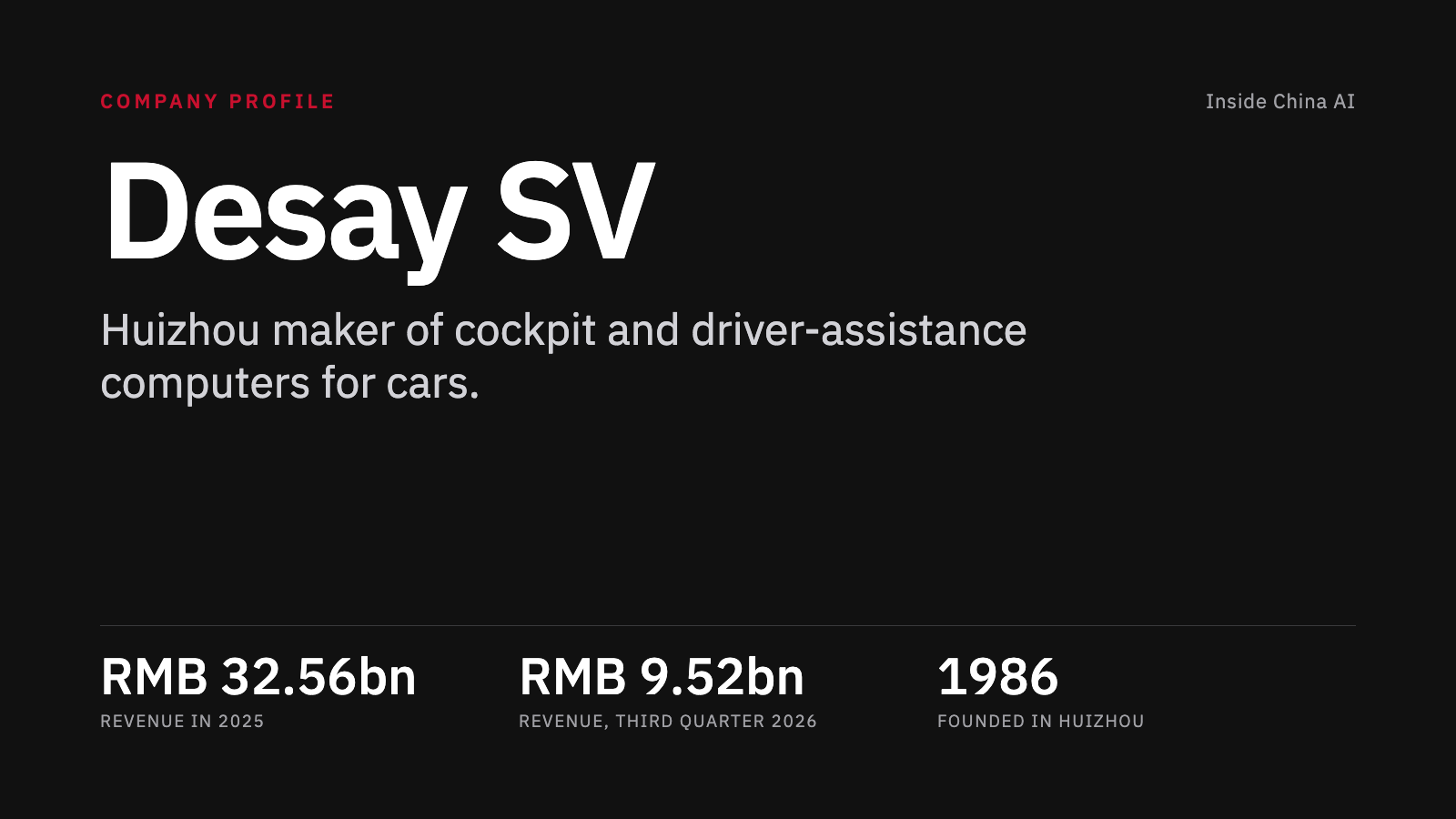
- Q3 2026 Revenue RMB 9.52 billion (+23.8%); net profit RMB 591 million (+4.5%) (Q3 report)
- January–September 2026 Revenue RMB 24.42 billion (+9.3%); net profit RMB 1.84 billion (+2.7%); R&D expense RMB 1.97 billion; operating cash flow down 63.9%; inventories more than doubled to RMB 9.85 billion, mainly raw-material stocks, the company says
- 2025 Revenue RMB 32.56 billion (+17.9%); net profit RMB 2.45 billion (+22.4%) (annual report summary)
- Revenue outside mainland China RMB 1.62 billion in H1 2026 (+55.7%), 10.9% of the total; Europe is not reported separately
- Customers Top five customers 55.5% of 2025 revenue, the largest 14.5%
- Staff 11,940 at the end of 2025, 42.4% in R&D, about 96.7% in China
- AI Cockpit and ADAS domain controllers on NVIDIA, Qualcomm and Horizon Robotics chips; on-device LLMs from partner developers; no own foundation model
The European angle
- Physical presence Yes. Desay SV Automotive Europe GmbH is headquartered in Weimar. The company says it has more than 225 employees in Weimar, Itzehoe, Wolfsburg, Sindelfingen, Guyancourt (France), Mladá Boleslav (Czech Republic) and Gothenburg (Sweden) (Desay SV Europe). The interim report also lists a Swedish company, Desay SV Spain S.L. and the antenna specialist ATC GmbH in Itzehoe (interim report); in October 2026 the company called ATC its former subsidiary (Desay SV). In 2019 it bought the German antenna maker Antennentechnik Bad Blankenburg (milestones).
- Germany In 2022 Desay SV opened a logistics and production site in Weimar. When it opened, the Thuringian development agency LEG said it would make radios, displays and infotainment systems and create 40 jobs; we found no current output figures (LEG Thüringen, 18 May 2022). On 27 October 2026 the company opened a 3D antenna test chamber there, which it offers to carmakers and suppliers for testing and validation (Desay SV). The European subsidiary has applied for a grant from Thüringer Aufbaubank, the Thuringian state development bank, and the parent has given a €1.8 million performance guarantee for it (interim report 2026).
- Carmakers In a note on guarantees, the interim report says that Desay SV Automotive Europe GmbH has signed a “business cooperation agreement” with Bayerische Motoren Werke AG. The Chinese parent has given a performance guarantee of RMB 755 million for the subsidiary’s obligations under the project contract, running from the start of the project until 15 years after it ends; the guarantee table dates it to December 2023 (interim report 2026). The filing does not name the product, the vehicles or the start of supply, and we found no statement from BMW. The same report lists cockpit and driving orders from Volkswagen, Stellantis, Renault and Asian carmakers, without saying which are for Europe. The company says it won a “2025 Volkswagen Group Award”, which it describes as given to ten suppliers a year (prospectus). It also hosted Volkswagen chief executive Oliver Blume at Volkswagen’s supplier fair IZB in 2026 (Desay SV).
- Spain Desay SV opened its plant in Linares, Andalusia, in November 2026. The company says the plant will make displays and cockpit domain controllers, with a maximum designed capacity of 2.8 million units a year once all phases are built. It plans to begin mass production in the first quarter of 2027 and has “formal project nominations from two international automotive manufacturers”, which it does not name (Desay SV, November 2026). Trial production and sample deliveries began in July 2026 (interim report). The Spanish government granted €5.5 million from its PERTE VEC III programme. In June 2025 it expected 1.5 million display units a year by 2028 and about 300 jobs (La Moncloa, 26 June 2025). The company now speaks of up to 500 direct jobs by 2030 (Desay SV, November 2026).
- Lists and regulation On 24 and 25 November 2026 we found no match for Desay SV on the US Consolidated Screening List (which includes the Entity List), the EU consolidated sanctions list or the US Defense Department’s 1260H list. This was a name match only. In its prospectus the company names US export controls as a risk and says it is looking at domestic substitutes for components.
- What a European buyer would actually encounter A Tier-1 supplier with German engineering and test sites and a Spanish plant about to start volume production. Its main products are the in-car computers that run cockpit AI and driver assistance, on US and Chinese chips.
What we could not verify
- The BMW agreement: which product, which vehicles and from when. The only source is the guarantee note in Desay SV’s interim report.
- The two carmakers with nominations for Linares, and how much the Weimar site produces today.
- Desay SV’s revenue in Europe, which the company does not report separately.
- The status of the Hong Kong listing application filed on 12 April 2026; Desay SV’s Shenzhen announcements up to 26 November 2026 contain no update.
The open question for Europe: when Linares reaches volume production in 2027, which European cars will carry Desay SV’s cockpit computers?

Comments are closed