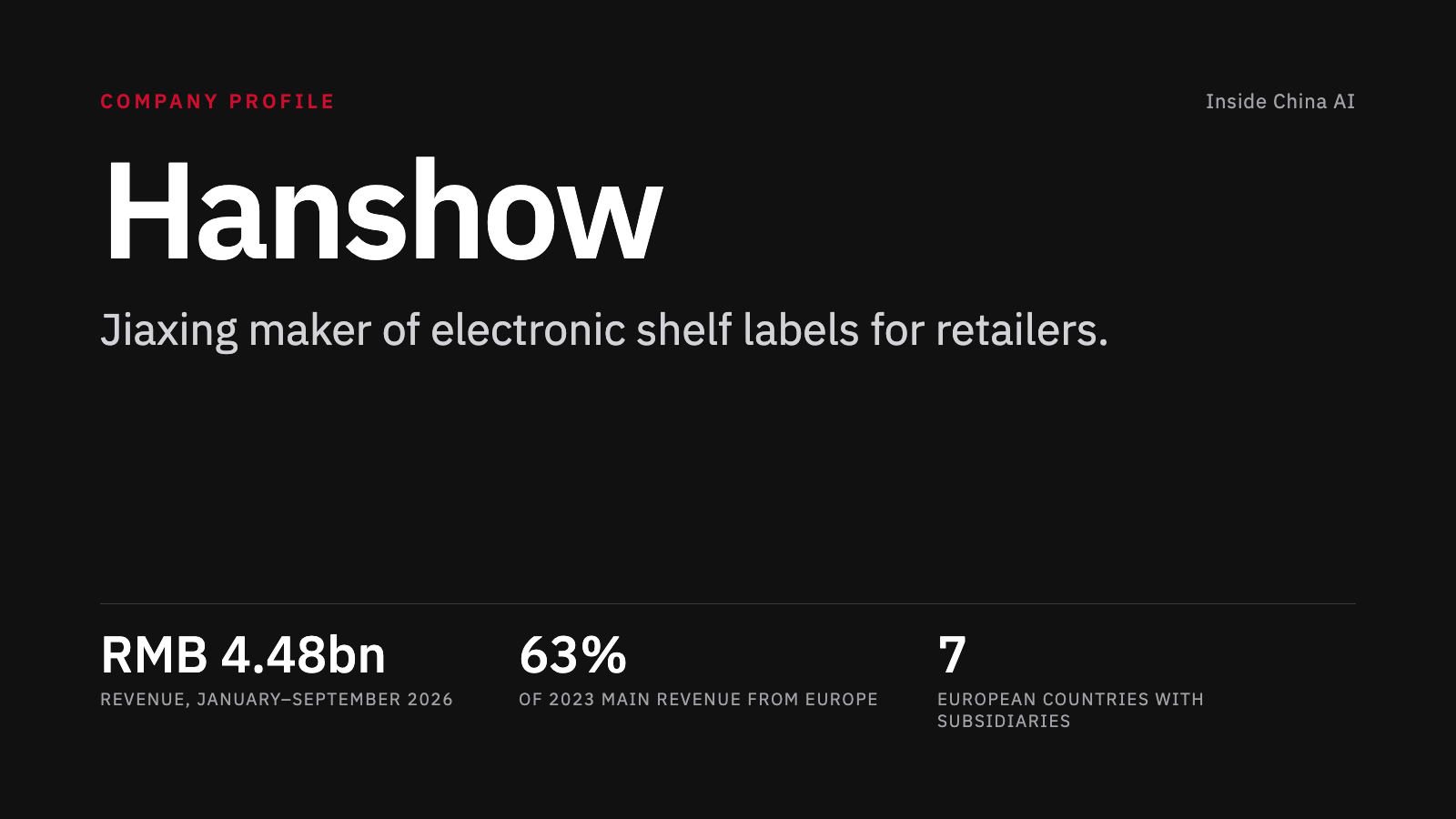
Graphic: Inside China AI
Hanshow: The Chinese Shelf-Label Maker That Built Its Business in European Supermarkets
Company profile · 26 November 2026.
Hanshow, based in Jiaxing in Zhejiang province, makes the electronic price labels that have replaced paper on the shelves of European chains such as Aldi, Netto, Albert Heijn, Auchan and the DIY retailer Leroy Merlin. From 2021 to mid-2024 more than half of its main-business revenue came from Europe; later reports no longer give a figure for Europe. It now sells AI shelf cameras, store robots and smart shopping carts on top of the labels, but those are still a small part of a business that is, at its core, a hardware company. For European retailers, Hanshow is already part of the store infrastructure. The question is how much of the new AI layer it can sell to them, and what that means for the data that cameras and carts collect in European stores.
Origins and backing
The company was founded in Jiaxing, Zhejiang province, on 14 September 2012 and became a joint-stock company on 25 December 2020 (IPO prospectus). Hou Shiguo has run it from the start: he was executive director and general manager of the predecessor company from September 2012 and has been chairman and general manager since December 2020. From February 2011 to March 2021 he was also general manager of Beijing Hanshow, which he controls and which is the company’s largest shareholder (annual report 2025).
Hanshow listed on the ChiNext board of the Shenzhen Stock Exchange on 11 March 2025 (stock code 301275). It sold shares at 27.50 yuan each and raised 1.16 billion yuan before costs (listing announcement). Hou remains in control. On 30 September 2026 Beijing Hanshow held 19.65 per cent, Hou 3.84 per cent directly and a Hou-controlled partnership a further 3.58 per cent. Two funds managed by the venture investor Legend Capital held 5.00 per cent each (third-quarter report 2026). Hanshow had 1,005 employees at the end of 2025, 329 of them in research and development (annual report 2025).
What they build
Electronic shelf labels are small e-paper displays clipped to the shelf edge. A store system updates prices and product information over a radio network. In 2025 these labels made up 91.24 per cent of Hanshow’s revenue. Software, SaaS and technical services made up 4.33 per cent. Hanshow sold 104.3 million labels that year (annual report 2025). It uses its own wireless protocol, HiLPC, combined with Bluetooth. Contract manufacturers build nearly all of the finished labels. The prospectus names the Chinese electronics groups Luxshare, BYD and HKC (IPO prospectus). Hanshow makes part of the e-paper display modules itself.
AI comes in at the next layer up. Under a strategy it calls “Hanshow 2.0”, the company sells AI cameras that watch shelves, a store robot (NexMate) that patrols aisles and detects empty shelves, and a smart shopping cart with an “AI shopping guide” and self-checkout. It also offers a “digital twin” platform, which the annual report describes as an “AI agent operating system” with four agents, for products, operations, marketing and inventory (annual report 2025). The company says the smart cart and AI camera are in live use at customers and that the cart began volume shipments in 2025. It gives no revenue figure for either.
Hanshow does not develop foundation models. In its 2025 research list, a project combining “vision AI, multimodal reasoning and large-model knowledge” is still marked as under development. Its English website says the AI camera monitors “shelves and customer traffic” (Hanshow). In June 2021 Hanshow said its SaaS platform was built on Microsoft Azure (Hanshow); its company timeline lists a strategic partnership with Microsoft in 2021 (Hanshow).
Key numbers
- Listing Shenzhen ChiNext (301275) since 11 March 2025; Hou Shiguo is the actual controller (Q3 report 2026)
- Revenue 4.48 billion yuan in January–September 2026, up 59.41 per cent; 1.57 billion yuan in the third quarter alone, up 88.24 per cent. The company attributes the growth mainly to deliveries to large customers (Q3 report 2026)
- Profit 482.3 million yuan net profit attributable to shareholders in January–September 2026, up 53.41 per cent; excluding one-off items 430.1 million yuan, up 17.55 per cent. The company attributes the gap mainly to currency forwards: a gain of 40.2 million yuan in 2026 against a loss of 75.2 million yuan a year earlier (Q3 report 2026)
- Full year 2025 revenue 4.21 billion yuan, down 6.12 per cent; net profit 451.7 million yuan, down 36.40 per cent (annual report 2025)
- Revenue abroad 91.68 per cent in 2025; the five largest customers, not named, account for 43.35 per cent (annual report 2025)
- Europe 63.33 per cent of main-business revenue in 2023 and 53.73 per cent in the first half of 2024, the last period with a published figure (IPO prospectus)
- Research 202.6 million yuan in 2025, 4.81 per cent of revenue (annual report 2025)
Part of the profit growth in 2026 comes from special effects rather than from the business itself. One is the currency hedging described above. The other is a tariff refund: by August 2026 Hanshow’s US subsidiary had received 23.1 million US dollars in refunded tariffs and interest, after the US Supreme Court ruled in February 2026 that the tariffs imposed under the IEEPA emergency law lacked legal authority. Some of that money has to be shared with customers. Hanshow estimates the net effect on its 2026 profit at about 71.2 million yuan, with negotiations still open (SZSE announcement, 18 August 2026). The third-quarter report does not list the refund among its one-off items and does not say how much of it is in the nine-month result. In the first half of 2026, profit excluding one-off items rose only 1.99 per cent (half-year report summary 2026).
The European angle
- Market Europe was Hanshow’s largest market in every period covered by its prospectus, 2021 to the first half of 2024: 58.64 per cent of main-business revenue in 2021, 64.55 per cent in 2022, 63.33 per cent in 2023 and 53.73 per cent in the first half of 2024. The main buyers are in Germany, France, the Netherlands and Italy (IPO prospectus). Later reports split revenue only into China and abroad. In 2025 overseas revenue fell 8.54 per cent, while the company reported rapid growth in North America (annual report 2025).
- Companies The 2025 annual report lists subsidiaries in Germany, France, the Netherlands, the United Kingdom, Spain, Poland and Greece; Poland and Greece were set up in 2025 (annual report 2025). Hanshow set up its French subsidiary in 2017 and put its European headquarters and innovation centre in the Netherlands in 2019 (IPO prospectus). Its contact page gives addresses in Amsterdam, Boulogne-Billancourt, Düsseldorf, London, Warsaw and near Athens, plus a Turkish company in Istanbul (Hanshow).
- Named customers In 2023 Hanshow’s two largest customers were German discounters. Aldi bought labels and services worth 681.9 million yuan, or 18.06 per cent of revenue. Netto Marken-Discount accounted for 13.85 per cent. Leroy Merlin (France, Spain and Poland) and the Dutch chain Jumbo were also in the top five. The prospectus says Netto’s and Aldi’s purchases were winding down in 2024. In the first half of 2024 the Auchan group, including Auchan France and Auchan Poland, accounted for 9.77 per cent of revenue (IPO prospectus). According to the prospectus, Hanshow serves four of France’s six largest grocery groups: Auchan, E.Leclerc, Système U and ITM (Intermarché). It has worked with Ahold Delhaize since early 2018, and Albert Heijn is rolling out a new label series developed with it, the company says (Hanshow).
- Rollouts in 2026 Alcampo, Auchan’s Spanish chain, plans to install more than 560,000 Hanshow labels in 84 supermarkets in 2026 (Hanshow). The Greek grocer Sklavenitis, with more than 460 stores, has begun a nationwide rollout (Hanshow). The health and beauty chain Superdrug had equipped 51 stores in the UK and Ireland by 2025 and planned 90 more for 2026, the company says (PR Newswire).
- AI in European stores The most concrete AI-related project in Europe that we found is a pilot. In October 2026 Hanshow announced 24 smart carts at an Auchan store in Bucharest, with self-checkout software from its partner shopreme. Auchan Romania already uses more than 1.7 million Hanshow labels in 57 locations, the company says (Hanshow). The cart, offered with shopreme and Lucky cart, won a 2026 RTIH Innovation Award for retail media (Hanshow).
- Production None in Europe. The filings describe contract manufacturing in China and a subsidiary in Vietnam. The 2025 annual report says Hanshow is exploring supply chains in several regions to spread geopolitical risk (annual report 2025).
- Lists and data We found no Hanshow entry on the US Consolidated Screening List, which includes the Entity List (version with entries up to 24 July 2026), on the Pentagon’s Section 1260H list or on the EU’s consolidated sanctions list (checked 25 and 26 November 2026). Hanshow’s privacy policy names the Chinese parent “and/or the relevant Hanshow affiliate” as data controller and refers to the GDPR (Hanshow). Cameras that track customer traffic in European stores are subject to the GDPR. We found no case brought by a European data protection authority.
- What a European retailer would actually encounter A supplier with local companies in seven European countries and large existing label installations at European grocers. It is now offering cameras, robots and carts, which are the parts that collect data in the store.
What we could not verify
- Europe’s share of revenue after June 2024. The 2025 annual report and the 2026 quarterly reports do not publish it.
- Who the five largest customers of 2025 are. Hanshow withholds the names under confidentiality agreements. Reports of a contract with Tesco come from a broker summary that we could not check.
- How much revenue the AI products bring in, and where data from European cameras, carts and the cloud platform is stored.
- Whether a Danish subsidiary still exists. The company timeline mentions one for 2017; the 2025 annual report does not.
The open question for Europe: will retailers that put Hanshow’s labels on their shelves also let its cameras and carts into their stores, and on what data terms?

Comments are closed