Graphic: Inside China AI
Elephant Robotics: Desktop Robot Arms and Wheeled Humanoids for Classrooms and Labs
Company profile · 28 November 2026.
Elephant Robotics, a privately held company in Shenzhen, makes small robot arms, mobile platforms, wheeled humanoids and robotic pets. Its main customers are schools, universities and research labs. The robots do not run on an AI model of Elephant Robotics’ own. They are built as hardware for AI work: researchers use them to train and test robot software, and the company sells kits for collecting training data. Europe matters because that is where many of these robots end up. The company names two British universities as customers, sells into Europe directly from Shenzhen and has shown its products in Berlin and Vienna. It has no company, office or named distributor in Europe.
Origins and backing
Shenzhen Elephant Robotics Technology Co., Ltd (深圳市大象机器人科技有限公司) was founded on 10 August 2016 (Elephant Robotics). Its English website names Joey Song as “one of the founders”. He took the company’s name from the Tao Te Ching (Elephant Robotics). In May 2024 the tech outlet 36Kr quoted Song Junyi (宋君毅) as chief executive, and the company republished the article on its own WeChat account (36Kr via Elephant Robotics). In August 2024 the company published an anniversary letter signed by Joey Song as chief executive officer (Elephant Robotics). According to its timeline, the company went through the hardware incubator HAX, which gave it seed funding from SOSV. Its first public appearance was at Hannover Messe in 2018 (Elephant Robotics).
The company is not listed. On its Chinese website it names its investors as Cloud Angel Fund, SOSV, Orient Securities, Shenzhen Capital Group, ZhenFund and the chipmaker GigaDevice. It does not give their stakes (Elephant Robotics). Its most recent disclosed round was a Pre-B round announced in May 2024. Qinghui Investment (清辉投资) led it and Yunzhuo Capital (云卓资本) took part. The money was meant for upgrading the humanoid production line and for research (36Kr via Elephant Robotics). No amount or valuation was published, and we found no later round.
What they build
The core of the range is small six-axis arms such as the myCobot series. They are sold with Raspberry Pi, M5Stack, Arduino or Nvidia Jetson controllers. Alongside them are the compact mechArm and ultraArm, the dual-arm myBuddy and the myAGV mobile platforms. The company says the range covers payloads from 0.25 to 10 kilograms. Above these sit the professional myCobot Pro arms and industrial joint modules. On the consumer side there are robotic pets: metaCat, metaDog and metaPanda (Elephant Robotics). New products in 2026 included the myAGV Plus mobile robot in May and the ultraArm P1 palletising arm in July (Elephant Robotics blog).
The humanoid line is called Mercury. The Mercury X1 is a wheeled humanoid with 19 degrees of freedom. It combines the dual-arm Mercury B1 with a mobile base and uses Nvidia’s Jetson Orin Nano Super as its main controller (Elephant Robotics). The company gives a maximum payload of 1 kilogram, a weight of 55 kilograms and up to eight hours of operation. The robots can be steered remotely through a Meta Quest 3 headset (Elephant Robotics). In 2023 the company said a Swedish industrial design team had designed the Mercury series. It did not name the team (Elephant Robotics). In May 2024 its chief executive said the company was aiming for more than 300 humanoid deliveries that year (36Kr via Elephant Robotics). We found no figure on how many were actually delivered.
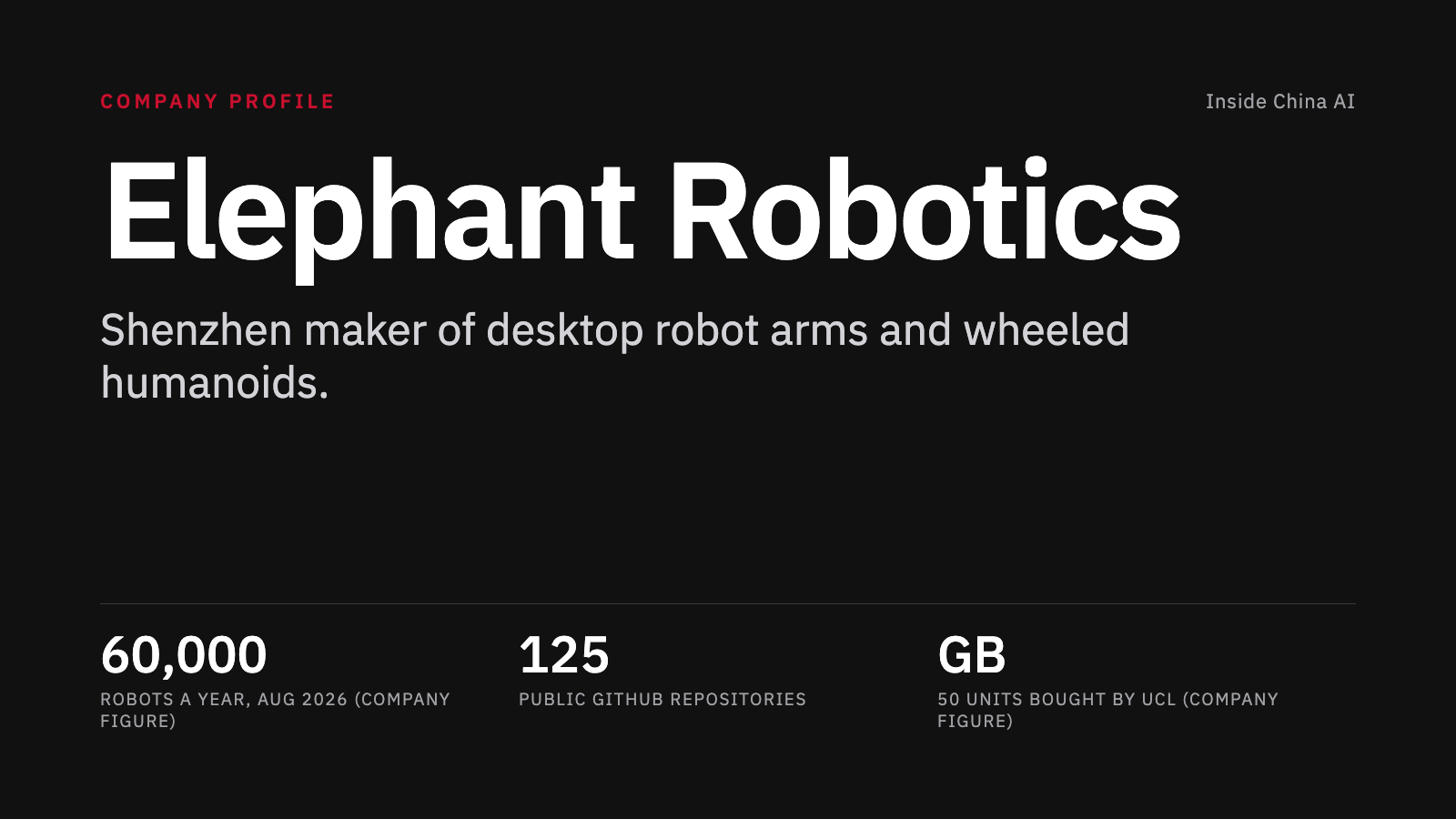
The AI layer comes from other developers. Elephant Robotics says the Mercury robots combine vision, laser and voice sensors “with the support of LLM”. It does not say which large language model they use (Elephant Robotics). We found no AI model of its own: the company has no models on Hugging Face. Its contribution is open control software and hardware for training data. Its GitHub organisation has 125 public repositories, and its Python control library pymycobot is under the MIT licence (GitHub). The myArm M&C kit and the myController S570 exoskeleton are designed for teleoperation and for collecting motion data. The company says the S570 records at 100 Hz “for precise AI training” (Elephant Robotics).
Key numbers
- Founded 10 August 2016, Shenzhen; privately held
- Funding Pre-B round announced May 2024, led by Qinghui Investment; amounts and valuation not disclosed
- Scale more than 60,000 robots shipped a year, users in more than 70 countries and regions, more than 200 partners and distributors, more than 150 core patents, the company said in August 2026 (Elephant Robotics)
- Financials revenue and profit not published; the team had grown to “nearly 100” people, the chief executive wrote in August 2024 (Elephant Robotics)
- AI no model of its own; third-party LLMs on Mercury robots, Nvidia Jetson computing, open-source control software, devices for collecting training data
- Europe no entity; direct web shop; two named UK university customers (company case studies)
The European angle
- Physical presence None found. The contact page lists only offices in Shenzhen (Elephant Robotics). The distributor page names partners only in Indonesia and Japan (Elephant Robotics).
- Customers In a case study on its website dated 11 September 2025, Elephant Robotics says University College London chose myCobot and myAGV robots and “has since procured 50 units of our robot units and kits”, which are used in teaching and competitions (Elephant Robotics). In a case study dated 16 September 2025, it says the Eureka Robotics Centre at Cardiff Metropolitan University built postgraduate courses around the myBuddy robot (Elephant Robotics). Neither university has confirmed this in anything we found. The company also says it has sold cobots to Germany, Italy and Greece, among other countries, but names no customers there (Elephant Robotics).
- Sales channel European customers buy from an international web shop that ships from Shenzhen and lists separate shipping rates for Europe (shipping policy). The shop’s terms grant EU consumers a 14-day right of withdrawal (refund policy). Its terms of service are governed by Chinese law (terms of service). The privacy policy says transfers of personal data out of the EEA or the UK rely on “recognized transfer mechanisms like the European Commission’s Standard Contractual Clauses” (privacy policy).
- Trade fairs Elephant Robotics exhibited at IFA in Berlin in 2025 (IFA). The company says it showed its robots at the ICRA robotics conference in Vienna in the second quarter of 2026 and at the United Nations Chinese Language Day in Geneva (Elephant Robotics). It also says it took part in the AI for Good Global Summit in Geneva on 30 and 31 May 2024 (Elephant Robotics).
- Regulatory exposure We found no entry for Elephant Robotics on the US Consolidated Screening List, which includes the Commerce Department’s Entity List. It is also not on the Pentagon’s 1260H list or on the EU’s consolidated financial sanctions list. This was a name check of the lists as of 27 November 2026, not a legal review.
- What a European buyer would actually encounter Low-cost, open-source robot hardware for teaching and research, ordered online and shipped from China. Orders, support and warranty go through the Shenzhen company; we found no European subsidiary.
What we could not verify
- The UK customers. The purchases by UCL and Cardiff Metropolitan University are described only in Elephant Robotics’ own case studies.
- The shipment figures. In May 2024 the company gave more than 20,000 robots shipped in total. In August 2026 it gave more than 60,000 a year. An undated page says more than 50,000 a year to over 51 countries. None of these figures can be checked.
- Who leads the company today. The most recent sources are from 2024: 36Kr named Song Junyi as chief executive in May, and an anniversary letter was signed by Joey Song as chief executive in August. We found no newer statement.
- Funding and ownership. We found no amounts, no valuation and no shareholdings.
- Which language models the Mercury robots and the robotic pets use, and where voice data is processed.
- European customers in Germany, Italy or Greece, and whether the company has any European distributor.
The open question for Europe: will Elephant Robotics build a European sales and service base for the robots that labs here already use, or keep selling from Shenzhen?

Comments are closed