Graphic: Inside China AI
Quicktron: A Shanghai Maker of Warehouse Robots Already at Work in European Fulfilment Centres
Company profile · 28 November 2026.
Quicktron (快仓) builds autonomous mobile robots that bring shelves, totes and pallets to warehouse workers, and the software that steers whole fleets of them. Its AI is not a large model but fleet control: navigation, route planning and task allocation across a fleet of robots. For Europe, Quicktron is not a future arrival. Its robots have been running in a Dutch fulfilment centre since 2023, delivered through the German intralogistics group KION, and the company says it also serves logistics sites in Bremen and runs a German subsidiary. What it does not publish are revenue or profit figures.
Origins and backing
Quicktron was founded in 2014 and is headquartered in Shanghai (Quicktron; KION). Its founder and chief executive is Yang Wei (杨威), who held that role when the company announced its latest funding round in September 2024 (Quicktron) and was still quoted as CEO in a Robotics 24/7 report on Quicktron’s appearance at the MODEX 2026 trade fair, published on 4 April 2026 (Robotics 24/7). The English website names Wuxi Quicktron Intelligent Technology Co., Ltd. in its footer, the Chinese website 上海快仓智能科技有限公司 (Shanghai Quicktron Intelligent Technology Co., Ltd.). KION’s 2025 annual report lists the Wuxi company with the note “formerly: Shanghai Quicktron Intelligent Technology Co., Ltd.” (KION).
The company’s own milestone list names its investors round by round: the logistics company Cainiao and SBCVC in the Series B of 2017, CBDEIF and Shanghai Guohe Capital in the Series C of 2018, and KION Group and Saudi Aramco in the Series C+ of 2020 (Quicktron). KION, which is based in Frankfurt, announced on 4 August 2020 that it planned “to acquire a minority stake of less than 10 percent” in Quicktron, alongside a distribution agreement (KION). KION still holds that stake: its list of shareholdings as at 31 December 2025 gives 6.67 percent in Wuxi Quicktron Intelligent Technology Co., Ltd. (KION annual report 2025); KION refers to “strategic partnerships with the companies” (KION). The investment also appears in KION’s half-year report for 2026 (KION). On 12 September 2024 Quicktron said it had closed a Series D of “over one hundred million US dollars”, co-led by Golden Oriole Capital, FarGlory Group, the Wuxi Liangxi Technology Innovation Fund and the Weifang Yuanfei Industrial Fund, with the money earmarked for overseas expansion and product improvement (Quicktron). Quicktron is not listed and has published no valuation.
What they build
Quicktron’s robots work in two settings: goods-to-person picking in warehouses, where robots carry the goods to a stationary picker, and material transport between workstations in factories. The company says its robots are “guided by proprietary software” (Quicktron). The range covers lifting robots (M series), picking robots that store and retrieve totes on racks up to 12 metres high (C series) and autonomous forklifts (F series); the website also lists an A series (Quicktron).
Its current flagship is QuickMix, which combines tote, case and pallet handling in one system. It joins QuickBin Ultra, a vertical tote store with lift speeds of up to 3 m/s and up to 600 tote presentations per hour per workstation, and QuickCube, a dense pallet store worked by four-way shuttle robots, the company says. All devices are coordinated by one Robot Control System that connects to a customer’s ERP and warehouse-management software (Quicktron, 9 February 2026).
The AI in this is fleet intelligence rather than a foundation model. In a company interview published on 29 May 2025, Quicktron describes “intelligent algorithms and virtual simulation capabilities” for multi-robot collaboration, dynamic slotting and route planning, and Yang Wei says the company has “brought in engineers from the autonomous vehicle industry” (Quicktron). We found no AI model of Quicktron’s own. The same interview sets out the strategy: “training in the Chinese market, generating revenue in overseas markets”.
Key numbers
- Founded 2014, Shanghai; founder and CEO Yang Wei
- Funding Series D of “over one hundred million US dollars” (September 2024); earlier rounds with Cainiao, KION Group and Saudi Aramco, the company says; KION held 6.67 percent on 31 December 2025
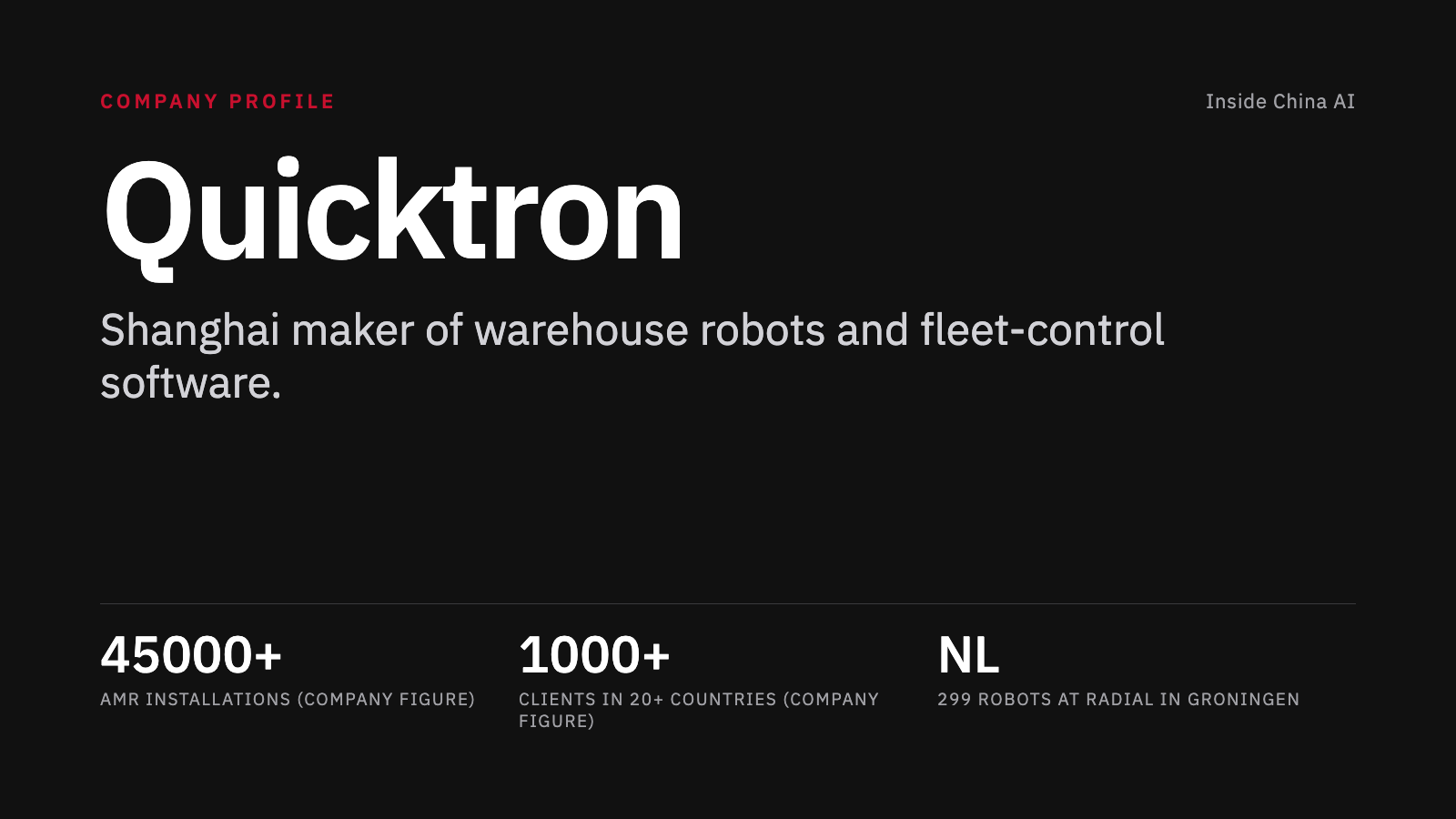
- Robots “45000+ AMR Installations” according to the English website; other company pages give 35,000 and 25,000
- Customers “1000+ Clients” in “20+ Countries”, the company says
- Staff “700+ Employees” on the English website; the Chinese site says more than 1,000
- Revenue not published
All figures are from Quicktron’s website, retrieved on 27 November 2026, except the KION stake (KION annual report 2025).
The European angle
- Customers The best-documented project is Radial Europe’s fulfilment centre in Groningen, the Netherlands. Dematic, the KION warehouse-automation company, completed the installation of 299 robots there, announced on 15 November 2023, and called it “its largest AMR order globally to date” (Dematic). KION says the transport robots were delivered by “KION’s strategic partner Quicktron” (KION, 25 January 2024), and Radial dates the go-live to May 2023 (Radial). Quicktron also names two German projects: the logistics provider 4PX in Bremen, with 76 robots in a shelf-to-person system (Quicktron), and the baby-care brand LILLYDOO, with more than 20 M100 robots (Quicktron). We found no independent confirmation of these two.
- Partners Under the 2020 agreement, Quicktron products are “to be distributed via the global sales and service networks” of KION’s Linde Material Handling, STILL and Dematic (KION). The first Linde robot with Quicktron technology, the M60, came off the line in China on 27 November 2020 (KION). In its 2025 annual report KION still refers to a strategic partnership with Quicktron (KION), without describing its current terms. In Romania, Quicktron announced a partnership with the integrator Total Technologies on 27 November 2023 (Quicktron).
- Own companies Quicktron says it set up a German subsidiary in 2021 and subsidiaries in Spain, France and the UK in 2022; its website map shows Darmstadt, Madrid, Strasbourg and Birmingham (Quicktron). Its German press releases are issued by Quicktron GmbH in Darmstadt (PresseBox), and its LogiMAT posts are signed by a marketing team for the EMEA region.
- Trade fairs and certification Quicktron showed QuickMix in Europe for the first time at the LogiMAT 2026 trade fair and says it will return for LogiMAT 2027 (Quicktron). It reports TÜV Rheinland CE-MD and CE-RED certification for its four-way shuttle and robot systems on 17 November 2025 (Quicktron); Yang Wei says CE compliance cost the company “tens of millions of RMB” (Quicktron).
- Lists On 27 November 2026 we found no match for Quicktron on the EU consolidated financial sanctions list, the US Consolidated Screening List or the US Department of Defense 1260H list (name check, not a legal review).
- What a European buyer would actually encounter A Chinese robot fleet steering goods through a European warehouse, supplied either directly or, as in Groningen, through KION’s Dematic; we found no production of Quicktron robots in Europe.
What we could not verify
- Revenue, profit and valuation: Quicktron publishes none of them.
- How many robots are installed: the company’s own pages give 25,000, 35,000 and 45,000 or more.
- The current terms of the KION partnership: KION reports its stake and a strategic partnership, but not whether the 2020 distribution agreement with Linde, STILL and Dematic is still in force in that form.
- The 4PX and LILLYDOO projects, which only Quicktron describes, and whether the Spanish, French and British companies are active.
- Where the fleet software runs for European customers, on site or in a cloud; we found no statement.
The open question for Europe: with its own companies in Germany and other European countries next to the KION channel, how much of Quicktron’s European business does it now run itself — and how large is it?

Comments are closed