Graphic: Inside China AI
Fibocom: A Shenzhen Maker of Wireless Modules Repositions Itself Around Edge AI and Robotics
Company profile · 28 November 2026.
Fibocom (广和通) makes the small cellular and Wi-Fi modules that connect routers, payment terminals, smart meters, cars and robots to the network. It does not train foundation models. Its AI business is about running other developers’ models on devices: AI modules with up to 100 TOPS of computing power, a deployment toolkit it calls Fibocom AI Stack, and the vision and navigation systems for robotic lawn mowers. For Europe, Fibocom is a component supplier with its own subsidiaries or representative offices in Germany and France, according to its annual results. Its modules sit inside devices that are sold in Europe under other companies’ brands, so few end users know the name.
Origins and backing
Fibocom was founded in Shenzhen in 1999 and launched its own module brand in 2009, the company says (company history). It is a joint-stock company incorporated in the People’s Republic of China. Its A shares have traded on Shenzhen’s ChiNext board (300638) since 2017. On 22 October 2025 it added a listing on the Main Board of the Hong Kong Stock Exchange (0638), which made it the first Chinese module maker with both A and H shares, the company says (Fibocom). Its company history also lists a strategic investment from Intel in 2014 and a European subsidiary set up in 2018.
Chairman Zhang Tianyu is by far the largest shareholder. At 30 September 2026 he held 31.33 per cent of the shares, of which 68.3 million shares were pledged. HKSCC Nominees, which holds H shares on behalf of investors, followed with 15.03 per cent, and executive director Ying Lingpeng held 2.84 per cent directly (third-quarter report). At the Hong Kong listing in October 2025 the company called Ying its chief executive. At the end of June 2026 the group had 1,936 regular employees (interim results).
The portfolio has been reshaped by several deals. In 2022 Fibocom bought the automotive OEM module business of Sierra Wireless, the company says (company history). It sold the overseas part of that business, run through Rolling Wireless S.à r.l. and a Hong Kong subsidiary, in a deal completed on 25 July 2024 (2025 annual results). On 4 September 2026 it completed the sale of Shanghai Faiot, a maker of industrial handheld terminals, to Luxshare Precision, at a base price of RMB 120 million for the whole company (HKEX announcement; completion). In the other direction, Fibocom agreed on 29 June 2026 to buy 37.16 per cent of the car-electronics maker Shenzhen Hangsheng Electronics (HSAE) for RMB 1.43 billion in cash. Together with shareholders who agreed to vote with it, Fibocom controls 51.40 per cent, enough to make HSAE a subsidiary. The stated aim is to move from supplying modules to carmakers’ suppliers (Tier 2) to selling complete systems to carmakers themselves (Tier 1) (HKEX announcement). Shareholders approved the deal on 14 October 2026, and the shares had been transferred by the time of the third-quarter report on 29 October 2026 (third-quarter report).
What they build
Most of Fibocom’s revenue comes from modules. In the first half of 2026 modules brought in RMB 3.47 billion and solutions RMB 239 million, out of total revenue of RMB 3.78 billion (interim results). The modules range from 5G, LTE and low-power IoT data modules and automotive modules to “smart modules” with their own processor and AI modules rated at “1–100TOPS”. New products in the first half of 2026 were built on Qualcomm, MediaTek and Samsung platforms, and the annual results list R&D cooperation with Intel, Qualcomm, UNISOC and MediaTek (annual results). The subsidiary Shenzhen Favalon Technology launched new automotive 5G and smart-cockpit modules in the first half of 2026, the interim results say.
The AI layer sits on top. Fibocom describes itself as “a global leading provider of wireless communication modules and AI solutions” whose offering includes “AI models, AI Agent, global connectivity, and cloud services”, the company says (Fibocom). In practice this means adapting existing models to small devices. In November 2026 the company described Fibocom AI Stack as its own platform “for model adaptation, performance optimization, and device deployment”. It works with Qualcomm’s AI Hub and is used to fit open models, including Alibaba’s Qwen3.5 and robot models, onto device chips (Fibocom). Products built on this include an AI dongle that runs language models locally on a PC or network storage device, launched on 20 November 2025 (Fibocom), AI companion devices and an AI cash register for unattended retail, according to the interim results.
Robotics is the second AI line. Fibocom set up a robotics product line in 2023 and entered through robotic lawn mowers: it supplies cameras, algorithm and positioning boards and its own perception and navigation software to mower makers. In the first half of 2026 it kept shipping to “leading domestic and overseas customers in the lawn mower robot sector”, and a vision and satellite-positioning box went to makers of quadruped robots, the interim results say. Its development platform Fibot, launched in 2024, is a desktop platform for robots with two arms (interim results). The group’s strategy now rests on “three core tracks: communications, edge AI (including robotics), and intelligent vehicles”, the company says.
Key numbers
- Listing Shenzhen ChiNext 300638 (since 2017), Hong Kong 0638 (since 22 October 2025)
- Revenue 2025 RMB 6.99 billion (−14.67%), mainly due to the sale of the overseas car-module business; profit attributable to shareholders RMB 347 million (−48.05%) (annual results)
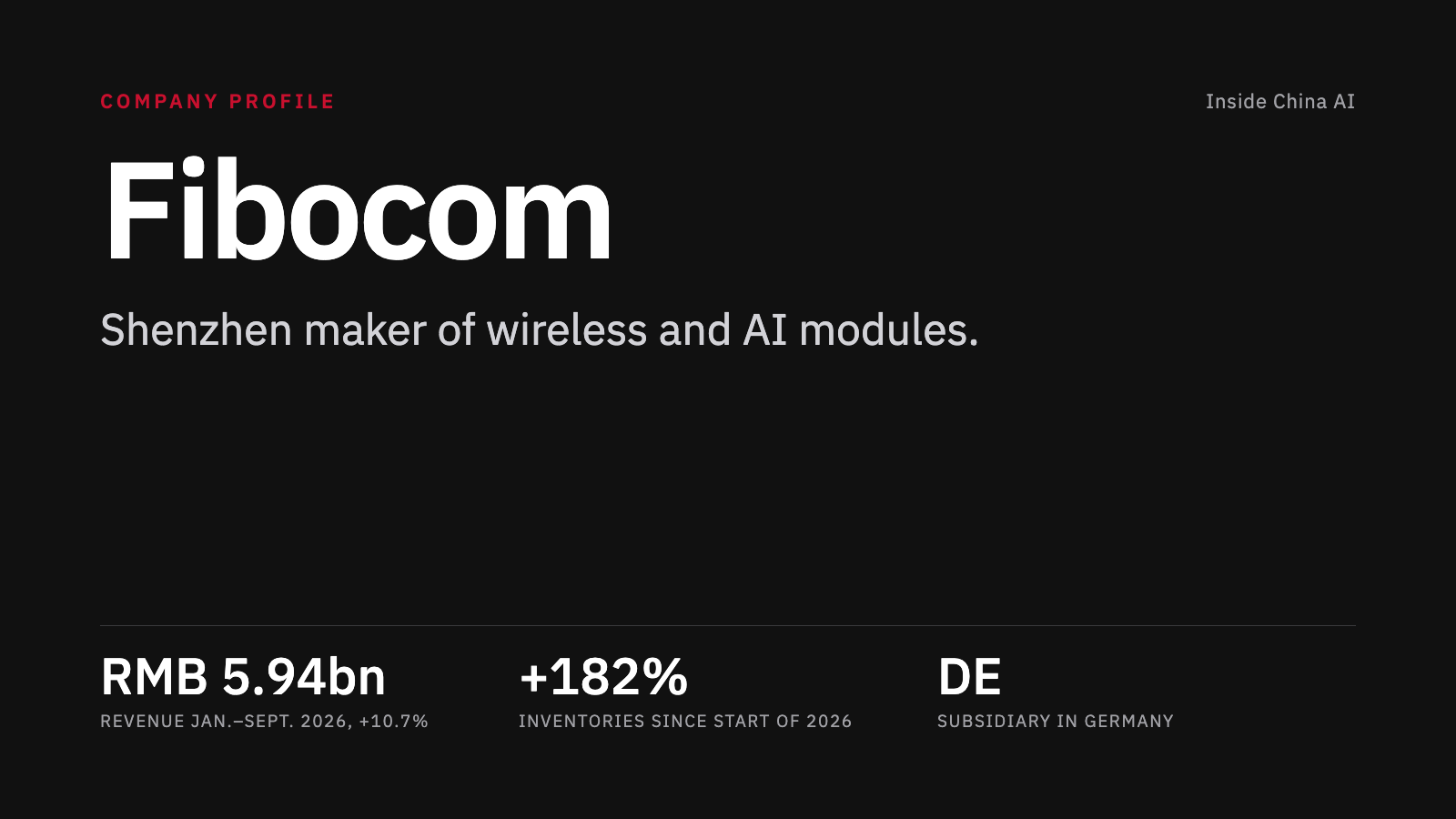
- Revenue January–September 2026 RMB 5.94 billion (+10.72%); net profit attributable RMB 176 million (−44.21%) (third-quarter report)
- Third quarter 2026 revenue RMB 2.16 billion (+30.39%); net profit attributable RMB 115 million (+16.57%), but only RMB 24 million (−74.48%) excluding one-off items such as RMB 62.6 million of investment income from disposals of businesses
- Cash and stock operating cash outflow of RMB 2.50 billion in the first nine months; inventories of RMB 3.80 billion at 30 September, up 182.24 per cent since the start of the year, which the company attributes mainly to stocking up on raw materials
- Overseas share 51.13 per cent of revenue in the first half of 2026, down from 63.02 per cent a year earlier (interim results)
- R&D RMB 509 million in 2025 (7.28% of revenue); 414 invention patents at 30 June 2026
- Staff 1,936 at 30 June 2026
The European angle
- Physical presence Yes. Fibocom’s 2025 annual results say it has “subsidiaries or representative offices in Hong Kong, Taiwan, the United States, Germany, France and South Korea”, and that it wants to build sales and service teams “composed mainly of local employees” there (annual results). The annual and interim results both mention a subsidiary established in Germany that holds assets in euros (interim results). For France, the filings speak only of “subsidiaries or representative offices” and “branches”, without saying which form it takes. The filings do not name the European companies, and the company’s office page lists only its Chinese sites.
- Partners and trade fairs In March 2021 Telefónica Tech, Fibocom and the start-up aitos.io agreed to develop a 5G module that records device data on a blockchain (Fibocom). Fibocom regularly exhibits in Europe: at NetworkX in Paris in October 2025 (Fibocom), at Enlit Europe in Bilbao in November 2025 and at electronica in Munich on 11 November 2026, where it showed mower, AI companion and module solutions (Fibocom release).
- Customers The company says its modules for smart electricity meters are “deployed at scale across EMEA and APAC” (Fibocom), but it names no European utility or manufacturer. In its own case study, released in Munich on 12 November 2026, Fibocom says that the entry-level robotic mower of its Chinese customer Suntek, built on Fibocom’s vision system, “has achieved commercial-scale deployment in Europe” (Fibocom release). That describes where a Chinese customer sells its mowers; it names no European customer of Fibocom.
- Lists and scrutiny A check on 27 November 2026 found no entry for Fibocom on the EU’s consolidated financial sanctions list, the US Consolidated Screening List (which includes the Entity List) or the US Defense Department’s 1260H list. In the United States, the House Select Committee on the Chinese Communist Party wrote to the chair of the Federal Communications Commission on 7 August 2023 about “the security risks posed by cellular connectivity modules” from Chinese suppliers, naming Quectel and Fibocom (letter). In her reply of 5 September 2023, FCC chair Jessica Rosenworcel wrote that the FCC can update its Covered List “only at the direction of national security authorities” and that she had directed two bureau chiefs to forward the committee’s concerns to those authorities. Their letters of 1 September 2023 said the FCC welcomed collaboration “including consideration of the inclusion of this equipment from Quectel and Fibocom on the Covered List” (FCC correspondence).
- Litigation On 13 January 2026 Panasonic Automotive Systems America sued the Fibocom subsidiary Shenzhen Link Future Wireless Technology in Georgia, USA, seeking indemnification of up to $10 million under a contract that came with the Sierra Wireless business, according to Fibocom’s interim results. The case is being heard in a state court and entered the evidence-disclosure stage on 16 July 2026; the interim results of 26 August 2026 report no further progress (interim results).
- What a European buyer would actually encounter Mostly a component inside someone else’s product: a module in a router, meter, payment terminal or mower, and increasingly a supplier that offers to fit AI models onto those devices as well.
What we could not verify
- The names and addresses of Fibocom’s companies in Germany and France, and how many people work there.
- Any named European end customer, such as a carmaker, operator or utility, in 2025 or 2026.
- How much revenue the AI modules and edge AI solutions bring in; the filings report only modules and solutions as a whole.
- Whether the US national security agencies or the FCC have taken any decision on Fibocom since 2023; the FCC’s Covered List page could not be retrieved.
The open question for Europe: as Fibocom moves from connecting devices to putting AI on them, will European manufacturers buy that AI layer from their module supplier?

Comments are closed