Graphic: Inside China AI
NovaStar: A Xi’an Maker of LED Display Controls Adds AI to Its Cloud Services and Designs Its Own Display Chips
Company profile · 28 November 2026.
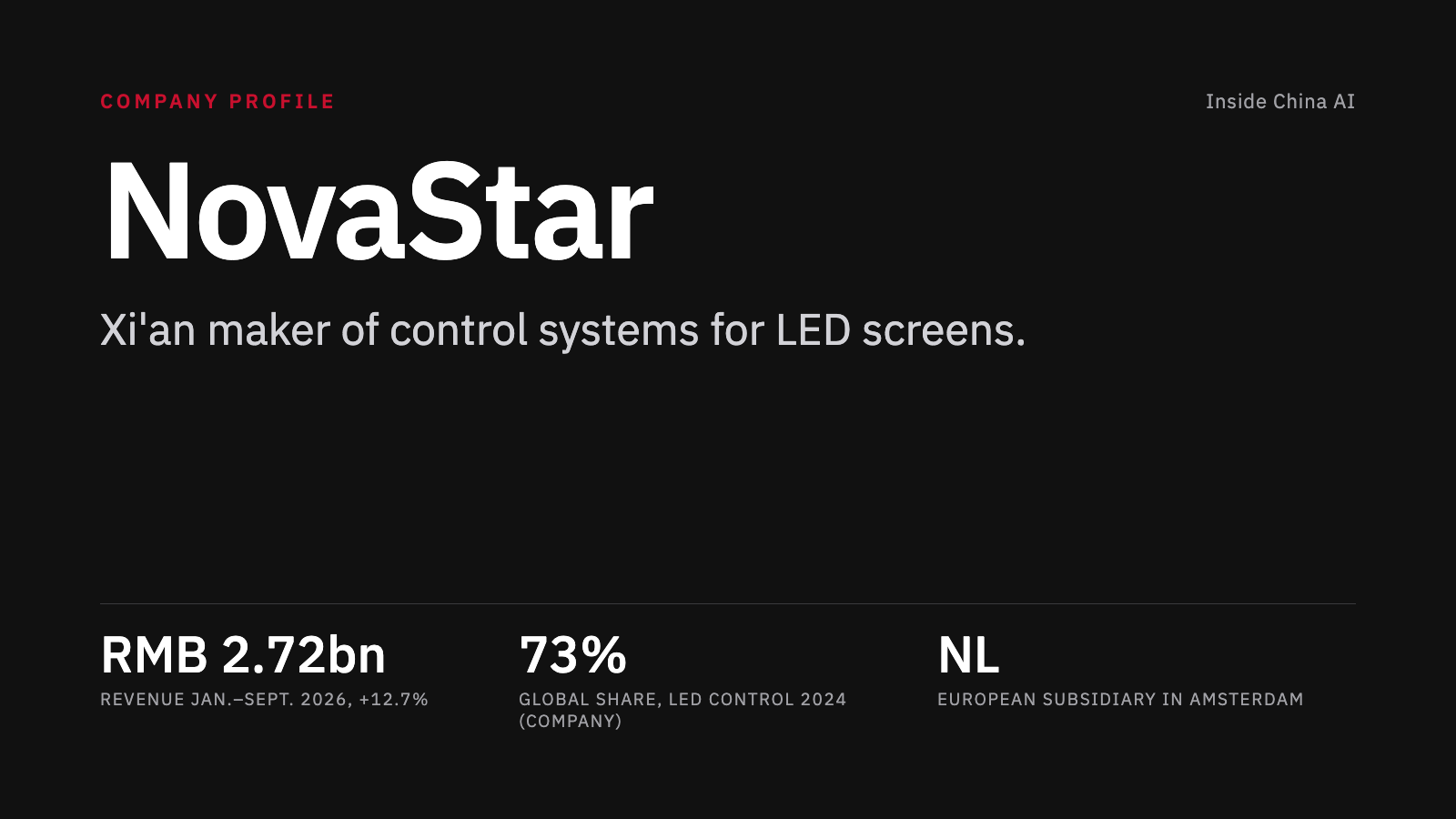
NovaStar makes the controllers, video processors and cloud software that turn a wall of LED modules into one picture. Citing TrendForce, the company says it held 73 per cent of the global market for LED display control systems in 2024. It is not an AI model company. But it is building AI functions into its cloud services for screen operators, and it designs its own chips for the next generation of Mini- and Micro-LED displays. For Europe, NovaStar is already part of the stage, broadcast and signage business. It has its own subsidiary in the Netherlands, it lists distributors across Europe, and the company says its systems were used at the Paris 2024 Olympics.
Origins and backing
NovaStar (诺瓦星云), legally Xi’an Novastar Tech Co., Ltd., was founded in Xi’an in 2008 (company website). Its registered office is in the Xi’an High-tech Zone. The company’s annual report names two controlling shareholders, Yuan Shengchun and Zong Jingguo, who have led the company since April 2008. Both also teach as associate professors at Xidian University in Xi’an. Yuan has been chairman and general manager since December 2015; Zong is a director and deputy general manager and runs the Beijing subsidiary Haidong Vision (北京嗨动视觉) (2025 annual report).
The shares have traded on the Shenzhen ChiNext board (301589) since 8 February 2024. At 30 September 2026 Yuan held 23.08 per cent and Zong 15.29 per cent. The two act in concert under an agreement that runs until 7 February 2027 and can be extended. Their shares are locked up until 8 February 2027. The largest outside holder is the state-owned Xi’an Hi-tech Industry Venture Capital with 4.56 per cent (third-quarter report). The company had 2,973 employees at the end of 2025. Up to 27 November 2026 we found no filing for a second listing in Hong Kong.
What they build
NovaStar’s filings describe three core businesses (2026 interim report):
- LED display control systems. These are the sending and receiving cards inside LED screens, sold in product families such as COEX and M3. In February 2026 the COEX MX2000 Pro controller was certified for IPMX, an open standard for sending professional video over IP networks. The company says it was among the first LED control makers to receive this certification.
- Video processing systems. These include video processors, splicers, switchers, consoles and media servers for LED, LCD and projection displays. They are used in concert rental, television studios, virtual production and control rooms.
- Cloud-based publishing and management. NovaStar runs two cloud platforms with networked media players: one publishes content to screens, the other manages screens from installation through service.
In the first half of 2026 cloud revenue rose 74.66 per cent to RMB 174 million, against 4.41 per cent for control systems. Most of NovaStar’s AI work sits in this segment. The interim report lists AI content generation, AI solution design, AI-assisted on-site commissioning, AI monitoring and an AI service assistant. The company says it is building base capabilities in “multimodal generation, knowledge intelligence, device intelligence, visual intelligence” and AI safety and governance. The filings do not name a model of its own. The Beijing subsidiary Haidong Vision sells a control-room system with what the company calls multi-agent technology. According to the company, it is in use at a State Grid dispatch centre in Qinghai. In July 2026 NovaStar agreed to work with the Chinese EDA software maker Xpeedic on AI-assisted circuit-board design (interim report).
NovaStar’s next market is MLED, the industry’s term for Mini- and Micro-LED displays. It sells inspection, calibration and repair machines for MLED production lines, along with chips it designs itself: an ASIC control chip, a high-speed interface chip and a PWM+PAM hybrid driver chip. The driver chip is the basis of “Infinity”, the company’s high-end picture-quality solution. The company says it works closely with BOE and has repeatedly won orders for the expansion of BOE’s MLED production in Zhuhai. It reports more than 4,000 customers in nearly 200 countries and regions, naming LG and Sony among its overseas customers. The company says its production base in Thailand “has started production and shipments” (interim report). In September 2026 the board approved up to RMB 650 million for a new science park in Shenzhen, subject to land purchase and permits (SZSE announcement). In October 2026 the Shenzhen subsidiary won the land-use rights for a plot in Longgang district for RMB 64.73 million; planning and construction approvals are still pending (progress announcement).
Key numbers
- Listing Shenzhen ChiNext (301589) since 8 February 2024; controlling shareholders Yuan Shengchun (23.08%) and Zong Jingguo (15.29%) at 30 September 2026
- Revenue RMB 2.72 billion in January–September 2026 (+12.7%); RMB 957 million in the third quarter (+8.5%) (third-quarter report)
- Net profit RMB 463 million attributable to shareholders in January–September 2026 (+3.9%); third quarter RMB 131 million (−13.5%), including non-recurring items of −RMB 46 million, mainly fair-value losses on financial assets
- Overseas sales RMB 475 million in the first half of 2026 (+35.5%), led by Latin America and Southeast Asia; 23.39 per cent of revenue in 2025 (annual report)
- 2025 revenue RMB 3.51 billion (+7.0%), net profit attributable RMB 588 million (−0.9%)
- Research RMB 277 million in the first half of 2026, 15.71 per cent of revenue; 1,158 R&D staff at 30 June 2026
- Market share 73 per cent of LED display control systems worldwide in 2024, the company says, citing TrendForce
- AI AI functions in its screen-management cloud and in control-room systems; own MLED chips; no AI model of its own named
The European angle
- Physical presence Yes. Novastar Technology Europe B.V. is a wholly owned subsidiary whose principal place of business is given as Amsterdam. Its business is selling hardware and software. Since August 2023 it has leased offices in Oude Meer, next to Schiphol airport, on a lease running to July 2028 (annual report). The filings do not give Europe revenue or staff numbers.
- Distribution NovaStar’s own distributor directory lists partners across Europe, from Spain to Estonia, among them PSCo in Bracknell (UK), Highlite International in Kerkrade and Fairlight in Bemmel (Netherlands), Ledcon and LEDTEK (Germany), Charmex (Spain) and SQM (Poland) (NovaStar distributors, accessed 27 November 2026). PSCo was appointed in August 2019 (Inavate), Highlite in July 2019 (TPi). In June 2026 the UK distributor Solstice AV, based in Tewkesbury, “signed a direct partnership agreement” with NovaStar (invidis). The company sells mostly direct: distributors accounted for 32.91 per cent of revenue in 2025 (annual report).
- Projects NovaStar says its systems lit up the Paris 2024 Olympics opening ceremony and its main venues (company website); its annual report also lists the Paris Games among events that used its products. It does not name the customer, and we found no independent confirmation. In February 2026 it exhibited at the ISE trade fair in Barcelona (interim report).
- Data NovaStar’s VNNOX cloud lets users choose a “Europe” server node alongside China, the US, Australia and India (VNNOX). The site does not say where the European node is hosted.
- Lists A name check on 27 November 2026 found no match for NovaStar on the EU’s consolidated financial sanctions list, on the US Consolidated Screening List (which includes the Entity List) or on the Pentagon’s 1260H list.
- What a European buyer would actually encounter NovaStar control hardware and software inside LED walls bought from screen makers, rental firms or integrators. The company serves them from its office near Amsterdam and through local distributors. Its AI features arrive through the cloud tools used to plan, run and service the screens.
What we could not verify
- Europe’s share of revenue and the number of NovaStar staff in Europe.
- The Paris 2024 contract: who the customer was, and which systems were supplied.
- The TrendForce market-share figure, which we saw only as cited in the company’s filing.
- Where the VNNOX Europe node is hosted and which company operates it.
The open question for Europe: as AI moves into the software that runs Europe’s LED screens, where will the data from those screens be processed?

Comments are closed