Graphic: Inside China AI
GDS: China’s Data-Centre Operator Bets on AI Demand at Home, While DayOne Builds in Finland
Company profile · 26 November 2026.
GDS Holdings (万国数据) builds and runs large data centres in China for cloud and internet companies, and it says that demand from artificial intelligence is now driving its sales. In Europe, GDS itself has no sites. The European connection is DayOne, its former international arm: GDS spun it off at the end of 2024 and now holds a minority stake. DayOne is building a campus in Lahti, Finland; according to the City of Lahti (10 April 2026), TikTok is the anchor tenant there. For European readers GDS is mainly an indicator of how much computing capacity China is building for AI. DayOne is the part of the story that has reached Europe.
Origins and backing
The listed holding company was incorporated in the Cayman Islands on 1 December 2006. It describes itself as “not an operating company in mainland China”. It controls its Chinese operations through contractual arrangements with variable interest entities (VIEs), which generated 97.5 per cent of revenue in 2025 (Annual Report 2025). Headquarters are in Pudong, Shanghai. William Wei Huang is the founder and chairman, and has been chief executive since 2002. Daniel Newman has been chief financial officer since September 2011.
The shares have been listed on Nasdaq (GDS) since 2016 and in Hong Kong (9698) since 2020. GDS is controlled through weighted voting rights, and Huang is “the sole controlling shareholder” for the purposes of Hong Kong’s Listing Rules. The largest economic shareholder is STT Garnet, with 26.2 per cent of the Class A shares (holding as of 30 January 2026, share of the total after the placement described below). STT Garnet is ultimately wholly owned by Singapore’s Temasek (HKEX announcement, 6 February 2026). On 6 February 2026 GDS closed a US$300 million placement of convertible preferred shares with Huatai Capital Investment, which GDS calls “a Chinese institutional investor”. On 10 March 2026 shareholders raised the voting power of Huang’s Class B shares from 20 to 50 votes per share on the two matters where these shares carry extra votes: electing a majority of the board and certain changes to the articles (HKEX announcement, 10 March 2026). GDS also funds itself by selling assets. Its C-REIT, NF GDS Data Center Infrastructure REIT, started trading on the Shanghai Stock Exchange on 8 August 2025 (HKEX announcement).
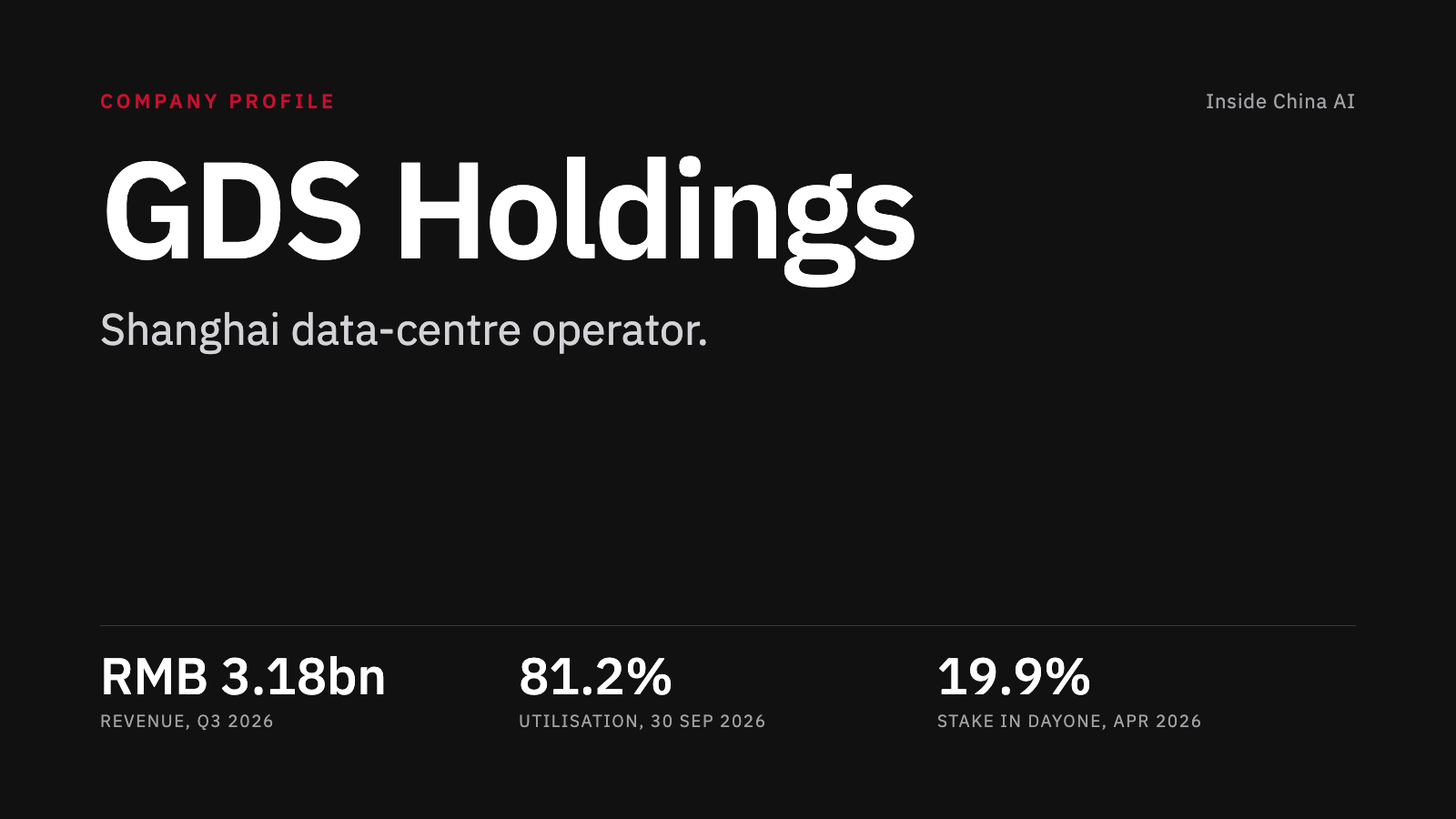
DayOne. GDS set up DayOne in May 2022 as DigitalLand Holdings (“GDS International”), the holding company for its data centres outside China. GDS stayed out of DayOne’s Series A (US$672 million) and Series B (US$1.2 billion) rounds. On 31 December 2024 DayOne ceased to be a consolidated subsidiary. After DayOne’s Series B closed, GDS held about 35.6 per cent and has since accounted for the stake using the equity method (Annual Report 2025; HKEX clarification, 12 February 2025). DayOne’s Series C diluted GDS to 30.1 per cent on 31 December 2025. In January 2026 DayOne bought back shares worth US$385 million from GDS. GDS says this let it “recycle approximately 95% of its principal” at “a nearly 6.5 times multiple of money” (HKEX announcement, 13 January 2026). On 29 April 2026 GDS held about 19.9 per cent (Q1 2026 results). GDS has not published a percentage since then; its Q3 2026 results of 25 November 2026 speak only of “a minority interest”. According to the 2025 annual report, Huang sits on DayOne’s board. DayOne announced the final close of its Series C at US$4.5 billion. It named Coatue and Hillhouse as its “two largest shareholders” (DayOne release via StorageNewsletter, 12 June 2026). DayOne is headquartered in Singapore, and Jamie Khoo is its chief executive (DayOne).
What they build
GDS rents data-centre space, power and cooling, mainly to cloud and internet companies. These customers held 56.0 and 33.3 per cent of committed area at the end of 2025. Its two largest customers, whom GDS does not name, accounted for 37.9 and 11.8 per cent. At the same date GDS operated 90 self-developed data centres with 664,690 square metres in service. Most are in and around Shanghai, Beijing, Shenzhen, Guangzhou and Chengdu/Chongqing. GDS is also expanding in “new growth markets, mainly Inner Mongolia, Ningxia and Shaoguan”, which customers use “for large scale computing purposes” (Annual Report 2025).
GDS does not train or sell AI models. Its link to AI is its customers. In the annual report it writes: “We are making significant investments to support the growing demand for artificial intelligence technologies, including generative AI.” In the first quarter of 2026 it recorded net new bookings of “around 200MW, the highest level ever for a single quarter”, according to Huang, who added: “With AI infrastructure demand intensifying, we believe GDS is uniquely positioned” (Q1 2026 results). In August he said that the opportunities in China were “driven mainly by AI demand” (Q2 2026 results). GDS also lists risks. It warns that US export controls on advanced computing “may impact AI-related demand for data centers in China”, and that investments in AI workloads may not achieve the expected return.
Key numbers
- Q3 2026 revenue RMB3,180.1 million (US$474.3 million), up 10.1 per cent year on year (Q3 2026 results, 25 November 2026; SEC 6-K)
- Q3 2026 profit Net income RMB28.5 million, against RMB728.6 million a year earlier, which included a gain from the C-REIT transaction. Adjusted EBITDA RMB1,380.2 million (+2.8 per cent), margin 43.4 per cent (46.5 per cent). Gross margin 19.7 per cent, down because of higher utility costs
- Capacity on 30 September 2026 690,529 sqm in service (+5.6 per cent), 81.2 per cent utilised. 823,876 sqm committed and pre-committed (+25.5 per cent). 191,930 sqm under construction (+163.8 per cent), 91.3 per cent of it pre-committed
- Outlook 2026 Revenue RMB12.7–13.0 billion and adjusted EBITDA RMB5.9–6.1 billion, unchanged since August. Capex cut to about RMB8.5 billion from RMB10 billion; the company gives no reason
- Balance sheet Cash RMB17.8 billion. Short-term debt RMB9.3 billion and long-term debt RMB38.0 billion (30 September 2026)
- Full year 2025 Revenue RMB11,432.3 million (+10.8 per cent), net income RMB959.4 million (FY 2025 results)
- DayOne GDS stake about 19.9 per cent (29 April 2026). DayOne had 1,250 MW of IT power committed and 444 MW billable at the end of 2025, according to GDS’s annual report
The European angle
- GDS itself We found no European site, company, customer or partnership of GDS’s own. Its 2025 annual report mentions neither Finland nor Spain. All European activity below belongs to DayOne, a company GDS no longer controls.
- Finland: Lahti In August 2025 DayOne announced a campus in Lahti worth about EUR 1.2 billion. It has a potential IT load of 128 MW and a first building of 50 MW. At the time, “no agreements” with tenants had been finalised (DayOne, 14 August 2025). On 10 April 2026 the City of Lahti named TikTok as the first confirmed customer and anchor tenant of the campus. According to the city, TikTok has announced a EUR 1 billion investment in equipment, software and services at the site. The city also says construction company SRV starts building in spring 2026, and operations are to begin during 2027 (City of Lahti, 10 April 2026).
- Finland: Kouvola and Nurmijärvi DayOne says it is developing a data-centre project in Kouvola with the local partner Hyperco. It gives a combined 281 MW for Lahti and Kouvola (DayOne Finland). In January 2026 it announced early-stage plans in Nurmijärvi, with up to 560 MW of grid power and a site agreement with Fortum. Zoning has not been decided, and the project needs a permit from Finland’s Ministry of Defence (DayOne, 22 January 2026). The same post says DayOne secured a mezzanine facility of up to EUR 1 billion from Brookfield and a sovereign investor for Finland and Europe in December 2025.
- Spain DayOne lists Spain among the markets where its data centres are located (DayOne), and it named Spain a key market when it announced the final close of its Series C in June 2026. DayOne gives no site, capacity or schedule for Spain on its own pages.
- What a European customer would actually encounter Not GDS, but DayOne: a Singapore-based operator whose two largest shareholders, according to DayOne in June 2026, are the investment firms Coatue and Hillhouse, and which is building its first European capacity in Finland. GDS holds a minority stake in it.
What we could not verify
- GDS’s current stake in DayOne. The last published figure is about 19.9 per cent on 29 April 2026; the Q3 2026 results of 25 November 2026 give no percentage.
- The status of the Kouvola project (capacity, start of construction, customers), and whether TikTok’s announced Kouvola project, mentioned by the City of Lahti, is the DayOne–Hyperco site.
- Where and how large DayOne’s Spanish project is. DayOne names Spain as a market but publishes no site details.
- When Lahti goes live. DayOne’s Finland page says “2026 onwards”, while DayOne’s 2025 announcement and the City of Lahti say 2027.
- Who GDS’s largest customers are. GDS does not name them.
The open question for Europe: as DayOne’s European sites come into service, will the stake that GDS still holds in it remain a passive investment?

Comments are closed