Graphic: Inside China AI
Sangfor: Shenzhen’s Security and Cloud Vendor Adds Its Own Security Models and Expands in Europe
Part of The Model Layer — profiles of the Chinese AI companies Europe is about to meet. Company profile · 26 November 2026.
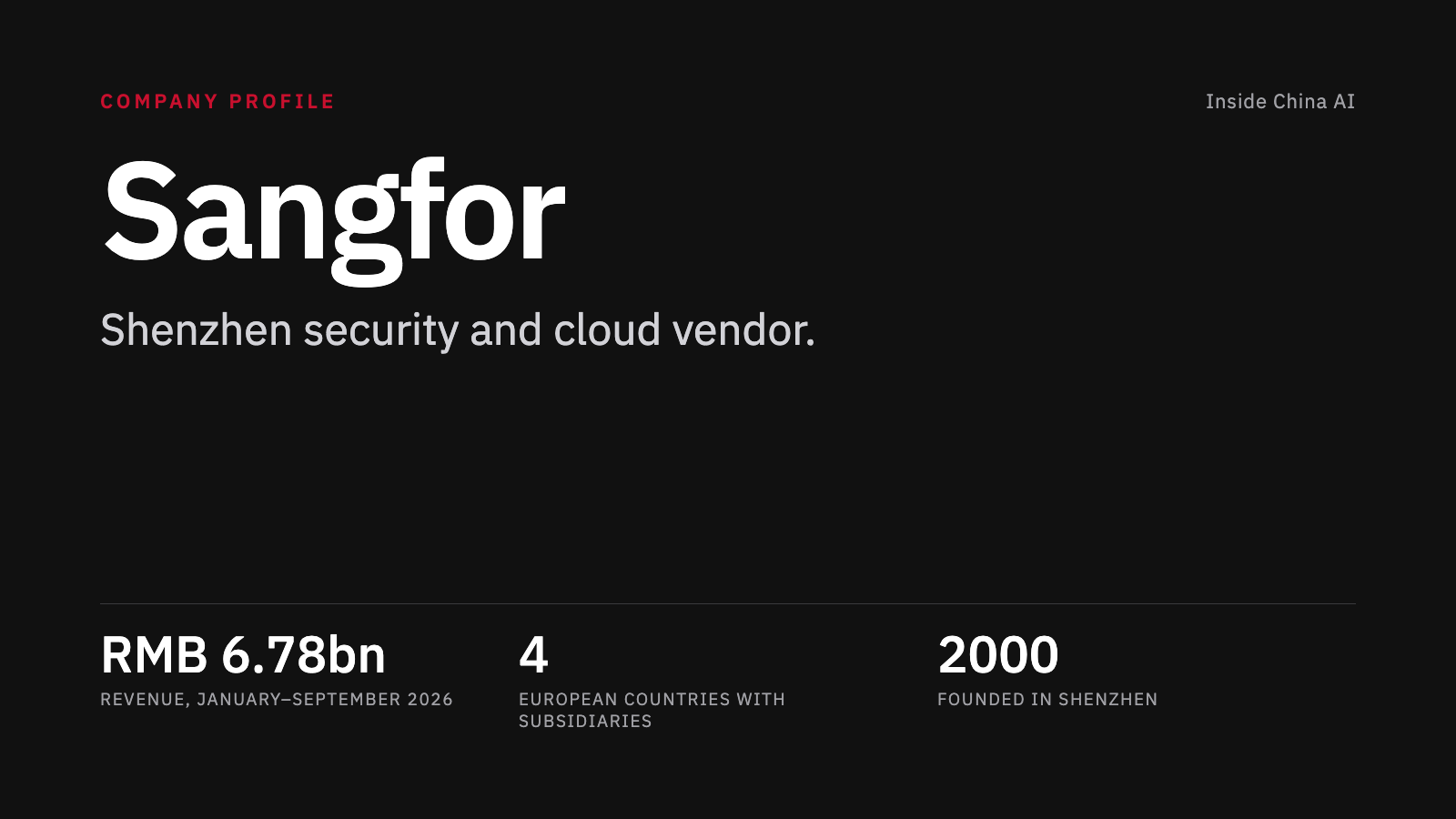
Sangfor Technologies is a Shenzhen-listed maker of firewalls, VPNs and hyperconverged infrastructure, the software that runs a company’s servers, storage and networks as a single virtualised platform. It sells almost entirely through resellers, builds what it describes as its own security language models under the name “Security GPT”, and reported revenue growth of 32 per cent for the first nine months of 2026. Europe matters to it more than its numbers suggest: overseas sales were only 7.45 per cent of revenue in 2025, but Sangfor now has its own companies in the United Kingdom, the Netherlands, Italy and Germany, and is recruiting partners in Germany. For European IT departments it is a supplier of core infrastructure rather than of models, which makes it a different kind of Chinese AI company from the model labs.
Origins and backing
Sangfor (深信服) was founded in Shenzhen in 2000, the company says, and is headquartered in the Sangfor Technology Building in the city’s Nanshan district. According to the 2025 annual report, He Chaoxi, Xiong Wu and Feng Yi set up the company jointly in December 2000. It listed on the ChiNext board of the Shenzhen Stock Exchange (code 300454) with a public offering on 16 May 2018 (annual report 2025).
The company is controlled by its three founders, who act in concert: He Chaoxi, chairman and general manager, held 19.52 per cent at 30 September 2026, Xiong Wu, vice chairman, 16.92 per cent, and Feng Yi, a director and vice president, 7.81 per cent (third-quarter report 2026). The next-largest holder is Hong Kong Securities Clearing, which holds shares for Stock Connect investors, with 3.40 per cent; the rest of the ten largest are private individuals and investment funds, among them a portfolio of China’s National Social Security Fund with 0.73 per cent. Sangfor had 7,282 employees at the end of 2025, 36.2 per cent of them in research and development (annual report 2025).
What they build
Sangfor runs two businesses. The first is cybersecurity: next-generation firewalls, VPNs, endpoint security, zero-trust access, detection-and-response platforms and managed security services. The second, now the larger one, is cloud computing and AI infrastructure: hyperconverged infrastructure (HCI), desktop virtualisation, storage and private cloud. In the first half of 2026 cloud and AI infrastructure brought in RMB 2.21 billion, up 58.6 per cent and 55 per cent of revenue, while security grew 10.6 per cent to RMB 1.59 billion (interim report 2026). The company attributes part of the cloud growth to rising prices for server hardware. Citing IDC, it says it held 19.2 per cent of China’s HCI market in the first quarter of 2026, the largest share.
The AI work sits on top of both businesses. Sangfor says it was the first Chinese security vendor to release a self-developed security large model, “Security GPT” (安全GPT) (annual report 2025). According to the company, the model family is used for traffic detection, security operations, phishing protection and data security. In 2025 Sangfor launched an AI security platform built on a common “security data and model base”, on which customers can train their own security models, and in October 2025 guardrails for large-language-model applications, marketed as “AI protecting AI” (annual report 2025). The company says its platform detects 98 per cent of phishing emails and replaces 80 per cent of manual triage work, and that “Sangfor AI” ranked first in the CyberGym AI security benchmark in August 2026 (interim report 2026). We have not checked these claims against the benchmark operators.
On the infrastructure side Sangfor sells an AI compute gateway that schedules mixed GPU clusters and deploys models. The models it runs there are mostly third-party open models such as DeepSeek, Qwen and Llama, the annual report says; they are not Sangfor’s own. It also offers CoStrict, which it describes as an open-source AI coding tool for companies that develop software on internal networks (Sangfor).
Key numbers
- Listing Shenzhen ChiNext, 300454; founders control about 44 per cent (30 September 2026)
- Q3 2026 Revenue RMB 2.78 billion (+31.5%); net profit attributable to shareholders RMB 345 million (+134%) (Q3 report)
- January–September 2026 Revenue RMB 6.78 billion (+32.3%); net profit RMB 576 million (+815%); non-recurring items added RMB 211 million after tax, mainly fair-value gains of RMB 197 million at two associated investment funds, one of which holds the robot maker Unitree, listed during the period
- Full year 2025 Revenue RMB 8.04 billion (+7.0%); net profit RMB 393 million (+99.5%); R&D spending RMB 2.06 billion, 25.6% of revenue (annual report)
- Overseas share RMB 599 million in 2025, 7.45% of revenue (+24.5%); not broken out for 2026
- Sales model 95.3% of 2025 revenue through channel partners
- AI Security GPT models, AI security platform, LLM guardrails, AI compute gateway, CoStrict coding tool
The European angle
- Group companies Sangfor’s 2025 annual report lists subsidiaries in the United Kingdom (Sangfor Technologies (UK) Limited), the Netherlands (Sangfor Technologies Netherlands B.V.), Italy (Sangfor Technologies Italy S.r.l.) and Germany, where Sangfor Technologies GmbH was set up in October 2025, as well as in Turkey. A second group company, 方未科技 (Fangwei Technology), has units in the Netherlands and Germany; the report lists them only as software companies and does not describe their business (annual report 2025). Worldwide, Sangfor reported 18 overseas branches and offices at the end of 2025 and “more than 20” in mid-2026.
- Italy Italy is Sangfor’s most developed European market. The company entered it in 2018 and had a team of 24 there in April 2025, its Italian country manager told LineaEDP. In October 2026 Sangfor said it had more than 4,450 customers in Italy (Office Automation). One named customer, according to the Milan integrator Comtel: in an undated case study Comtel says it installed Sangfor HCI with disaster recovery for M3S Spa, an IT company that monitors infrastructure (Comtel case study).
- Germany In a press release of 9 November 2026 Sangfor said a team of seven was responsible for the German market and that it worked with more than 20 partners and resellers and three distributors there; it aims for more than 100 partners and more than 100 per cent annual growth over three years (Digital Business). One of those partners, U+P Systemhaus in Cologne, announced on 20 August 2025 that it had become a certified Sangfor reseller (U+P).
- Spain and Poland Spain’s investment agency ICEX-Invest in Spain reported Sangfor’s entry into the Spanish market on 17 September 2021, with the distributor Esprinet, through GTI, as wholesaler (Invest in Spain); the 2025 annual report lists no Spanish subsidiary. In Poland the distributor Stovaris carries Sangfor products (Stovaris).
- Why it matters Sangfor’s European pitch is infrastructure that European companies run on their own premises: virtualisation, firewalls and, increasingly, AI security. That means its software would sit at the core of customers’ networks, and its security models would analyse their traffic and email.
- Lists and warnings In a name search on 27 November 2026 we found Sangfor neither on the US Consolidated Screening List, which includes the Entity List, nor on the Pentagon’s Section 1260H list of Chinese military companies as published on 10 June 2026. The list of current warnings under Section 13 of Germany’s BSI Act did not include Sangfor on the same day (BSI), and the US CISA catalogue of known exploited vulnerabilities listed no Sangfor product in its release of 25 November 2026.
What we could not verify
- Sangfor’s international website blocked our requests, so we could not read its European office list, its European customer stories or its privacy terms for European customers.
- Other named European customers, including public-sector customers in Italy that Sangfor presents as references.
- Europe’s share of revenue: Sangfor reports only one overseas figure, and none for 2026 so far.
- How Security GPT is built: the filings do not say whether it is trained from scratch or based on another company’s model.
- The benchmark results Sangfor cites (CyberGym, AV-Comparatives).
- Whether Sangfor still has its own office in Spain.
The open question for Europe: as Sangfor moves from selling firewalls to selling AI that reads a company’s traffic and email, where will European customers’ security data be processed — and will Sangfor say so?

Comments are closed