Graphic: Inside China AI
Hikvision: The Hangzhou Camera Maker Putting Large Models Into Its Devices
Company profile · 28 November 2026.
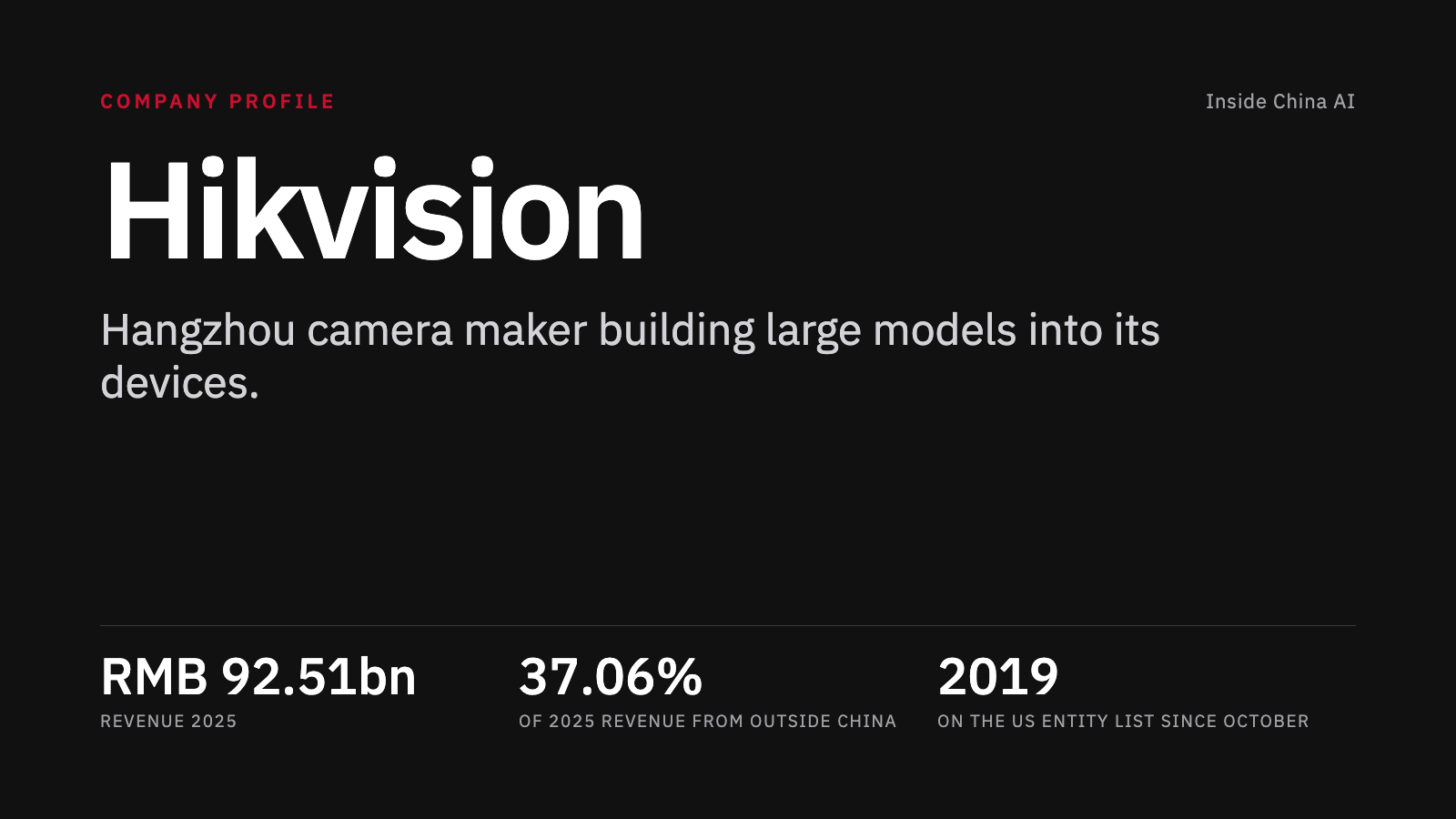
Hangzhou Hikvision Digital Technology makes cameras, recorders, sensors and software, and says it launched “several hundred” AI large-model products in 2025, built on its own Guanlan models. Its revenue was RMB 92.5 billion in 2025, 37 per cent of it from outside China, and its controlling shareholder is the state-owned China Electronics Technology Group. In Europe it has subsidiaries in the Netherlands, the United Kingdom and Italy and a factory in Britain, according to its filings. It is also on four US lists, from the Entity List of October 2019 to the FCC’s Covered List. In Europe, Britain has replaced surveillance equipment from companies subject to China’s National Intelligence Law on sensitive government sites, the Czech cyber agency rates Chinese network cameras a “high risk”, and Amsterdam intends to replace the Chinese cameras it uses. At the same time, an EU cybersecurity certificate was issued for one of its camera series in May 2026.
Origins and backing
Hikvision was registered in Hangzhou on 30 November 2001 as a Sino-foreign joint venture, became a joint-stock company in June 2008 and listed on the Shenzhen Stock Exchange (002415) on 28 May 2010 (interim report 2026). Its chairman, Hu Yangzhong, was an engineer at the 52nd Research Institute of China Electronics Technology Group (CETC) from 1989 to 2001 and then Hikvision’s general manager until August 2024. The current general manager, Xu Peng, came from the same institute in 2004 and started at Hikvision as camera R&D manager (2025 annual report).
The state holds control. On 30 September 2026, CETC Hikvision Group owned 37.28 per cent, CETC Investment Holdings 2.71 per cent and CETC’s 52nd Research Institute 1.97 per cent; the company describes the three as acting in concert. Gong Hongjia, listed as an overseas individual, held 10.50 per cent (Q3 2026 report). The annual report calls the controlling shareholder “central state-owned” and names CETC, a central state-asset body, as actual controller (2025 annual report).
Hikvision also owns large parts of other listed or listing-bound companies. It holds 48 per cent of the smart-home maker EZVIZ, listed in Shanghai (EZVIZ in our directory), and 60 per cent of the machine-vision and warehouse-robot maker Hikrobot (Hikrobot profile). With thermal imaging, automotive electronics and storage, these “innovation businesses” brought in RMB 15.17 billion in the first half of 2026, 32.4 per cent of revenue (interim report 2026).
What they build
Hikvision makes and sells security, network and smart devices, automotive parts and software, and builds systems and projects (interim report 2026). It says it offers more than 30,000 hardware models, and that its factories produced 277 million devices in 2025 (2025 annual report).
The AI work goes back a long way, the company says: an algorithm team since 2006, and in 2023 the “Hikvision Guanlan large model” (观澜大模型), which it says received the industry’s first level-5 rating for model development in an evaluation by the China Academy of Information and Communications Technology. According to the 2025 annual report, Hikvision launched “several hundred” large-model products in 2025, covering visible light, X-ray, millimetre-wave radar and infrared, from cameras to cloud platforms. It describes a tiered “L1 to L4” architecture for large models that run on the device, centred on the camera. For markets outside China the report names DeepinViewX cameras and DeepinMind recorders with embedded vision models, which it says cut false alarms in perimeter protection, and AcuSeek recorders, which use a multimodal model to let users search video in natural language (2025 annual report). We found no model card, parameter count, open weights or independent benchmark for Guanlan.
After a flat 2025, revenue is growing again. In 2025 it was RMB 92.51 billion, up 0.01 per cent; net profit rose 18.52 per cent to RMB 14.20 billion (2025 annual report). In the third quarter of 2026 revenue rose 13.71 per cent to RMB 27.22 billion and net profit 36.97 per cent to RMB 5.02 billion. Hikvision attributes the nine-month profit growth to higher revenue and a higher gross margin. Operating cash flow for January to September fell 47.34 per cent, “mainly due to increased procurement and inventory expenditure”; inventories stood at RMB 33.33 billion on 30 September, against RMB 20.47 billion at the start of the year (Q3 2026 report, English version).
Key numbers
- Listed Shenzhen Stock Exchange (002415) since 28 May 2010 (interim report 2026)
- Ownership CETC Hikvision Group 37.28%, Gong Hongjia 10.50%, CETC Investment Holdings 2.71%, CETC 52nd Research Institute 1.97% (30 September 2026, Q3 2026 report); actual controller CETC
- Revenue RMB 92.51 billion in 2025 (+0.01%), of which RMB 34.29 billion (37.06%) outside China; RMB 74.04 billion in January–September 2026 (+12.60%) (2025 annual report; Q3 2026 report)
- Profit RMB 14.20 billion in 2025 (+18.52%); RMB 12.91 billion in January–September 2026 (+38.55%) (2025 annual report; Q3 2026 report)
- R&D RMB 11.75 billion in 2025; RMB 9.35 billion in January–September 2026 (2025 annual report; Q3 2026 report)
- Staff 57,202 at the end of 2025; R&D and technical-service staff “nearly 50%”, the company says (2025 annual report)
- AI Guanlan large models (since 2023); on-device models in cameras and recorders; no published model sizes
The European angle
- Physical presence Yes. Hikvision Europe B.V. in the Netherlands, founded on 29 September 2009, sells the group’s products; it had revenue of RMB 1.83 billion and a net profit of RMB 21.5 million in 2025. Hikvision UK Limited, founded on 10 April 2014, had revenue of RMB 485 million and a net profit of RMB 22.6 million (guarantee announcement, 18 April 2026). The annual report also names Hikvision Italy S.r.l. and Hikrobot Europe B.V., which the guarantee announcement lists as a sales company in the Netherlands. The organisation outside China is split into four regions, one of them “pan-Europe” (2025 annual report).
- Production Hikvision lists “localised factories” outside China in India, Brazil and the United Kingdom, in addition to its Chinese plants in Tonglu, Chongqing and Wuhan (2025 annual report). The report does not say where in Britain the factory is or what it makes.
- Certification On 15 May 2026, the Dutch certification body TrustCB issued an EU cybersecurity certificate (EUCC, assurance level “Substantial”) for Hikvision’s network camera series iDS-2CD7x, version V5.9.22, valid until May 2031; Bureau Veritas Cybersecurity Europe did the evaluation (ENISA certificate register). Hikvision calls it “the world’s first product in the CCTV camera category” with this certificate (Hikvision via PR Newswire, 3 July 2026). The certificate applies to that series and version.
- Customers The annual report says Hikvision’s retail loss-prevention systems are in use “in Europe and several other markets” and that partners’ software on its platform helps “large cities” in Europe with traffic congestion, but it names no customers (2025 annual report).
- United Kingdom On 24 November 2022 the government told departments to “cease deployment” of surveillance equipment on sensitive sites “where it is produced by companies subject to the National Intelligence Law of the People’s Republic of China”, and not to connect such equipment to core networks (written statement HCWS386). The statement names no company. Hikvision replied that “it is categorically false to represent Hikvision as a threat to national security” and that its cameras comply with UK rules (The Register, 25 November 2022; CNN Business, 25 November 2022). On 18 November 2025 the government said all sensitive sites originally identified “have now finished their replacement work” (written statement HCWS1065).
- Czech Republic A strategic analysis by the national cyber agency NÚKIB, dated 29 August 2025, names Hikvision and Dahua as the largest makers, calls the use of Chinese network cameras in the country a “high risk” and judges it “probable (55–70%)” that some of them are compromised to a degree by Chinese authorities. It cites Hikvision as an example of a formally private company in which Beijing holds a stake (NÚKIB, in Czech). We found no response from Hikvision.
- Netherlands On 5 June 2024 Amsterdam’s executive told the city council that it expects to replace all of its roughly 1,280 Chinese cameras within five years. The council motion behind this asked how equipment “of Chinese make, including the brand Hikvision and Dahua” could be taken out of use. The letter says the city currently imposes “no general restriction” on products made in China (council letter, copy published by IPVM, in Dutch; Binnenlands Bestuur, 10 June 2024).
- US lists Hikvision has been on the Entity List, an export-control list, since 9 October 2019. The Commerce Department said the listed entities “have been implicated in human rights violations and abuses in the implementation of China’s campaign of repression, mass arbitrary detention, and high-technology surveillance against Uighurs, Kazakhs, and other members of Muslim minority groups” in Xinjiang (Federal Register). Hikvision said it “strongly opposes the decision by the U.S. Government and it will hamper efforts by global companies to improve human rights around the world” (Hikvision statement). Since 3 June 2021 the Treasury’s Chinese military-industrial complex list has named Hikvision “for operating or having operated in the surveillance technology sector”; under the order, the notice says, purchases or sales of the listed companies’ publicly traded securities by US persons are prohibited (Federal Register). The Pentagon’s Section 1260H list of “Chinese military companies”, which is not a sanction, says in its notice of 10 June 2026 that “Hikvision is indirectly owned by SASAC and is directly affiliated with the PLA” (Federal Register). When it first appeared on a Pentagon list of Chinese military companies in June 2020, Hikvision said: “This latest inclusion is baseless”, and that it was not a “Chinese military company” (SecurityInfoWatch, 29 June 2020; Reuters via TechCentral, 25 June 2020). Separately from Hikvision’s own entries, its actual controller CETC is itself on the Treasury list since 3 June 2021 (Federal Register) and named in the 1260H notice of June 2026 (Federal Register). Since 12 March 2021 its video-surveillance and telecom equipment has been on the FCC’s Covered List when used for public safety, government facilities, critical infrastructure and national security; a notice in force since 16 July 2026 also bars further imports and marketing of such equipment authorised before the FCC’s 2022 rules, with the critical-infrastructure part suspended for now, while equipment already in use may still be used. The FCC rejected “Hikvision’s arguments that we lack the statutory authority” (Federal Register). We found no EU sanctions (checked 28 November 2026).
- What a European buyer would actually encounter A supplier with its own European companies, an EU certificate for one camera line and a factory in Britain, whose products increasingly carry on-device AI models, and whose use on sensitive public sites depends on the country and sometimes the city.
What we could not verify
- Hikvision’s other European subsidiaries. The filings we read name only the Dutch, British and Italian companies; Hikvision’s own website blocked automated access.
- Where the British factory is and what it produces. The annual report gives neither the site nor output figures.
- Named European customers and Hikvision’s revenue in Europe; the company reports only “overseas”.
- The Guanlan models: size, versions, benchmarks, and which large-model products are sold in Europe.
- Measures in Lithuania, Denmark and at the European Parliament, which we know only from the Czech agency’s summary, not from the governments or institutions themselves.
The open question for Europe: will national security rules or EU certification decide where Hikvision’s AI cameras can be used?

Comments are closed