Graphic: Inside China AI
Montage Technology: The Shanghai Chip Designer Between AI Servers’ Processors and Memory
Part of The Model Layer — profiles of the Chinese AI companies Europe is about to meet. Company profile · 28 November 2026.
Montage Technology builds no AI models and no accelerators. It designs the small chips that sit on server memory modules and on the links between processors, GPUs and memory — parts that AI servers need in quantity. Listed in Shanghai since 2019 and in Hong Kong since February 2026, the company reported record quarterly revenue and profit in October 2026 and links the growth to rising server demand from AI inference and AI agent applications. For Europe, Montage is a supplier one level removed: its memory chips reach data centres through memory module makers, its direct customers, and we found no Montage company, office, partner or customer in Europe.
Origins and backing
Montage Technology (澜起科技) was established in Shanghai on 27 May 2004, according to its 2025 annual report. Its co-founders, Dr Howard C. Yang and Stephen Kuong-Io Tai, still run it: Yang is chairman, chief executive and chief scientist, and Tai is president and an executive director. The board listed in the company’s notice of 20 November 2026 is unchanged from the list of directors of 24 June 2026.
The company was among the first to list on Shanghai’s STAR Market in July 2019 (688008) and added a Main Board listing in Hong Kong in February 2026 (6809), the company says. Its H shares were priced at HK$106.89 and began trading on 9 February 2026; gross proceeds before the over-allotment option were HK$7,043.0 million (allotment results).
Montage has no controlling shareholder and no actual controller, the annual report states. At 30 September 2026 the largest registered holders were the nominees for Stock Connect and for H shares, followed by WLT Partners, L.P. with 3.69 per cent; the report adds that WLT Partners’ controlling person also holds significant interests in another top-ten shareholder, Shanghai Rongying (third-quarter report). Intel Capital, a wholly owned subsidiary of Intel, held more than 5 per cent until 13 June 2024; from 14 June 2024 its stake fell below 5 per cent, according to the annual report.
What they build
Montage has two product lines: interconnect chips and the Jintide server platform. The interconnect chips are the core business. They include memory interface chips that buffer signals between a server’s processor and its DDR5 memory modules, clock chips, PCIe Retimers that keep high-speed signals intact over longer distances, and CXL memory expander controllers (MXC) that let servers add and pool memory. The company presents these together as an AI server solution.
The AI link is specific. According to the interim results of 28 August 2026, a typical AI server with eight GPUs needs eight to sixteen PCIe Retimers, and “certain domestic servers” use 24. The same filing says Montage is “one of the only two suppliers” of first-generation MRCD/MDB chips, used on the high-bandwidth MRDIMM memory modules for AI and cloud servers. Citing Frost & Sullivan, the annual report says Montage ranked first in memory interconnect chips in 2024 with about 36.8 per cent of the global market by revenue and second in PCIe Retimers with about 10.9 per cent.
In its release of 31 July 2026 on trial production of a CXL 3.2 memory expander controller, the company says memory module makers including Samsung and SK hynix have integrated the chip into next-generation CXL products and completed initial validation. Development continues: in the first half of 2026 Montage sampled a sixth-generation DDR5 register clock driver and began preliminary research on DDR6, and it targets an engineering tape-out of a PCIe 7.0 Retimer by the end of 2026, the interim results say.
The second line, Jintide, is an x86 server processor family. The annual report says Montage built it “with the x86 cores that we procured from Intel”, adding its own pre-check and dynamic security-check features; the sixth generation, released in August 2025, has up to 86 performance cores. Jintide brought in RMB 250 million in the first nine months of 2026, against RMB 5,158 million from interconnect chips (third-quarter report).
Key numbers
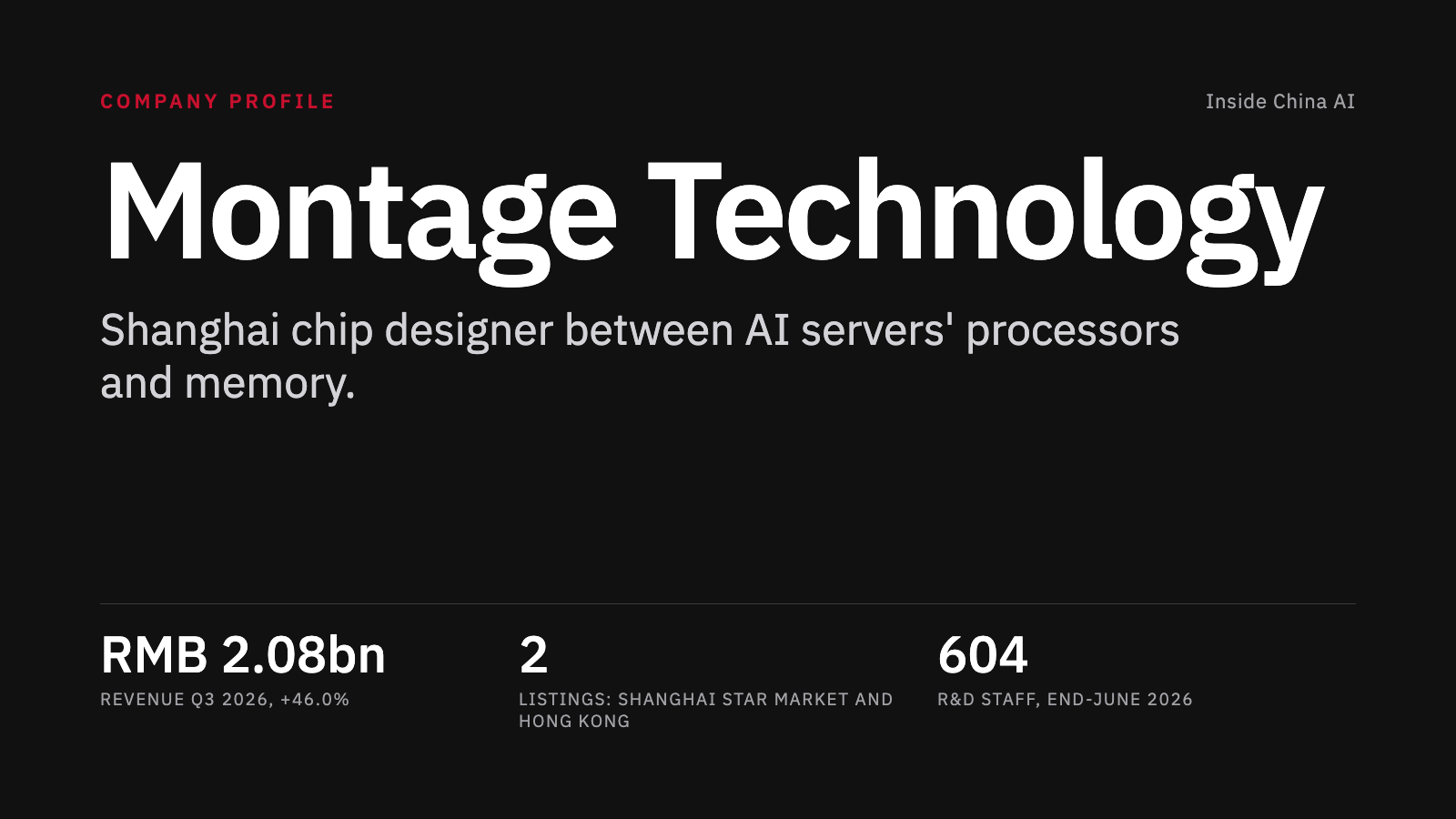
- Listings SSE STAR Market 688008 (July 2019); HKEX Main Board 6809 (9 February 2026)
- Revenue 2025 RMB 5,456 million (+49.9%); profit attributable to shareholders RMB 2,236 million (+58.4%) (annual report)
- Q3 2026 revenue RMB 2,079 million (+46.0% year on year); profit attributable RMB 1,240 million (+162.0%), RMB 1,005 million excluding non-recurring items (third-quarter report, 29 October 2026)
- January–September 2026 revenue RMB 5,414 million (+33.4%); profit attributable RMB 3,237 million (+98.3%); investment income and fair-value gains in the period totalled RMB 904 million, the company says
- Interconnect chips Q3 2026 revenue RMB 2,047 million, gross margin 68.4%; order backlog for Q4 2026 delivery RMB 2.50–2.79 billion as of 26 October 2026, the company estimates
- Research 604 R&D staff at end-June 2026, 74.1% of employees (interim results)
- Customers five largest customers 77.2% of 2025 revenue, the largest 29.7% (not named)
- AI no AI models; memory interface, PCIe Retimer, CXL and clock chips for AI and cloud servers; Jintide x86 server CPUs
The European angle
- Physical presence None found. Montage lists branch offices in mainland China, Macao, the United States and South Korea (company website). The subsidiaries in the 2025 annual report are registered in mainland China, Hong Kong, Macao, the Cayman Islands, the British Virgin Islands and the United States; none is in Europe. The interim results mention offices in “the United States, South Korea and other regions” without naming them.
- Customers and sales Montage’s direct customers for memory interface chips are memory module makers, the annual report says, and its principal customers, suppliers and chip-design tool licensors are “predominantly overseas entities”. It reports revenue only as “Mainland China and Hong Kong” and “Others”; in 2025, RMB 2,925 million of its RMB 5,456 million total revenue came from South Korea (interim results). We found no European customer, distributor or partner named by the company, and no European trade-fair appearance in 2026.
- Investigation in South Korea On 15 July 2026 (South Korea time) the Fair Trade Investigation Division of the Seoul Central District Prosecutors’ Office began an on-site search and seizure at the office of a Montage group company in South Korea “regarding an investigation of a potential competition law violation”, the company disclosed in a voluntary announcement of 16 July 2026. As of 28 August 2026, it said, no group company, director or employee had been charged, the group was cooperating fully, and neither the timing nor the outcome of the investigation could be predicted (interim results). Its later HKEX filings up to 28 November 2026, including the third-quarter report of 29 October 2026, contain no update.
- Lists Our name check on 28 November 2026 found no entry for Montage Technology or 澜起科技 on the EU consolidated financial sanctions list, the US Consolidated Screening List (including the Entity List) or the US Department of Defense 1260H list. In its annual report, the company names a further tightening of semiconductor export controls as a risk to its business and personnel.
- What a European buyer would actually encounter Most likely not Montage itself, but its chips on server memory modules and in servers bought from other suppliers — a link in the supply chain that the company’s filings do not trace to Europe.
What we could not verify
- Who the largest customer is, at 29.7 per cent of 2025 revenue; the company does not name it.
- Any sales to European customers or a European distributor; the regional breakdown does not show Europe.
- Which “other regions” the interim results mean when listing Montage’s offices.
- The state of the South Korean investigation after 28 August 2026.
The open question for Europe: as European data centres add memory for AI workloads, how much of it already runs through Montage chips — and will the company ever sell here directly?

Comments are closed