Graphic: Inside China AI
Iluvatar CoreX: A Shanghai GPU Designer, Listed in Hong Kong, That Sells Almost Only in Mainland China
Company profile · 28 November 2026.
Iluvatar CoreX (天数智芯) is a Shanghai designer of general-purpose graphics processors for training and running AI models. It listed in Hong Kong on 8 January 2026 and reported revenue growth of 191.6 per cent for the first half of 2026 together with a profit, which it attributes primarily to an unrealised gain on a shareholding. In 2025 and the first half of 2026 all of its revenue came from mainland China and Hong Kong. We found no European entity, partner or customer, and no listing on the main EU and US restriction lists when we checked on 27 November 2026. For Europe, Iluvatar CoreX is not a supplier. It matters as one of the companies building China’s AI computing on domestic chips.
Origins and backing
The company, legally Shanghai Iluvatar CoreX Semiconductor Co., Ltd., was established in Shanghai on 29 December 2015 as a limited liability company and became a joint-stock company in January 2025. Its registered office is in Minhang District, Shanghai (interim results 2026). According to the timeline on its website, it raised a Series A in February 2018, formally began designing GPU chips in June 2018, moved its headquarters to Minhang in February 2020 and put its Tiangai 100 training card into volume production in September 2021 (Iluvatar CoreX).
Gai Lujiang, chairman and chief executive, joined in July 2020 after about 17 years in finance and investment and is a certified public accountant in China (annual report 2025); he signed the company’s announcement of 2 November 2026 as chairman (announcement). Chip development is led by executive director and vice president Sun Yile, who joined in January 2018 after 14 years in GPU chip design, the annual report says. Wang Peng has been chief financial officer since 13 February 2026 (announcement).
At 30 June 2026, Gai was deemed interested in 21.25 per cent of the shares, held by shareholding platforms whose general partner he wholly owns. Funds of Centurium Capital, controlled by Li Hui, held 24.12 per cent; a unit of the state-owned bank ICBC holds a 46.1 per cent limited-partner interest in the largest of these funds. Funds with state or district investors from Shanghai, Beijing, Sichuan and Qingdao held smaller stakes, each below 1.4 per cent (interim report 2026). These percentages date from 30 June 2026, before the July placing and the capitalisation issue described below; we found no updated shareholder table in later filings.
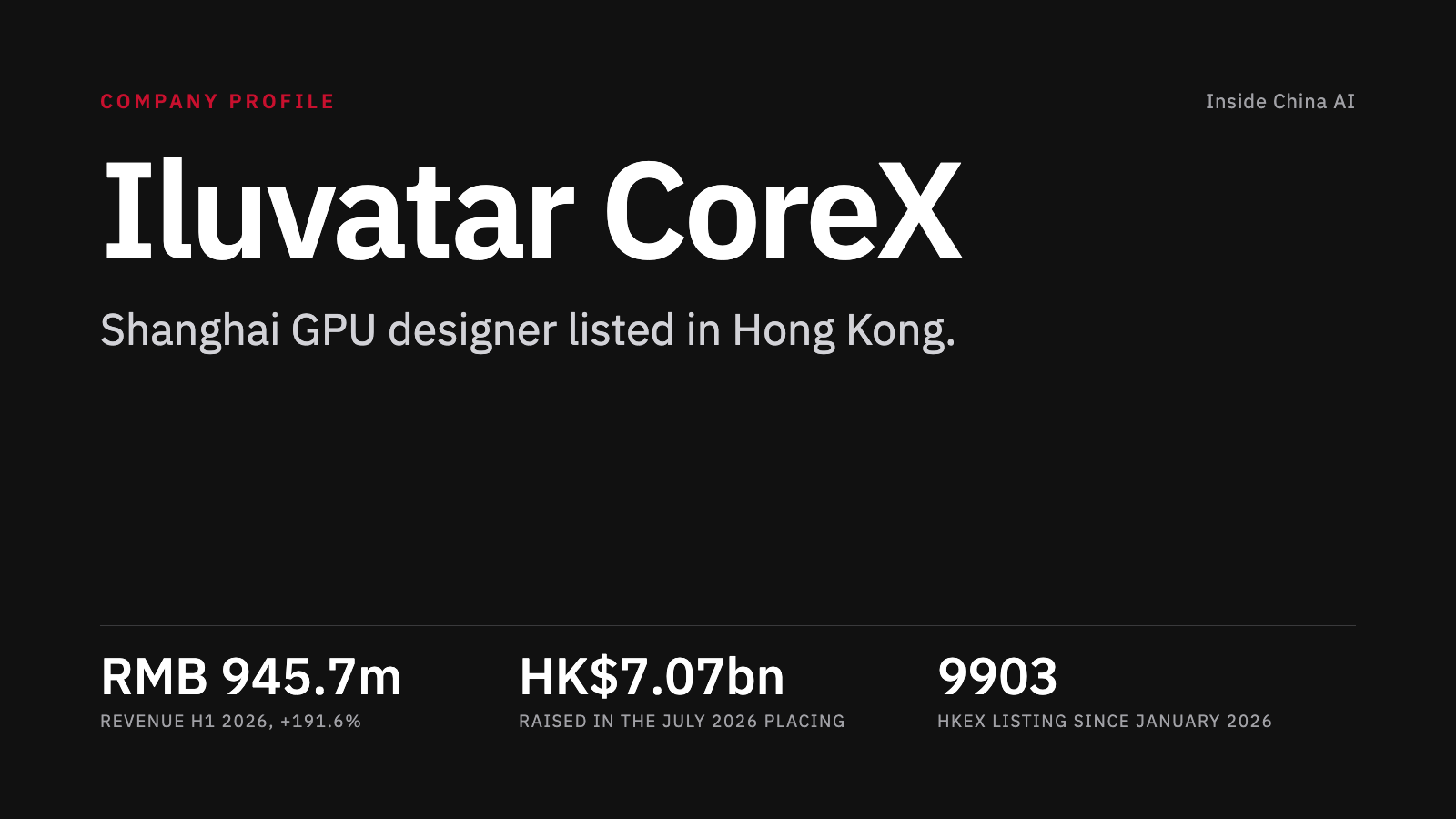
The Hong Kong listing on 8 January 2026 sold 25.4 million H shares at HK$144.60 each, raising HK$3.68 billion gross; the retail tranche was subscribed 414 times (allotment results). On 13 July 2026 the company placed another 14.9 million new H shares at HK$476.00, for HK$7.07 billion gross, and said it would spend 60 per cent of the net proceeds on “supply-chain resilience and procurement planning for critical materials and components” (completion announcement). A capitalisation issue of two new shares for every share held then raised the share count from 269.2 million to 807.5 million (announcement). The stock joined the Hang Seng TECH Index on 7 September 2026 (announcement). On 16 October 2026 the company applied to the China Securities Regulatory Commission to convert its remaining 27.6 million unlisted shares, about 3.42 per cent, into H shares; the filing was not yet complete (announcement).
What they build
Iluvatar CoreX sells general-purpose GPUs (GPGPUs) and computing systems built on them; GPU products made up 96.9 per cent of revenue in the first half of 2026 (interim results 2026). The Tiangai (天垓, TG) series is for training; the company calls it “China’s first domestically mass-produced GPGPU product”. The Zhikai (智铠, ZK) series is for inference in data centres and at the edge; its revenue rose 651.8 per cent to RMB 654.2 million in the first half of 2026. The Tongyang (彤央) edge modules were launched in January 2026 with a four-generation chip roadmap, and a new flagship, TG Gen 4, followed in July 2026. It also sells servers and clusters and runs an open-source software community, DeepSpark (Iluvatar CoreX). We found no AI models of its own; its chips train and run other developers’ models.
The company relies on others to make its chips. It names “heavy reliance on third-party contract manufacturers and a limited pool of key suppliers for critical components, EDA software and IP cores” among its main risks and does not name its foundry; in 2025, 171 of its 180 suppliers were in mainland China (annual report 2025).
At a media day in Shanghai on 28 October 2026 the company demonstrated its Tiangai 300 for the first time and presented an IXL144 “supernode” with 144 GPUs and about 10.1 terabytes of memory in a single rack, which it called the densest of its kind, the 21st Century Business Herald reported on 30 October 2026. These are company claims; we found no independent benchmark.
The company does not name its customers. It says it had served more than 380 by 30 June 2026, (interim results 2026). In 2025 its five largest customers accounted for 43.0 per cent of revenue and the largest for 16.1 per cent (annual report 2025). On 2 November 2026 it said it had shipped more than 80,000 chips in the first ten months of 2026, a figure it describes as unaudited and not an indication of revenue (announcement).
The company attributes its first-half profit “primarily” to an unrealised gain on its shares in SJ Semiconductor, a company listed in Shanghai. Iluvatar CoreX invested RMB 100.0 million for about 0.27 per cent; at 30 June 2026 the stake, still within a lock-up period, was valued at RMB 855.9 million, an unrealised gain of RMB 755.9 million (interim report 2026). Over the same period the gross margin fell from 50.1 to 17.2 per cent. The filing attributes the lower GPU margin to the product mix; a new line of semiconductor components showed a gross loss of RMB 171.0 million, and inventories were written down by RMB 72.2 million. Operating activities used RMB 2.79 billion in cash (interim results 2026).
Key numbers
- Listing Hong Kong Main Board (9903) since 8 January 2026; HK$3.68 billion raised at the listing and HK$7.07 billion in the July 2026 placing, gross
- Revenue RMB 945.7 million in January–June 2026, up 191.6 per cent, unaudited (interim results 2026); RMB 1.03 billion in 2025, up 91.6 per cent (annual report 2025). The company reports half-yearly; there are no third-quarter figures.
- Result Profit of RMB 106.3 million in the first half of 2026, primarily from an unrealised investment gain, according to the company; loss of RMB 1.00 billion in 2025
- Gross margin 17.2 per cent in the first half of 2026, down from 50.1 per cent a year earlier
- Research and development RMB 558.9 million in the first half of 2026 (interim report 2026)
- Shipments More than 80,000 chips in January–October 2026, according to the company, unaudited
- Staff 916 full-time employees at 30 June 2026, more than 650 of them in R&D (interim results 2026)
The European angle
- Physical presence None found. The subsidiaries named in the 2025 annual report are all in mainland China, and the company says its non-current assets were all located there (annual report 2025). We found no European office, distributor, partner or customer in its filings, on its website or in news coverage.
- Where it sells In 2025, RMB 1,033.4 million of revenue came from mainland China and RMB 0.2 million from Hong Kong (annual report 2025); in the first half of 2026, RMB 930.9 million and RMB 14.8 million (interim report 2026). No other region appears.
- Regulatory exposure Iluvatar CoreX is not on the EU’s consolidated list of financial sanctions, the US Consolidated Screening List (which includes the Commerce Department’s Entity List) or the Pentagon’s 1260H list, according to our name check of the published lists on 27 November 2026. The company itself lists export controls, economic sanctions and outbound investment rules among its key risks (annual report 2025).
- Why it still matters European companies that buy AI computing in China may meet Iluvatar CoreX hardware in local data centres.
What we could not verify
- Performance. Claims for the Tiangai 300 and the IXL144 come from the company; we found no independent benchmark.
- Manufacturing. Which foundry makes the chips, and on which process.
- Customers. The filings name none.
- Products. Whether TG Gen 4, released in July 2026, is the Tiangai 300 shown in October; the company’s documents we read do not say.
- Early history. Who founded the company and what it did between its establishment in December 2015 and the Series A in 2018.
The open question for Europe: will a Chinese GPU maker that sells almost entirely at home look for customers abroad at all?

Comments are closed