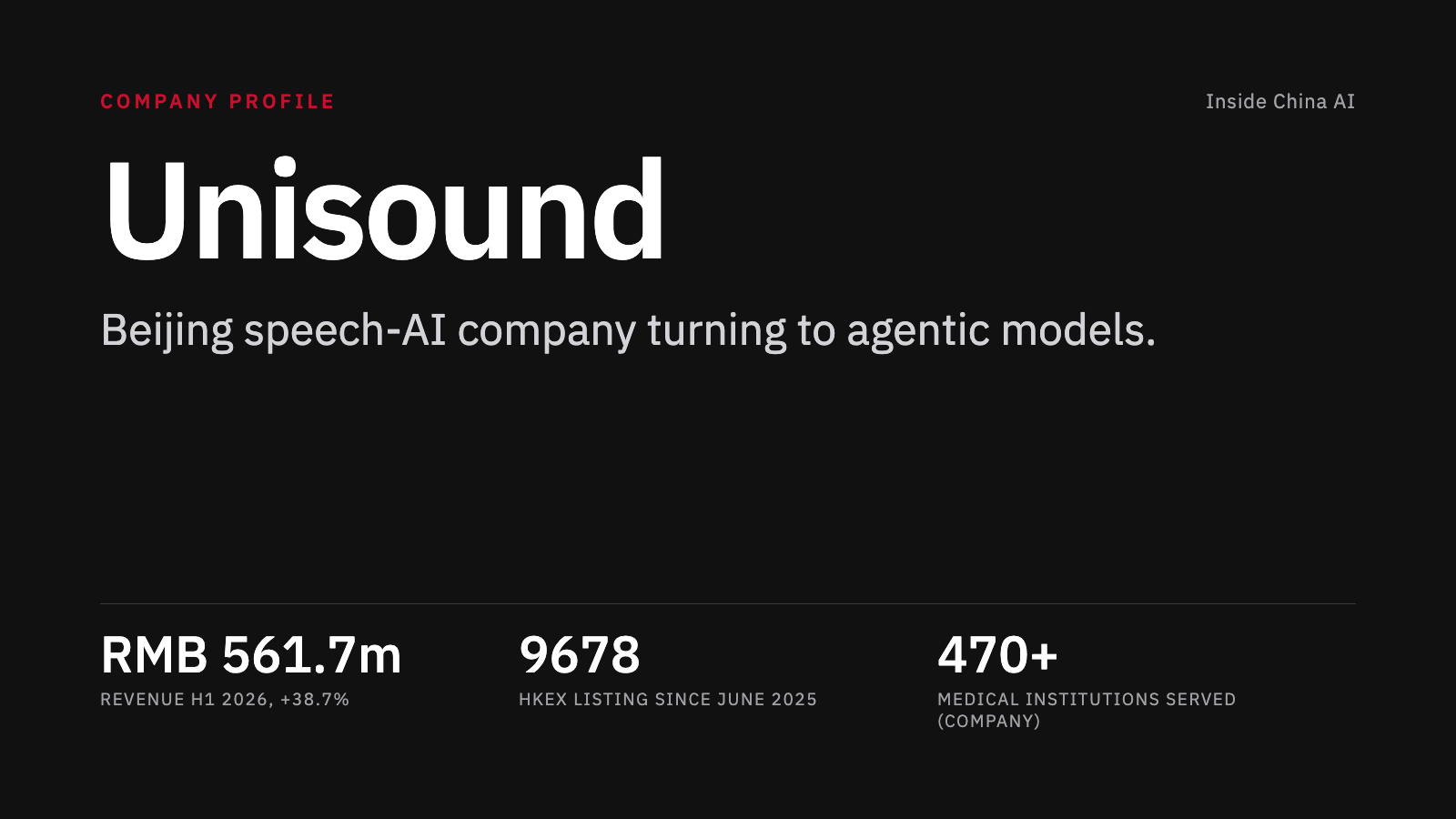
Graphic: Inside China AI
Unisound: A Beijing Speech-AI Veteran Turns to Agentic Models, With Its Business Still in China
Company profile · 28 November 2026.
Unisound (云知声) has built speech recognition, voice chips and hospital software in China since 2012, and has been listed in Hong Kong since June 2025. In 2026 it repositioned itself around its own large models, the U2 family, and began selling them by the token. Revenue grew about 53.3 per cent year on year in the third quarter of 2026, according to company figures that are unaudited and not confirmed by its auditors (inside-information announcement filed with HKEX, 23 November 2026), and the company joins the Hang Seng Tech Index on 7 December 2026 (announcement). It is still loss-making. For Europe, Unisound is a company to watch rather than one to meet: it names Europe among the “key overseas markets” for its speech models, but its filings show no European entity, partner or customer, and its own API terms say the service is to be used inside mainland China.
Origins and backing
The company was founded in Beijing on 29 June 2012 and became a joint-stock company in 2019; its legal name is Unisound AI Technology Co., Ltd. (雲知聲智能科技股份有限公司), with headquarters in Haidian District (interim report 2026; Unisound). It started with a cloud speech-recognition platform and says it was among the first companies to use deep learning for commercial speech recognition (Unisound). Its co-founders lead it today: Liang Jia’en is chairman and chief technology officer, Huang Wei is chief executive (annual report 2025; announcement of 23 November 2026).
Unisound’s H shares began trading on the Hong Kong Stock Exchange (stock code 9678) on 30 June 2025 at HK$205 each. The offering raised HK$368 million gross (interim report 2026). The company then raised more money through three share placements in 2026: HK$196.6 million in January at HK$252 a share, HK$312.5 million in February at HK$310, and HK$387.6 million in June at HK$228 (interim report 2026).
Control remains with the founders. Huang Wei, Liang Jia’en and the executive director Kang Heng act in concert and, with their holding vehicles, are the controlling shareholders. On 30 June 2026 they were interested in 9.46 per cent of the issued capital through H shares and 22.07 per cent through unlisted domestic shares. Other substantial shareholders at that date included funds of the investment firm Trustbridge Partners, the China Internet Investment Fund (中國互聯網投資基金), the investment bank CICC and JD.com (interim report 2026).
What they build
Unisound has three businesses. The largest is “enterprise intelligent services”: agent applications, agent platforms and integrated solutions for hospitals, insurers, transport operators and other organisations in more than ten sectors. The second is a new token business, which sells access to its models through a pay-per-use API. The third is “edge AI”: voice chips, modules and in-car voice technology (interim report 2026). The company says it supplied about 13 million consumer AI chips in 2022 and licenses its chip design technology (NPU IP) for car chips. By 30 June 2026, it says, it had served more than 470 medical institutions, over 80 per cent of them tertiary hospitals (interim report 2026).
Its first large model, Shanhai (山海), launched in 2023. The prospectus describes it as a 60-billion-parameter language model with multilingual and multimodal generation (prospectus, 20 June 2025). Its current model family is U2, introduced in the first half of 2026: a sparse mixture-of-experts model with 260 billion parameters, of which about 10 billion are active; the company says it can carry out workflows of more than 100 steps on its own (interim report 2026). U2-Flash followed on 15 September 2026. It is built on U2 for coding and agent tasks, has about 266 billion parameters with about 10 billion active, and the company calls it its first step towards “recursive self-improvement”, with the model helping to generate its own training tasks (announcement of 15 September 2026). An update, U2-Flash-1118, followed on 18 November 2026: it keeps the language backbone unchanged and adds a vision module of about 1 billion parameters (announcement of 18 November 2026).
The family also includes models for specific fields: U2-Med for medicine, health insurance and pharmaceuticals, U2-RadiMed for medical imaging, U2-ASR and U2-TTS for speech, and U1-OCR for documents. The company says U2-Med scored first among the evaluated models on OpenAI’s HealthBench medical benchmark in results published in October 2026 (announcement of 23 November 2026). We found no open weights for any Unisound model on Hugging Face. The models are offered through Unisound’s own API platform (Unisound MaaS) and, for U2, through Alibaba Cloud‘s Model Studio in the China (Beijing) region (Alibaba Cloud).
The token business is small but growing fast. In the first half of 2026 it brought in nearly RMB 30 million, more than RMB 25 million of it in the second quarter. The company says the growth was “mainly driven by US-dollar revenue”, without naming customers or countries (interim report 2026). By 23 November, it says, U2-Flash was handling a weekly token volume at “trillion level” (announcement of 23 November 2026).
Key numbers
- Founded 29 June 2012, Beijing; co-founders Liang Jia’en (chairman, CTO) and Huang Wei (CEO)
- Listing Hong Kong Stock Exchange since 30 June 2025 (9678.HK); IPO at HK$205; joins the Hang Seng Tech Index on 7 December 2026 (announcement)
- Revenue 2025 RMB 1,211.4 million, up 29.0 per cent; loss for the year RMB 329.5 million (annual report 2025)
- First half 2026 Revenue RMB 561.7 million, up 38.7 per cent; loss RMB 238.7 million; research and development spending RMB 284.1 million, up 69.0 per cent (interim report 2026, unaudited)
- Third quarter 2026 Revenue about RMB 344 million, up about 53.3 per cent; gross margin about 41.8 per cent (announcement of 23 November 2026; company figures, unaudited, not confirmed by the auditors and subject to adjustment; no net result given)
- Models Shanhai (2023), U2 and U2-Flash (2026), plus U2-Med, U2-RadiMed, U2-ASR, U2-TTS, U1-OCR; no open weights found on Hugging Face (27 November 2026)
- Staff 483 full-time employees on 30 June 2026 (interim report 2026)
The European angle
- Physical presence None found. The principal subsidiaries listed in the 2025 annual report are all in mainland China, and the company’s contact list names offices in Chinese cities and one company in Hong Kong (annual report 2025; Unisound). The interim report states that the group’s revenue comes mainly from China and that all its operating assets are there (interim report 2026).
- Stated interest In the filings we checked (prospectus, annual report 2025, interim report 2026 and the model and business announcements of July to November 2026), Europe appears as a market only once, as a language market. On 28 July 2026 Unisound said that U2-ASR had added 13 international languages “covering Europe, Southeast Asia, the Middle East and Latin America and other key overseas markets” (announcement of 28 July 2026; our translation). The 2025 prospectus planned to enter overseas markets through overseas partners and distribution channels, without naming countries, and noted the risks of geopolitics and trade policy (prospectus).
- Where it goes abroad instead The concrete overseas projects named so far are outside Europe. Working with China Mobile and others, Unisound used U2 to write live-stream scripts for an Ethiopian cross-border e-commerce company. Its “token export” base in Xiamen opened in September 2026, and it plans overseas sites in Malaysia and Ethiopia (announcement of 23 November 2026). The company says its shipments of edge AI chips for overseas markets rose 50 per cent in the first half of 2026, without naming the countries (interim report 2026).
- Who a developer contracts with Unisound’s API platform is run by the Beijing parent. Its user agreement says the customer “shall use the service within China (for the purpose of this agreement, excluding Hong Kong, Macao and Taiwan)”, and its privacy policy says: “We store personal information collected within the People’s Republic of China within the People’s Republic of China” (user agreement; privacy policy; our translation). We found no international version of the platform. U2 is also not listed on OpenRouter, and on Alibaba Cloud’s Model Studio it is offered only in the Beijing region.
- Lists Unisound is not on the EU’s consolidated financial sanctions list, the US Consolidated Screening List (which includes the Entity List) or the Pentagon’s 1260H list, according to our check of the published lists on 27 November 2026.
What we could not verify
- Who pays the US-dollar token revenue, and from which countries.
- Which overseas markets buy its edge AI chips.
- Any European customer, partner, distributor or office. We found none; that does not prove there are none.
- The benchmark results for U2-Flash and U2-Med. These are the company’s own statements; we did not check them against the leaderboards.
The open question for Europe: will Unisound’s multilingual speech models reach European customers through a contract outside mainland China, or only through the Chinese companies that use them abroad?

Comments are closed