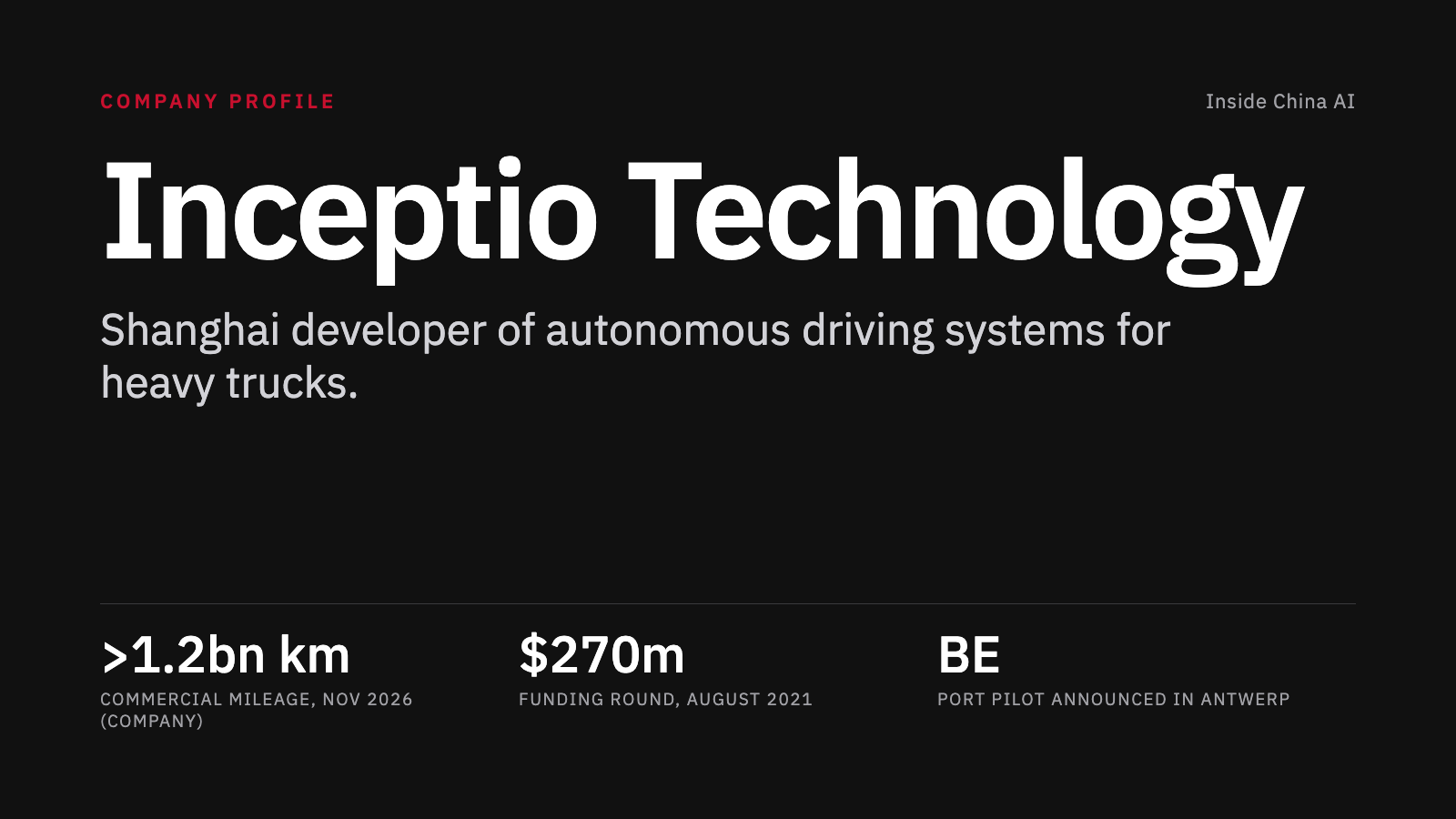
Graphic: Inside China AI
Inceptio Technology: The Shanghai Truck-Autonomy Company Preparing Its First European Pilot in Antwerp
Company profile · 28 November 2026.
Inceptio Technology (嬴彻科技) writes the software and builds the computers that let Chinese heavy trucks steer, brake and change lanes on motorways while a driver supervises. The company says its systems have covered more than one billion kilometres in commercial freight. In September 2026 the Port of Antwerp-Bruges named it as the technology partner for the port’s first commercial pilot with an autonomous truck, and in Shanghai it signed a memorandum with a Luxembourg haulier in the presence of Luxembourg’s economy minister. For Europe, Inceptio is a supplier preparing its entry rather than one already in business: it names a representative office in Germany and a head of Europe, but no European customer with trucks in operation, and we could not confirm that the Antwerp pilot has started.
Origins and backing
Inceptio was founded in April 2018 with research centres in Shanghai and Fremont, California (Inceptio). Its headquarters are on the Changyang Campus in Shanghai’s Yangpu district; its US office is now in Santa Clara, and the company’s website names Jiluo Technology (Shanghai) Co., Ltd. as the operator (Inceptio). Its founder and chief executive is Julian Ma (马喆人) (Inceptio; Luxembourg government).
The company is privately held and has not published a valuation. It raised $100 million in April 2020 and $120 million in November 2020; the second round was led by the battery maker CATL, with GLP, NIO Capital and G7, which Reuters called “Inceptio’s key strategic investor”, taking part (Reuters, 9 November 2020; Paperjam). On 3 August 2021 it closed a $270 million Series B led jointly by JD Logistics, Meituan and PAG, with IDG Capital, Deppon Express and others joining (Inceptio release). In February 2022 followed a $188 million Series B+ led by Sequoia Capital China and Legend Capital (Inceptio; National Business Daily). We found no later funding round and no stock-exchange filing.
What they build
Inceptio’s product is a full-stack driving system for heavy trucks, which it calls Xuanyuan and first released in March 2021 (Inceptio). In daily use it runs as Truck Navigate-on-Autopilot (T-NOA): the truck controls speed and changes lanes on motorways “while the driver remains responsible for supervision”, the company says (Inceptio). Inceptio says it rolled out the first series-production L3 trucks with Chinese manufacturers in late 2021 (Inceptio); its product page lists models from Dongfeng, Sinotruk (Huanghe and Sitrak), Foton and Chenglong (Inceptio). Customers it names include the express carriers ZTO, YTO, STO and Deppon (Inceptio).
The hardware is Inceptio’s own. Since June 2026 its Taurus control unit has been in mass production, the company says; it runs on a single Journey 6M chip from the Chinese chip designer Horizon Robotics with 128 TOPS, and its perception models now use a Transformer architecture (Inceptio, 17 June 2026).
The AI story changed in September 2026. Inceptio now describes its work as “Freight Physical AI”: end-to-end driving models trained around truck dynamics and load, a “Freight World Model” — in the company’s words “a composable simulation and reconstruction system built from real-world freight data” — a library of real-world scenarios, and a cloud platform that turns alerts from single trucks into fleet-level information (Inceptio release, 8 September 2026).
Fully driverless operation is still a goal. Inceptio says it holds L4 test permits in Zhejiang, Beijing and Hainan, and since May 2026 has run a commercial pilot of driverless light-duty trucks on public roads with SF Express (Inceptio). With JD Logistics it runs an L4 cargo demonstration on a 31-kilometre route in Beijing, with a Sitrak truck that, fully loaded, runs at a combined truck-and-trailer weight of 43 tonnes (Inceptio, 27 October 2026). In May 2026 Ma told CNBC that Inceptio was keeping to “a mid-2028 commercialization milestone” (CNBC); in September the company said it expected to collect about 8 billion kilometres of data by 2028 and was “targeting commercial operations with no driver in the cab around the same timeframe” (Inceptio). In the CNBC interview Ma had named 5 billion kilometres.
Key numbers
- Founded April 2018, Shanghai; founder and CEO Julian Ma
- Ownership private; disclosed rounds of $100m and $120m (2020), $270m (August 2021) and $188m (February 2022); no valuation published
- Mileage more than 1 billion km of commercial operation by August 2026 (Inceptio), more than 1.2 billion km by November 2026 (Inceptio), the company says
- Fleet about 7,000 trucks remotely managed in September 2026 (Inceptio); “more than 10,000 commercial trucks” equipped by November 2026 (Inceptio), company figures
- Market “more than 90% market share in China’s autonomous trucking market” and about 97 per cent of China’s motorway network covered, the company says, without naming a source for the share (Inceptio)
- AI Xuanyuan driving system, T-NOA, freight-native end-to-end models, Freight World Model; Taurus control unit on a Horizon Journey 6M chip
- Europe announced port pilot in Antwerp (Belgium); MoU in Luxembourg; representative office in Germany, the company says
The European angle
- Belgium: the port pilot On 16 September 2026 the Port of Antwerp-Bruges announced that, together with Inceptio and the logistics company Group-GTS, it “will launch its first commercial pilot project involving an autonomous truck in the Antwerp port area”. The truck, “fitted with autonomous technology from Inceptio, will transport containers day and night” between the Group-GTS depot in Kallo on the Left Bank and container terminals on the Right Bank; a next phase is to extend the project towards North Sea Port and Rotterdam (Port of Antwerp-Bruges). The port put the start in the autumn; eurotransport, citing the Belgian trade title Transportmedia, reported on 16 July 2026 that the vehicle is a Sitrak tractor unit with an SAE Level 4 package (eurotransport). Inceptio referred to “ongoing pilot activities” there on 23 September (Inceptio). By 27 November 2026 we found no announcement from the port or Group-GTS that regular runs had begun.
- Luxembourg: a memorandum On 23 September 2026 Inceptio signed a memorandum of understanding with the Luxembourg haulier Arthur Welter Transports in Shanghai, during an economic mission led by the economy minister Lex Delles, who had visited Inceptio two days earlier (Inceptio; Luxembourg government). The two companies want to test autonomous freight in Luxembourg and on cross-border corridors. Paperjam noted that the agreement came without “any announcement regarding trucks ordered, a test route or a date for the service to begin” (Paperjam). Inceptio says it is “exploring Luxembourg as a potential base for its European operations”.
- Germany: a representative office Inceptio says it has had a representative office in Germany since 2024 and has since been in contact with European truck makers, logistics operators and suppliers (Inceptio, 3 March 2026); it does not give an address, and we found no German company. Julian Ma presented at the Next Truck conference in Berlin in November 2025 (Inceptio release) and, the company says, attended a symposium of the China–Germany economic advisory committee in Beijing on 25 February 2026 (Inceptio). The head of Europe is Kai Xue (Inceptio).
- Preparing for European truck makers In April 2026 Inceptio announced Automotive SPICE Capability Level 2 certification, a process standard set by the German automotive association VDA, which it presented as a prerequisite for working with “international truck makers and Tier-1 suppliers” (Inceptio). No European truck maker has been named as a partner.
- Lists A name check on 27 November 2026 found no entry for Inceptio on the EU’s consolidated financial sanctions list, the US Consolidated Screening List (including the Entity List) or the Pentagon’s 1260H list.
- What a European haulier would actually encounter For now, a Chinese supplier looking for its first European routes: a port pilot in Antwerp, a memorandum in Luxembourg, and a system that in China still needs a driver at the wheel.
What we could not verify
- Whether the Antwerp pilot is running, on which roads, and whether a safety driver is on board.
- Where the German representative office is and in what legal form.
- Inceptio’s fleet and market-share figures, which are the company’s own and use different bases: operating, remotely managed and equipped trucks.
- The current shareholder structure, valuation and revenue; the company publishes no financial figures.
- Any approval path for Inceptio’s system under European vehicle rules.
The open question for Europe: will the Antwerp pilot turn Inceptio’s Chinese motorway kilometres into a European customer, and with which truck maker would it come here?

Comments are closed