Graphic: Inside China AI
Neolix: China’s Driverless Delivery Vans Look for a Start in Europe
Company profile · 28 November 2026.
Neolix builds and operates small driverless delivery vans for parcel depots, shops and warehouses. In China, the company says, its vans work for the big courier groups, and its fleet passed 30,000 vehicles in 2026. In Europe it is at the start: a planned European headquarters in Luxembourg, a Brussels pilot that was still waiting for a federal test permit when it was announced, and a proof of concept with a Portuguese partner. For European cities, the questions are practical: what a driverless van on a public road needs to be allowed to do, who supervises it, and where its data goes. Neolix’s first European projects are meant to answer them.
Origins and backing
Neolix (新石器) was founded in 2018 and is based in the Beijing Economic-Technological Development Area. Its legal name is 新石器慧通科技股份有限公司, a joint-stock company (neolix.net). The founder and chief executive is Yu Enyuan (Neolix, 23 October 2026; Gasgoo). Will Zhao is executive president and speaks for the company in its European announcements (Nikkei Asia via KrASIA). Beijing gave Neolix the first robovan permit in 2021, according to the same report.
Neolix is privately held and backed by venture and state-linked investors. In October 2025 it announced a Series D of more than $600 million, led by the UAE-based Stone Venture with co-leads including CITIC Capital, CDH VGC and the Beijing AI industry investment fund (Neolix, 23 October 2025). On 20 October 2026 it announced a Series E of nearly $400 million, co-led by Boyu Capital and a “national-level fund” that the company did not name. New investors include Alibaba’s AEF NextGen Hong Kong fund, Temasek’s Vertex Growth and GAC Capital; SoftBank Asia and other existing shareholders followed on. The company puts its cumulative funding above 10 billion yuan (Neolix, 20 October 2026; TechNode). It has not published a valuation, revenue or profit.
What they build
The core product is a battery-electric van without a cab, built for Level 4 driving on set routes in cities: from depots to parcel stations and between warehouses and stores. Outside China, the vans are sold under the brand Xolra. The two main models, the company says, are the X3, with 3 cubic metres of cargo space, 520 kg payload, a range of 120 km and a top speed of 50 km/h, and the X6, with 6 cubic metres, up to 1,130 kg and 200 km. Both carry 12 cameras and one lidar (Neolix, 28 September 2026). Since 25 August 2026 the X6 has been built with GAC’s commercial-vehicle unit at its plant in Conghua, Guangzhou; 12- and 20-cubic-metre models are to follow (Neolix, 25 August 2026).
The AI sits in three layers, according to the company:
- Driving. Neolix says its vans drive without high-definition maps, using its own vision-action foundation model, Neolix-VA (Neolix, 26 June 2026). It describes a combination of cloud, edge and vehicle models trained on data from its fleet (Neolix, 20 October 2026). Neolix has published no paper, model card or benchmark for Neolix-VA.
- Fleet safety. “Xuanwu”, launched on 20 August 2026, is a safety agent that monitors fleet data, flags risks such as repeated hard braking on one road and tracks how each case is handled, the company says (Neolix, 20 August 2026).
- Operations. “NeoClaw”, launched on 7 April 2026 in Neolix’s fleet app, lets staff control vans by voice, for example to open doors or send low-battery vans to charge (Neolix, 7 April 2026).
Customers can buy or lease vans (Nikkei Asia via KrASIA) or book delivery capacity on demand without buying a vehicle (Neolix, 27 November 2026). In China, Neolix names the leading courier groups as customers, among them SF, JD Logistics, China Post and J&T (Neolix, 23 October 2025). IKEA China uses X6 vans at its Hefei store to move click-and-collect orders from an outside warehouse; the company says waiting times fell from six to two hours (Neolix, 2 April 2026). Abroad, Neolix says 300 vans are running in Abu Dhabi, and it founded a Japanese subsidiary in October 2026 (Neolix, 23 October 2026; Neolix, 27 November 2026). Yu said on 23 October 2026 that the next step is robots for loading and unloading (Neolix).
Key numbers
- Founded 2018, Beijing; privately held
- Funding Series E of nearly $400 million (October 2026); more than 10 billion yuan in total, the company says
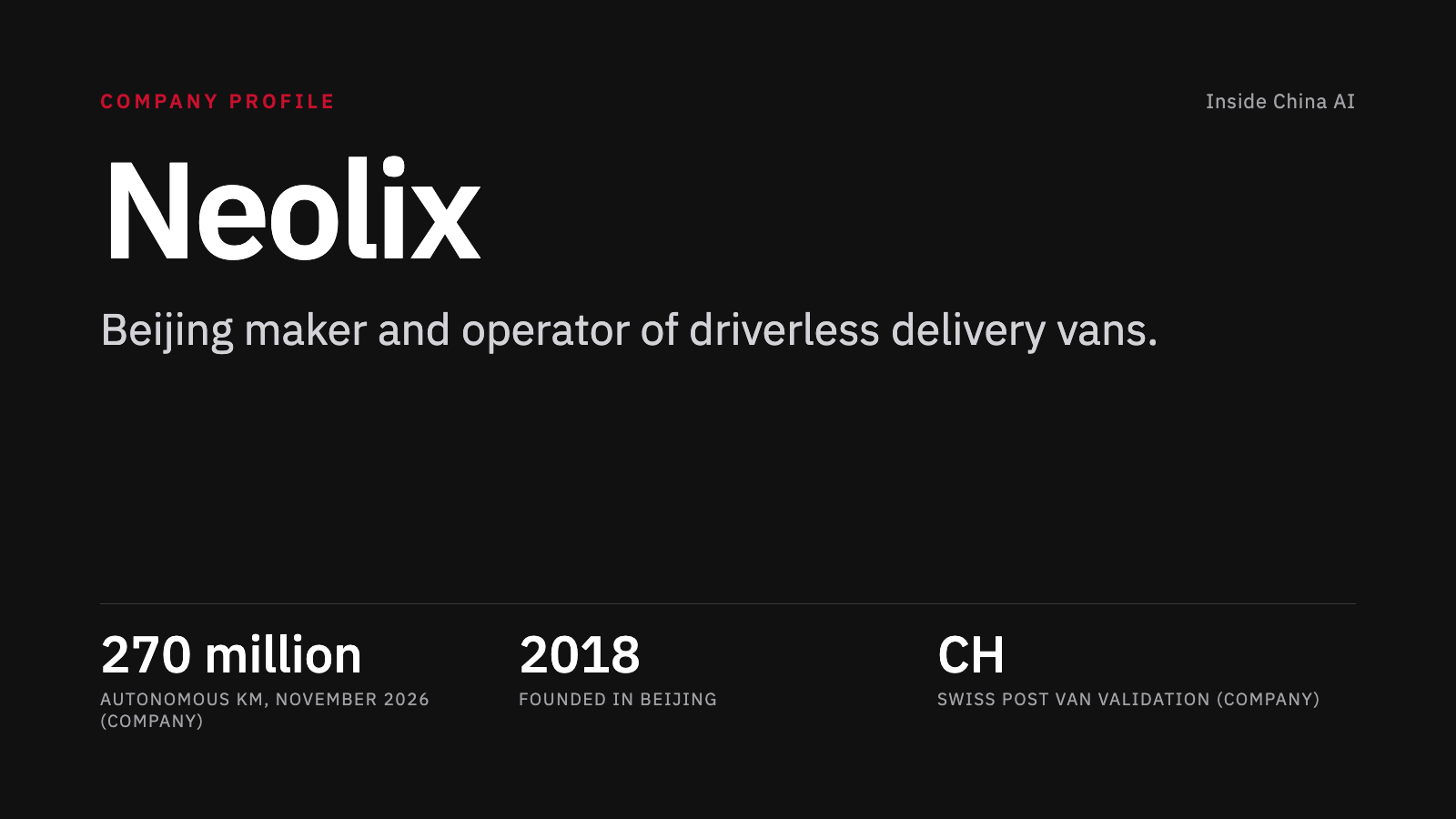
- Fleet more than 30,000 vehicles in more than 320 cities and 20 countries, 270 million autonomous kilometres (company figures, 27 November 2026)
- Models X3 (3 m³, 520 kg) and X6 (6 m³, up to 1,130 kg); outside China sold as Xolra
- AI Neolix-VA driving model; Xuanwu safety agent; NeoClaw operations agent
- Europe European HQ planned in Luxembourg; Brussels pilot pending a federal test permit (September 2026); proof of concept planned in Portugal; Swiss Post and REWE projects listed by the company
- Lists no match on the EU sanctions list, the US Consolidated Screening List or the US 1260H list (name check, 27 November 2026)
Neolix’s fleet figures differ by channel. In June 2026 it gave 21,000 vehicles, in September about 27,000, and in November more than 30,000. Its own website still showed more than 13,000 vehicles in 15 countries on 27 November 2026.
The European angle
- Headquarters On 14 September 2026, at IAA Transportation in Hanover, Neolix said it “is establishing its European headquarters in Luxembourg” as its “corporate and regulatory base” and plans more local entities later (Neolix). The European business is led by Dr. Yong Gessner, Vice President and Head of Neolix Europe. The company did not name the Luxembourg company, and we found no Luxembourg press report or government statement on it.
- Belgium The most concrete project is a 12-month pilot in central Brussels under the AutoLog project, with the Brussels consultancy Espaces-Mobilités and the non-profit STALEM. Xolra vans would run on a set route from a depot near Gare du Midi to shops on the southern edge of the pedestrianised centre, for deliveries and waste collection, with a two-person logistics team per vehicle. On 14 September 2026 the company said operations were “targeted to begin in Q4 2026” and that the federal test permit was “in formal review” at the Federal Public Service Mobility and Transport (Neolix). The release quotes Brussels mobility minister Elke Van den Brandt and federal minister Jean-Luc Crucke. We found no announcement that the permit has been granted or that the vans are running.
- Portugal On 6 January 2026 Neolix announced a strategic alliance with the Portuguese automotive and mobility group Salvador Caetano Auto and its Caetano Mobility business, starting with a proof of concept in Portugal (Neolix and Salvador Caetano). We found no start date.
- Trade fairs Neolix showed vans at EUROBIKE in Frankfurt in June 2026, at IAA Transportation in Hanover in September and at Parcel+Post Expo in London at the end of September, its first demonstration in the UK (Neolix, 26 June 2026; Neolix, 28 September 2026).
- Country list The company says its European footprint spans Luxembourg, Belgium, Germany, the Netherlands, Portugal, France and Switzerland. A release on the same day describes Belgium, Portugal, France and the Netherlands as markets where it is “scoping opportunities”. We found named projects only in Luxembourg, Belgium and Portugal, plus the Swiss and German projects listed on the company’s international website (see Customers).
- Approvals and data Neolix says it “holds German TÜV Rheinland certification and European E-MARK compliance”, without saying for which vehicles or rules, and that it works with “global cloud infrastructure providers” on data residency (Neolix, 26 June 2026). It names no provider.
- Customers Neolix’s international website lists a Swiss Post project in Switzerland: a fleet validation with Xolra 3 vans and positioning technology from the Swiss company Fixposition, with a go-live date of December 2025 (Neolix). The same site lists a “REWE Autonomous Distribution Pilot” in Germany, without place or date (Neolix). We found no announcement of either project by Swiss Post or REWE. Neolix vehicles have run in Switzerland before: in October 2020 Swiss Post made a Neolix van available for a delivery pilot on the EPFL campus in Lausanne (EPFL, 12 October 2020).
What we could not verify
- The Luxembourg headquarters: whether the company exists yet, and how many people work there.
- The Brussels permit: whether the federal test permit has been granted and the pilot has started.
- Activity in the Netherlands and France, which the company lists without naming partners or projects.
- The Swiss Post and REWE projects: whether they are running, where, on which roads and with how many vehicles. Both are listed only by Neolix.
- Neolix-VA: size, training data and test results of the driving model.
- Fleet size and finances: all fleet figures are the company’s own; revenue, profit and valuation are not disclosed.
- The second lead investor in the Series E, which Neolix calls only a “national-level fund”.
The open question for Europe: will a Brussels street see a Neolix van drive itself in 2026 as planned, and on what permit?

Comments are closed