Graphic: Inside China AI
Kunlunxin: Baidu’s AI Chip Unit Waits for Its Listing — and Names Only Chinese Customers
Company profile · 21 November 2026.
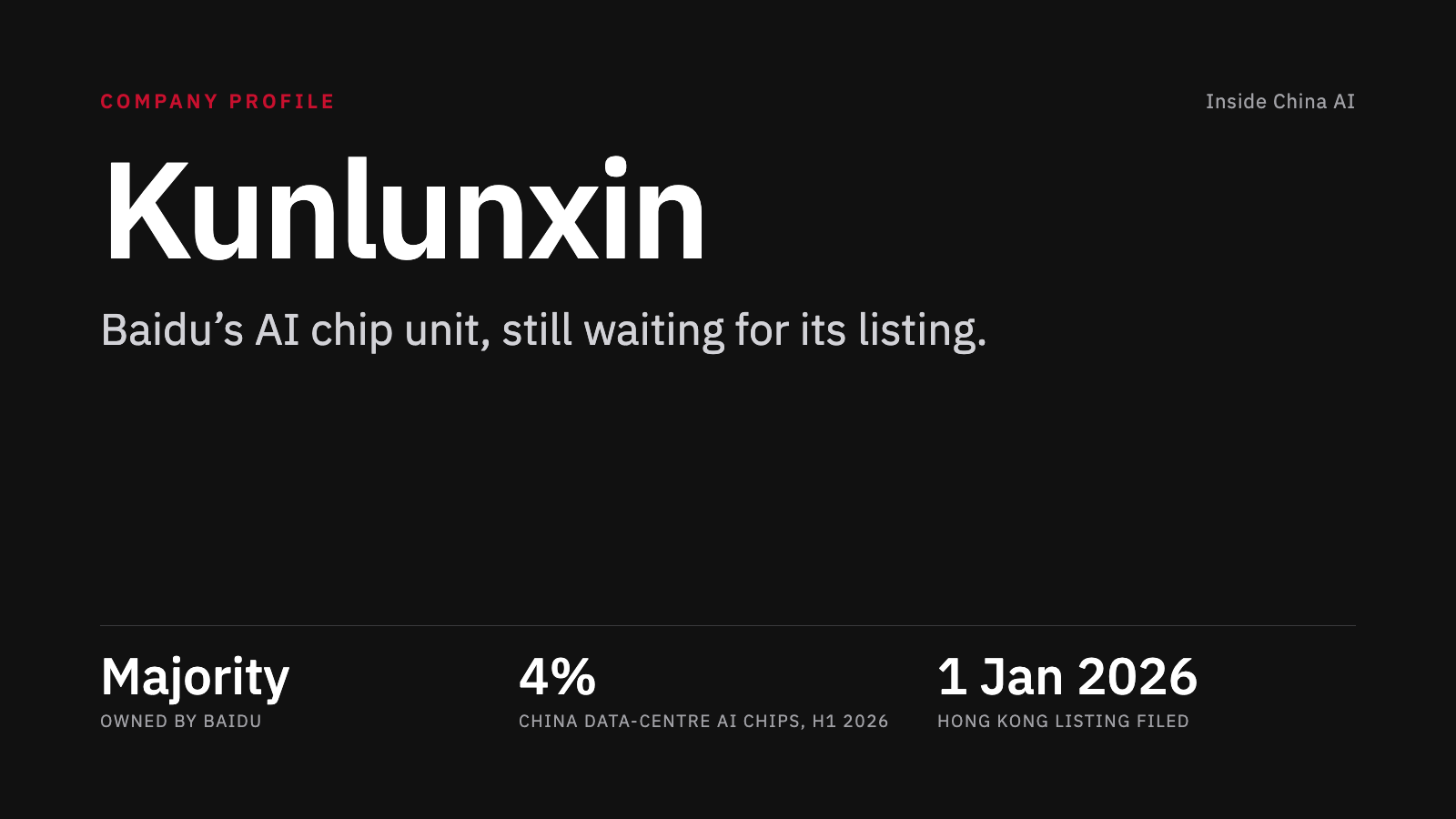
Kunlunxin designs the AI chips that run much of Baidu‘s computing, and increasingly sells them to China’s state-owned telecoms, power grids and banks. Baidu owns a majority of it and filed for its Hong Kong listing on 1 January 2026; in May it emerged that Kunlunxin is also preparing a listing in Shanghai. Neither has happened yet: on 3 November 2026 Bloomberg reported that the Hong Kong debut may slip to 2027, which Baidu denied. For Europe, Kunlunxin is not a supplier — we found no European office, partner or customer. It matters as one of the companies on which China’s AI labs are building an alternative to Nvidia, as a possible listing that international investors could buy into, and as a test of how far a Chinese chip designer gets as US rules on contract manufacturing tighten.
Origins and backing
Kunlunxin (昆仑芯) grew out of Baidu’s intelligent chip and architecture department, which started work on accelerated computing in 2011, and completed its first independent financing in 2021, the company says (Kunlunxin). The independent company was set up on 24 June 2021 with Ouyang Jian, until then Baidu’s chief chip architect, as chief executive; the first outside round, led by CPE with IDG, Legend Capital and Yuanhe Puhua, valued it at about RMB 13 billion (Kunlunxin). Ouyang still led the company as CEO when he spoke at the World Artificial Intelligence Conference in Shanghai on 18 July 2026 (Caiwen). Its legal name is now Kunlunxin (Beijing) Technology, a joint-stock company with offices in Beijing, Shanghai and Shenzhen (Kunlunxin).
Baidu calls Kunlunxin “a non-wholly owned subsidiary” (Baidu announcement). Baidu (China) holds 57.67 per cent, according to the tutoring filing for a planned Shanghai listing as reported by 21st Century Business Herald and Jiemian; we could not open the filing itself. Other investors include BYD and funds linked to China Mobile (21st Century Business Herald via Sina; Jiemian). In its last round before the listing plans, in 2025, Kunlunxin raised more than RMB 2 billion from a China Mobile fund and other investors at a valuation of about RMB 21 billion, Reuters reported, citing people familiar with the matter (Reuters via The Standard).
The listing has two tracks. On 1 January 2026 Baidu announced the proposed spin-off and a separate listing of Kunlunxin’s H shares in Hong Kong, for which an application had been submitted “on a confidential basis”; it needs approval from the exchange and a filing with the China Securities Regulatory Commission, and Kunlunxin is to remain a Baidu subsidiary afterwards (Baidu announcement). On 29 April 2026 Kunlunxin also registered with the regulator’s Beijing office to prepare a listing on Shanghai’s STAR Market, according to 21st Century Business Herald (via Sina); the regulator published the filing on 7 May, according to Jiemian. On 3 November Bloomberg reported that the Hong Kong listing, planned at about $2 billion, may be deferred to 2027 because Kunlunxin is still waiting for the regulator’s approval; a Baidu spokesman “denied the relevant market rumours” and said details could not be disclosed during a confidential filing (via The Standard). As of 20 November 2026 the Hong Kong exchange listed no application from Kunlunxin among its published filings (HKEXnews). Reported valuation targets range widely — $50 billion, according to The Information as reported by The Next Web on 28 June 2026, among others — and none has been confirmed.
What they build
Kunlunxin makes AI chips, accelerator cards and rack-scale systems; it does not develop AI models of its own. Its first-generation chip, launched in 2018, was made on Samsung’s 14-nanometre process (21st Century Business Herald via Sina; Asia Economy) and, the company says, has been deployed in the tens of thousands in Baidu’s search engine and Xiaodu devices (Kunlunxin). The second generation went into mass production in August 2021 and the third in 2024 (Kunlunxin). That third generation, the P800, is its main product today. Kunlunxin says it switched on a cluster of 10,000 P800 cards in February 2025 and expanded it to 32,000 cards in April 2025 (Kunlunxin). Its “supernodes” put 32 or 64 cards into one liquid-cooled rack; at the World Artificial Intelligence Conference in July 2026 the company said these were in volume delivery and showed a 256-card version (Kunlunxin).
The next chips are running late. At Baidu World on 13 November 2025 Baidu said the M100, an inference chip, would launch in early 2026 and the M300, for training and inference, in early 2027 (China Daily); it also announced an N series for 2029 and a cluster of one million Kunlun chips by 2030 (Caixin). In its third-quarter results of 16 November 2026, Baidu said the M100 was shown publicly for the first time in July and “is expected to be ready for volume production by the end of 2026” (Baidu Q3 results). Neither Kunlunxin nor Baidu says where the P800 or M100 are manufactured.
The customer base is moving beyond Baidu. According to investment materials seen by Reuters, Kunlunxin had revenue of about RMB 2 billion and a net loss of about RMB 200 million in 2024 and expected more than RMB 3.5 billion in revenue and break-even in 2025; over half of 2025 revenue was expected to come from outside customers, according to people familiar with the matter (Reuters via The Standard, 5 December 2025). Kunlunxin has published no audited figures. The company names the power grid operators State Grid and China Southern Power Grid, China Merchants Bank and SPD Bank as customers, and vivo as a partner for cloud-based AI on phones (Kunlunxin). It says that in August 2025 it won the largest share in all three lots of China Mobile’s tender for inference servers based on CUDA-like software, an order in the billions of yuan; it has not given the amount (Kunlunxin). By the research firm IDC’s count, Kunlunxin had 4 per cent of China’s data-centre AI chip shipments in the first half of 2026, against 28 per cent for Huawei (via The Standard) and 34 per cent for Nvidia (TechNode, citing Reuters).
Software is the other half of the pitch. Kunlunxin says it has adapted more than 40 leading models on the day of their release, including models from Zhipu, Alibaba’s Qwen team, Moonshot‘s Kimi and StepFun (Kunlunxin); its latest such announcement, on 19 November 2026, concerned a SenseTime model (Kunlunxin).
Key numbers
- Owner Baidu (China), 57.67 per cent according to the STAR Market tutoring filing as reported in May 2026 (filing not seen by us); CEO Ouyang Jian since June 2021
- Listing Confidential Hong Kong filing on 1 January 2026; STAR Market preparation registered on 29 April 2026; neither completed as of 20 November 2026
- Valuation About RMB 21 billion in the 2025 round (Reuters); IPO targets reported up to $50 billion, none confirmed
- Revenue About RMB 2 billion in 2024, net loss about RMB 200 million; more than RMB 3.5 billion expected for 2025 (according to investment materials seen by Reuters; unaudited)
- Chips Three generations in volume use (first generation deployed at scale from 2020, second and third in mass production from 2021 and 2024, the company says); P800 current; M100 volume production expected by end-2026 (Baidu), M300 announced in November 2025 for early 2027
- Market share 4 per cent of China’s data-centre AI chip shipments in H1 2026 (IDC)
The European angle
- Presence None that we could find. Kunlunxin’s website is in Chinese only and lists offices in Beijing, Shanghai and Shenzhen (Kunlunxin). We found no European subsidiary, distributor, partner, customer or data centre using its chips.
- Export controls Kunlunxin is not on the US Entity List: it does not appear in the US Consolidated Screening List (file of 20 November 2026, latest entries July 2026), and no Federal Register document names it (Federal Register search). What affects it are the general US rules on advanced chips. On 19 November 2026 Reuters reported that, after new US rules took effect that day, TSMC was halting affected orders from Chinese chip designers at 16 nanometres and below unless they obtain US export licences (Reuters via The Standard). The report does not name Kunlunxin. The Financial Times reported on 19 November 2026 that Samsung, too, was halting shipments of certain processors to Chinese customers while it applies for US licences; in its summary of the FT report, the Seoul Economic Daily names Kunlun, “the AI data center unit of Baidu”, among Samsung’s Chinese customers (Seoul Economic Daily, citing the FT). We could not read the FT report itself, and neither report says what Samsung supplies to Kunlunxin or whether those shipments were stopped. Where its current chips are made is not public.
- Other lists Its parent Baidu was added to the US Defense Department’s Section 1260H list of “Chinese military companies” on 10 June 2026; Kunlunxin itself is not named in that notice (Federal Register). Baidu rejects the designation; the list is not a sanction. A name check against the EU’s consolidated financial sanctions list (version of 23 October 2026) found no entry.
- For investors A Hong Kong listing would be the first chance for international investors to buy into Kunlunxin directly. The Information reported in June 2026 that Kunlunxin had asked prospective IPO investors to also commit to buying its chips (via The Next Web); the company has not commented.
- What a European buyer would actually encounter Today, nothing for sale. Europeans meet Kunlunxin indirectly: the Chinese open models they download — Qwen, GLM, Kimi, MiniMax — are increasingly tuned to run on Chinese chips like Kunlunxin’s as well as on Nvidia’s.
What we could not verify
- Audited revenue and profit for 2025 and 2026; no prospectus has been published.
- Baidu’s exact stake: the 57.67 per cent comes from press reports on the tutoring filing; the regulator’s website was not reachable for us.
- Who makes the P800 and the M100, and on which process.
- The status of the Hong Kong application beyond Bloomberg’s report and Baidu’s denial.
- The size of the China Mobile order, which Kunlunxin describes only as in the billions of yuan.
The open question for Europe: will Kunlunxin’s chips ever be offered outside China — and if the listing goes ahead, how much will its investors learn about where they are made?

Comments are closed