Graphic: Inside China AI
MetaX: A Shanghai GPU Designer Founded by AMD Veterans Reports Its First Profits — With Sales Almost Entirely in China
Company profile · 21 November 2026.
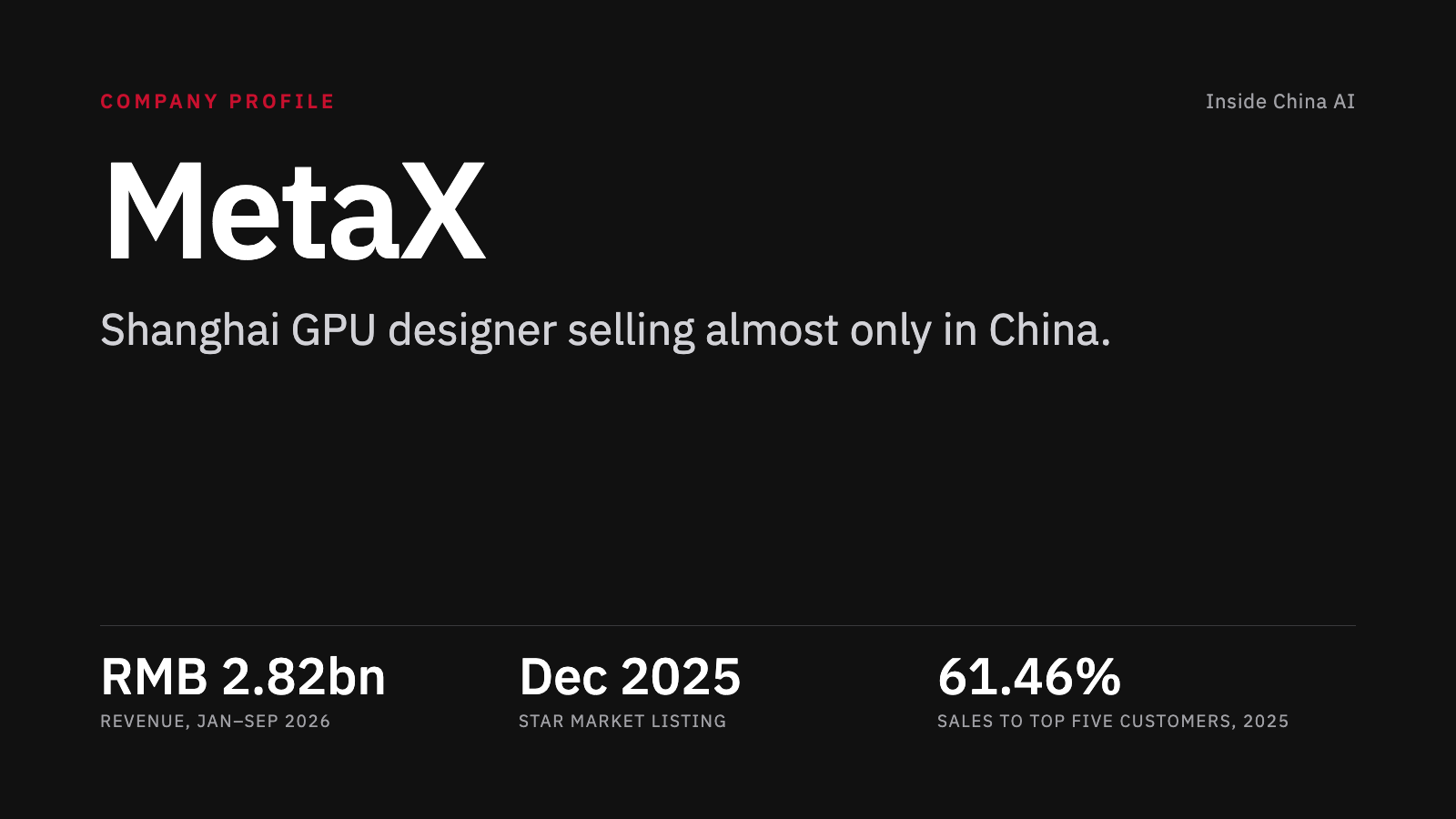
MetaX designs graphics processors for AI training, inference and scientific computing in Shanghai and sells them almost only in mainland China. In the third quarter of 2026 its revenue rose to RMB 1.50 billion, and for the first nine months it reported a net profit of RMB 639 million, much of it from gains on investments. In 2025 and the first half of 2026 its only revenue outside the mainland came from Hong Kong. Moore Threads and Biren, two other Chinese GPU designers, are on the US Entity List; for MetaX we found no listing when we checked on 21 November 2026. For Europe, MetaX is not a supplier. It matters as one of the companies building China’s AI computing on domestic supply chains, and as a Chinese GPU maker that, on our check, is not on the main US restriction lists.
Origins and backing
MetaX (沐曦), legally MetaX Integrated Circuits (Shanghai) Co., Ltd., was established on 14 September 2020 and is registered in the Shanghai Pilot Free Trade Zone (listing announcement). Its founder, Chen Weiliang, was a senior director at AMD in Shanghai from January 2007 to August 2020 and has been chairman and general manager since joining MetaX in September 2020, according to the same document. He still signed the third-quarter report as head of the company on 29 October 2026 (Q3 report). The co-founders Peng Li and Yang Jian also worked at AMD in Shanghai for more than a decade, Peng until September 2020 and Yang until November 2019; Yang then worked as an architect at Huawei and HiSilicon before joining MetaX in September 2020. The 2025 annual report lists both as directors, deputy general managers and chief technology officers (annual report 2025).
MetaX listed on the Shanghai Stock Exchange’s STAR Market (688802) on 17 December 2025. It sold 40.1 million new shares at RMB 104.66 each and raised RMB 4.20 billion gross, RMB 3.90 billion net (listing announcement). Before the allocation was adjusted, the online retail tranche was subscribed about 4,498 times (offering results). On the first day the shares opened at RMB 700 and closed at RMB 829.90, up 693 per cent (Reuters).
Chen controls the company. At 30 September 2026 he held 5.03 per cent directly. His platform Shanghai Jiaomai, the largest shareholder, held 11.96 per cent, and the employee platform Shanghai Xiji, which he also manages, held 3.64 per cent (Q3 report). Together that makes 20.63 per cent (our calculation). The investor Ge Weidong and his company Shanghai Chaos Investment held another 6.73 per cent between them. China’s state-owned enterprise structural adjustment fund held 1.76 per cent.
MetaX is preparing a second listing in Hong Kong. The board approved the plan on 12 June 2026 to deepen its “global strategy” and said the outcome was highly uncertain; shareholders approved it on 29 June 2026 (announcement; shareholder vote). On 28 October 2026 Chen proposed a share buyback of RMB 100–200 million (announcement).
What they build
MetaX is a fabless chip designer. It buys wafers from foundries, packaging and testing from other suppliers, and has its boards assembled by contractors (half-year report 2026). The filings do not name the manufacturers. It sells four GPU families: the Xisi N series for inference, the Xiyun C series for training and inference, the Xisuo X series for scientific computing, and the Xicai G series for graphics, which the half-year report describes as still in development. The N100 went into volume production in April 2023, the C500 in February 2024 and the C600 in May 2026, according to the same report.
The C600 is the product MetaX builds its supply strategy around. The company says it is its first GPU made entirely with a domestic manufacturing process, and says the main significance of that is to secure supply “against a complex geopolitical background”. In May 2026 the C600 passed a security and reliability evaluation by two Chinese state testing centres (half-year report 2026). On its English website MetaX describes the C600 as an OAM module with up to 1,000 watts of board power that can be linked into “supernodes of up to 128 GPUs” (MetaX). The next chip in the C series is the C700, which the company has in development (annual report 2025).
MetaX sells cards, servers, workstations and whole clusters. Its software layer, MXMACA, is “highly compatible” with Nvidia’s CUDA ecosystem, the company says, and recorded more than 110 million API calls between the opening of its open-source community in February 2025 and 28 July 2026 (half-year report 2026). In 2025 it sold 33,649 training-and-inference cards and 4,946 inference cards, and by the end of that year more than 55,000 of its GPUs had been sold in total (annual report 2025). We found no foundation models of its own; its chips run and train other developers’ models. Our own reporting found that Zhipu‘s GLM-5 family runs inference on MetaX chips among other Chinese silicon (Inside China AI).
The filings name no customers. MetaX says its products run in AI computing platforms, operators and commercial AI computing centres in Beijing, Shanghai, Hangzhou, Changsha and Hong Kong (half-year report 2026). In the first half of 2026 it signed a strategic agreement with China Unicom’s Shanghai branch to use its GPUs in computing clusters, and set up a joint venture in Wuxi with the humanoid robot maker UBTech to develop chips for robots (half-year report 2026). That venture, Xilect, said on 12 November 2026 that it had raised RMB 500 million in an angel round and plans to release its first chip in 2028 (Xilect; TechNode).
Demand claims need care. On 9 July 2026 China Daily reported, citing Peng Li, that customer orders were “already stretching well into next year”, and quoted senior vice-president Sun Guoliang as saying orders for several other product lines were booked “through next year and beyond” (China Daily). In a filing dated the same day, MetaX said media reports that its staff had said some orders were booked into next year or later were untrue, and that Sun had not commented on orders at the event in Shanghai. The filing does not name an outlet or mention Peng (clarification). The China Daily article was still online unchanged on 21 November 2026.
Key numbers
- Listing Shanghai STAR Market (688802) since 17 December 2025; offer price RMB 104.66, gross proceeds RMB 4.20 billion (listing announcement)
- Revenue RMB 2.82 billion in January–September 2026, up 128 per cent; RMB 1.50 billion in the third quarter alone, up 367 per cent (Q3 report). RMB 1.64 billion in 2025, up 121 per cent (annual report 2025)
- Profit Net profit RMB 639 million in January–September 2026, of which RMB 26.5 million in the third quarter; excluding one-off items, RMB 259 million for the nine months and RMB 308 million for the quarter; unaudited. One-off items included RMB 543 million of fair-value and disposal gains on financial assets for the nine months, but a loss of RMB 383 million on them in the third quarter, which left the quarter with a pre-tax loss of RMB 71 million (Q3 report). Net loss in 2025: RMB 789 million (annual report 2025)
- Margin Gross margin 56.5 per cent in 2025 (annual report 2025); about 55 per cent in January–September 2026 (our calculation from the Q3 report)
- Cash Operating cash outflow of RMB 1.34 billion in January–September 2026; prepayments to suppliers rose to RMB 2.31 billion from RMB 0.83 billion at the end of 2025; cash of RMB 3.88 billion plus RMB 3.88 billion in trading financial assets at 30 September 2026 (Q3 report)
- Customers Five largest customers: 61.46 per cent of 2025 sales; five largest suppliers: 82.34 per cent of purchases (annual report 2025)
- Research R&D spending RMB 828 million in January–September 2026, 29 per cent of revenue (Q3 report); 747 R&D staff at 30 June 2026, 70.4 per cent of the workforce (half-year report 2026)
- Revenue outside mainland China RMB 2.5 million in 2025 (0.15 per cent; annual report 2025) and RMB 0.5 million in the first half of 2026 (half-year report 2026), all from Hong Kong
The European angle
- Presence None that we could find. MetaX’s only revenue outside the mainland came from Hong Kong: RMB 2.48 million in 2025, or 0.15 per cent of the total (annual report 2025), and RMB 0.49 million in the first half of 2026 (half-year report 2026). Its only subsidiaries outside the mainland are a trading company in Hong Kong and a company set up in Macau in 2026; foreign assets were 0.06 per cent of the total at 30 June 2026 (half-year report 2026). The English website names no European office, distributor or partner (MetaX).
- Supply chain The company says US government policy restricts its access to advanced-node foundry capacity and to HBM memory. In 2025 it worked with some foreign suppliers for manufacturing, and its main suppliers of HBM, chip design software and some interface IP were based abroad; it does not name them or their countries (annual report 2025). Production equipment for its N100 and C500 chips is idle and has been written down in full. The C500 equipment is idle because “part of the supply chain production was suspended”, the company says, without giving a reason or naming the supplier (annual report 2025); the equipment was still listed as idle at 30 June 2026 (half-year report 2026).
- Export controls We found no listing for MetaX on the US Entity List when we checked on 21 November 2026. A full-text search of the Federal Register for “MetaX”, “Muxi” and “MetaX Integrated Circuits” returned no documents, and the US government’s Consolidated Screening List, which includes the Entity List (version of 21 November 2026), contains no entry under these names (Consolidated Screening List). MetaX’s filings do not mention the Entity List. Moore Threads and Biren, which also design GPUs in China, have been on it since October 2023 (88 FR 71991).
- Other lists MetaX is not named in the US Defense Department’s Section 1260H list of 10 June 2026 (91 FR 35189). A name check against the EU’s consolidated financial sanctions list (version of 20 November 2026) found no entry.
- What a European buyer would actually encounter Today, nothing for sale. For European investors, the shares are traded in Shanghai; small positions held through Goldman Sachs Bank Europe, Barclays and other banks appear among the largest freely tradable holdings (Q3 report).
What we could not verify
- Who the customers are. The filings anonymise them, including the five that made up 61 per cent of sales in 2025.
- Who manufactures the chips, on which process, and why part of the C500 supply chain was suspended.
- When the Hong Kong listing will happen. We found shareholder approval from June 2026 but no published prospectus. Press reports citing unnamed sources say MetaX has filed confidentially; up to 21 November 2026 MetaX had not announced a filing in its Shanghai disclosures.
- The company’s performance claims for its chips, its CUDA compatibility and its clusters, which no independent test we found has confirmed.
The open question for Europe: MetaX is building its newest chip on a domestic supply chain and, on our check, is not on the Entity List. If it lists in Hong Kong in the name of a global strategy, will it try to sell outside China?

Comments are closed