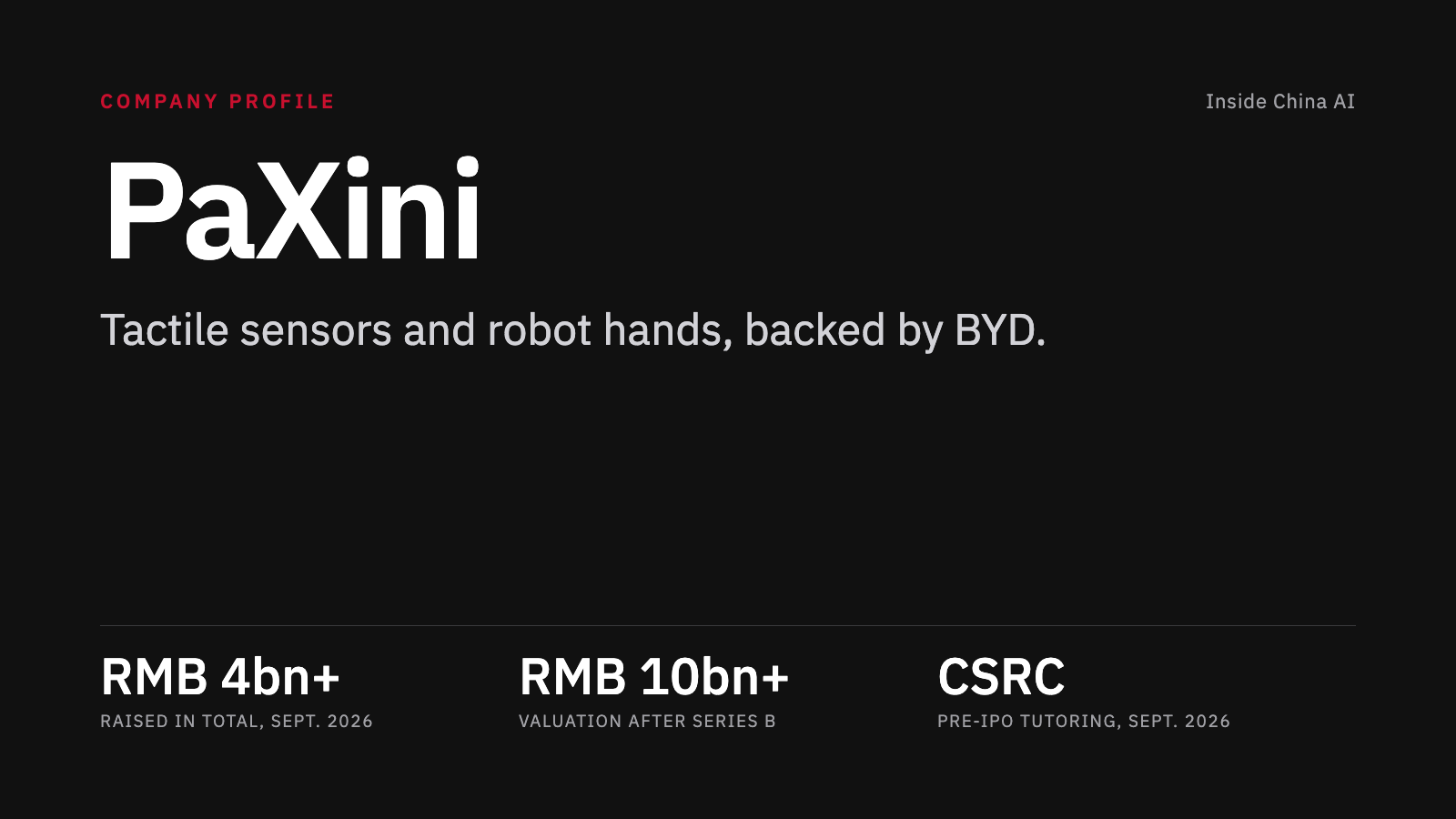
Graphic: Inside China AI
PaXini: The Tactile-Sensing Start-up Backed by BYD That Is Preparing a Listing in China
Company profile · 28 November 2026.
PaXini builds the sense of touch for robots: tactile sensors, sensor-covered robot hands, wheeled humanoids and the gloves and “data factories” used to record how humans handle objects. Founded in Shenzhen in June 2021 by engineers from Waseda University’s robotics laboratory, it has raised more than RMB 4 billion, counts BYD and JD.com among its investors and, in September 2026, began the formal preparation for an initial public offering in mainland China. For Europe, PaXini matters as a supplier: touch is one of the components that decides whether humanoid and dexterous robots can do factory work, and PaXini wants to sell that component, and the data that comes with it, worldwide. So far we found no presence in Europe: no subsidiary, office, distributor or named customer.
Origins and backing
PaXini (帕西尼) was founded in Shenzhen in June 2021 (CnEVPost). The company says its “founding members … come from the Robotics Laboratory of Waseda University in Japan” (PaXini). Its founder and chief executive is Xu Jincheng (许晋诚), who holds a doctorate from Waseda, according to the Chinese financial outlets Cailian Press (via Eastmoney, 16 September 2026) and 21st Century Business Herald (via 10jqka, 21 September 2026).
The company has been funded quickly and by a mix of carmakers, platform companies and state-linked funds. BYD made a strategic investment in April 2025 (CnEVPost). JD.com led a RMB 1 billion Series A in August 2025, and in March 2026 PaXini raised more than RMB 1 billion, about $145 million, in a Series B led by Huangpu River Capital, Kaitai Capital and the state-backed CIM International Group, which pushed its valuation above RMB 10 billion (Caixin). On 3 August 2026 the company announced a further RMB 1 billion strategic round, bringing its total to RMB 3.5 billion; it was co-led by what PaXini called “an unnamed global consumer electronics and semiconductor group”, together with BOC International Investment, Kunpeng Fund and Hexin Fangce (TechNode). PaXini has not named that investor. A round of several hundred million yuan followed on 16 September 2026, with Guangxin Fund, Sichuan Science and Technology Innovation Investment Group and Suqian Chanfa Venture Capital among the investors, taking cumulative funding above RMB 4 billion (Cailian Press).
In July 2026 PaXini moved its registered seat from Shenzhen to Beijing and converted into a joint-stock company. On 20 September 2026 the China Securities Regulatory Commission disclosed that the company, now named 帕西尼人工智能科技(北京)股份有限公司, had registered for pre-listing tutoring with its Beijing bureau, with Guotai Haitong as tutor, the first formal step towards a listing on China’s domestic A-share market, according to two Chinese financial outlets citing the regulator’s disclosure (21st Century Business Herald; Caizhongshe via Eastmoney). PaXini has not said on which exchange or board it intends to list (Caizhongshe). Xu Jincheng has described Beijing as the company’s research base and Shenzhen as its main production base (Caizhongshe). The company’s contact page lists offices or sites in Beijing, Shenzhen, Shanghai, Tianjin, Suzhou and Suqian (PaXini).
What they build
PaXini describes itself as a full-stack company: “Our full-stack technology integrates perception, data, and manipulation within a unified architecture” (PaXini). In practice that means four product layers.
Sensors. The core is a family of multi-axis tactile sensors built on what PaXini calls an ITPU, an “Intelligent Tactile Processing Unit” (PaXini). The current PX6AX GEN4 is marketed as “Powered by the World’s First True 6D Tactile Sensing Chip”, a claim we cannot check; the company says it is rated IP68 and lasts more than ten million cycles (PaXini). In August 2026 the company said its tactile-sensing chips had “shipped nearly 1 million units over the past year” (TechNode).
Hands and robots. The DexH13 is a four-finger hand with 16 degrees of freedom, 13 of them driven, and a camera in the palm, according to the company (PaXini). TORA-ONE is a wheeled humanoid whose height adjusts between 1.46 and 1.86 metres and which, the company says, carries 2,280 tactile sensing units (PaXini); TORA-DOUBLE ONE is a lighter successor (PaXini).
Data. PaXini sells data-collection gloves such as the PXCap III, which records touch, vision and hand position so that human movements can be mapped onto robot hands (PaXini), and runs what it calls “Super EID” data factories in Tianjin and Suqian (PaXini). In January 2026 it said it had the capacity to produce “nearly 200 million omni-modality data entries annually” and planned to offer the data through a cloud store (PaXini press release).
Models. PaXini’s research unit, SPiRAL Labs, works on OmniVTLA, which the company calls an “omnimodal foundation model” combining vision, touch, language and action, as well as on world models (PaXini). We found no published model card, weights or independent benchmark for OmniVTLA.
Its best-documented customers are Chinese carmakers. On 25 August 2026 PaXini and BYD signed a strategic cooperation agreement at BYD’s headquarters in Shenzhen covering data collection and robotics; BYD will give PaXini access to vehicle and component manufacturing processes (CnEVPost). PaXini says a TORA-ONE robot, running OmniVTLA 2.0, was deployed at Geely’s Qiantang base for tasks such as wire-harness insertion, with a success rate of 99.8% (PaXini); CnEVPost also reports the Geely deployment. The company lists the Japanese manufacturer Shinwa and a Shenzhen metro station among its other cases (PaXini). PaXini does not publish revenue.
Key numbers
- Founded June 2021 in Shenzhen; registered seat moved to Beijing in July 2026; founder and CEO Xu Jincheng
- Funding More than RMB 4 billion in total as of September 2026 (Cailian Press; 21st Century Business Herald); investors include BYD and JD.com
- Valuation Above RMB 10 billion after the March 2026 Series B (Caixin; Caizhongshe); no later figure confirmed
- Listing Pre-IPO tutoring registered with the CSRC Beijing bureau, disclosed 20 September 2026, towards an A-share listing; exchange and board not stated
- Shipments Nearly 1 million tactile-sensing chips in the year to August 2026, the company says
- Products PX6AX tactile sensors, DexH13 hand, TORA-ONE and TORA-DOUBLE ONE humanoids, PXCap data gloves, OmniVTLA model
- Revenue and staff Not published
The European angle
- Physical presence None found. The company lists only sites in China (PaXini); we found no European subsidiary, office, distributor or factory, and no appearance at a European trade fair. Its overseas shows between December 2025 and November 2026 were in Tokyo, Las Vegas, Pittsburgh and Goyang, South Korea, according to its own press releases.
- How Europeans can buy PaXini runs an overseas sales address and an AliExpress store, and its ecosystem programme invites distributors and integrators “worldwide” (PaXini). In August 2026 it named “overseas growth” as one use of its new funds, without naming Europe (TechNode).
- Lists PaXini is not on the EU’s consolidated list of financial sanctions, the US Consolidated Screening List (which includes the Entity List) or the Pentagon’s 1260H list, according to our name check on 27 November 2026.
- What a European buyer would encounter A component supplier with heavy Chinese industrial backing, products aimed at robot makers and research labs, and a data business built on Chinese factory floors, but no local entity to contract with or support from in Europe.
What we could not verify
- The unnamed August 2026 investor. PaXini has described it only as a global consumer-electronics and semiconductor group.
- Revenue, orders and headcount. Not published by the company.
- Technical claims such as the “first true 6D” sensing chip and the 99.8% success rate at Geely.
The open question for Europe: will PaXini, now preparing for a listing at home, build a sales and support presence for European robot makers, or will its sensors reach Europe only inside other companies’ robots?

Comments are closed