Graphic: Inside China AI
Sugon: China’s Supercomputer Maker Builds AI Supernodes, Almost Entirely for Its Home Market
Company profile · 28 November 2026.
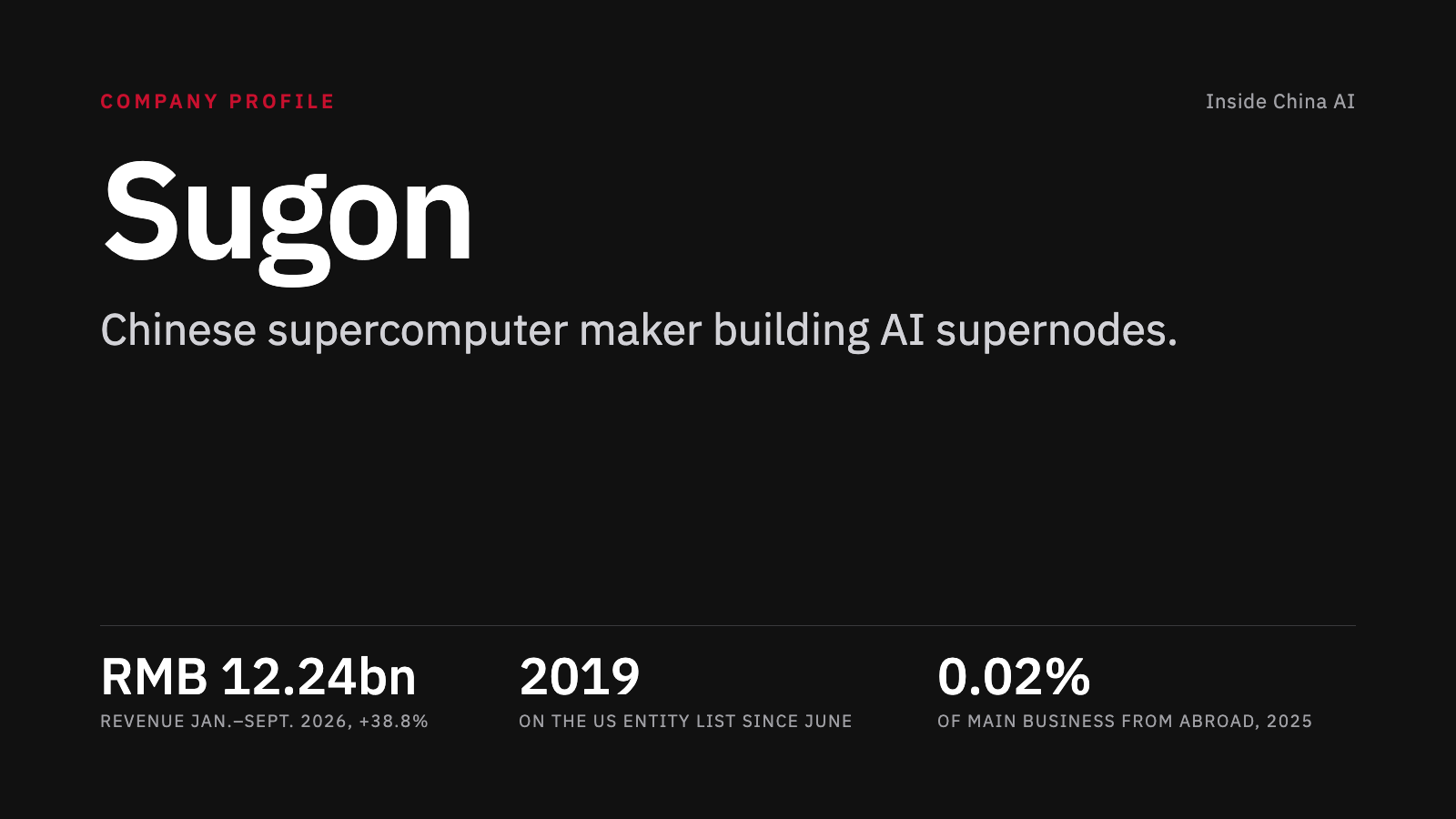
Sugon (中科曙光), whose actual controller is an institute of the Chinese Academy of Sciences, builds servers, storage and supercomputers, and now cabinet-sized AI “supernodes” that, the company says, link 640 accelerator cards. Its revenue rose 38.75 per cent to RMB 12.24 billion in the first nine months of 2026. Almost none of it comes from abroad: in 2025 Sugon booked RMB 3.24 million outside China. Since 24 June 2019 the company has been on the US Entity List. For Europe, Sugon is less a supplier than a measure of how far China’s AI computing infrastructure has developed under US export controls. In June 2026 it exhibited at ISC High Performance in Hamburg, but its own documents name no European company, office or current customer.
Origins and backing
The listed company, Dawning Information Industry Co., Ltd. (曙光信息产业股份有限公司), uses the short name Sugon, is registered in Tianjin and has its offices in Beijing; it is listed in Shanghai under the code 603019 (2025 annual report), since 2014 according to its website. The company says it was founded in 1996 (Sugon). Its controlling shareholder is Beijing Zhongke Suanyuan Asset Management, and its actual controller is the Institute of Computing Technology of the Chinese Academy of Sciences (2025 annual report). On 30 September 2026 Zhongke Suanyuan, classed as a state-owned legal person, held 14.68 per cent (Q3 2026 report).
Li Jun, who holds 2.76 per cent of the shares according to the same report, was elected chairman on 6 May 2026 and reappointed general manager the same day (board announcement). Sugon owns 27.96 per cent of the chip designer Hygon Information Technology, which it accounts for as an associate (H1 2026 report). A plan for Hygon to absorb Sugon through a share swap was called off by Sugon’s board on 9 December 2025; the company said the market environment had “changed significantly” since the deal was first planned (termination notice). In July 2026 Sugon raised RMB 8 billion through six-year convertible bonds (prospectus summary). At the end of 2025 it had 6,025 employees, 3,199 of them in research and development (2025 annual report).
What they build
Hardware still dominates. In 2025 IT equipment brought in RMB 12.50 billion of revenue; software development, system integration and technical services RMB 2.45 billion, up 75.34 per cent. The customer base is narrow: the five largest customers, none of them named, accounted for 82.56 per cent of 2025 sales, the largest alone for 19.36 per cent (2025 annual report).
The AI business is built around what Sugon calls supernodes. The scaleX640, launched in 2025, puts 640 accelerator cards in a single cabinet, supports “multiple brands” of AI accelerators and, the company says, can be scaled to clusters of 100,000 cards. The scaleX40, launched in the first half of 2026, is a box-sized supernode with 40 GPUs and more than 28 PFLOPS at FP8 precision, according to the company; it is joined by scaleFabric, a self-developed 400G network for linking such clusters (H1 2026 report). The filings we read do not name the accelerators. In its annual report of April 2026 the company noted that its supernode and supercluster products had “not yet” been deployed at large scale on the market (2025 annual report).
Since then Sugon has reported larger installations. According to its half-year report, the core node of China’s National Supercomputing Internet in Zhengzhou went fully online in July 2026 on a Sugon scaleX supercluster, and the company has developed “Sugon 8000”, an intelligent supercomputer with 100,000 cards. Its computing-service network, the company says, connects more than 3.5 million CPU cores and 250,000 GPU cards (H1 2026 report). We found no foundation model of its own. Its AI software consists of platforms: DeepAI, launched in February 2025 for developing large-model applications on domestic accelerators, and OneScience, launched in October 2025 for scientific models (2025 annual report). Its subsidiary Sugon DataEnergy builds liquid cooling for data centres; the company says it has delivered 1,650 MW of such systems (H1 2026 report).
The money from the convertible bonds goes into three projects: a computing-cluster system for AI built around a next-generation supernode, an AI training and inference appliance based on domestic CPUs and AI accelerators, and a domestic storage system (H1 2026 report).
Growth has picked up in 2026. In the third quarter revenue rose 60.68 per cent to RMB 4.77 billion and net profit 217.19 per cent to RMB 753 million. The company attributes this to better domestic demand for computing power and higher sales of high-end computers; inventories more than doubled, by 128.44 per cent, as it stocked up for high-end computer orders, computing-centre and liquid-cooling projects (Q3 2026 report).
Key numbers
- Listed Shanghai Stock Exchange (603019); actual controller: Institute of Computing Technology, Chinese Academy of Sciences (2025 annual report)
- Ownership Beijing Zhongke Suanyuan Asset Management 14.68% (state-owned legal person), 30 September 2026 (Q3 2026 report)
- Revenue RMB 14.96 billion in 2025 (+13.81%); RMB 12.24 billion in January–September 2026 (+38.75%) (2025 annual report; Q3 2026 report)
- Net profit (attributable to shareholders) RMB 2.18 billion in 2025 (+13.87%); RMB 1.72 billion in January–September 2026 (+78.51%) (2025 annual report; Q3 2026 report)
- R&D RMB 1.09 billion in H1 2026 (+78.36%), 14.65% of revenue (H1 2026 report)
- Revenue outside China RMB 3.24 million in 2025; overseas assets 0.29% of total assets (2025 annual report)
- AI scaleX640 and scaleX40 supernodes, scaleFabric network, DeepAI and OneScience platforms; we found no foundation model of its own
- Capital RMB 8 billion convertible bonds, term from 15 July 2026 to 14 July 2032 (prospectus summary)
The European angle
- Physical presence We found no European company, office or site. The only foreign subsidiaries named in the half-year report are a parts-trading company in Hong Kong and a subsidiary of Sugon DataEnergy in Singapore (H1 2026 report); the annual report says the liquid-cooling business entered overseas markets “starting from Southeast Asia” (2025 annual report). The contact page of the English website gives addresses only in Beijing and Tianjin and lists regional platforms only in China (Sugon).
- Stated interest The English website says: “Sugon develops international business in Europe, Southeast Asia, South America and Africa” (Sugon). Sugon exhibited AI supernodes, storage and liquid-cooling systems at ISC High Performance 2026 in Hamburg; its press release of 24 June 2026 names no European partner or customer (Sugon).
- Earlier customer In November 2016 the Slovenian ICT company Arctur announced that the infrastructure of its Arctur-2 system was “entirely provided by Sugon”, calling it Sugon’s first installation in continental Europe (Arctur). We found no later statement on the cooperation from either side.
- US lists: Entity List Sugon has been on the Entity List, an export-control list of the Commerce Department’s Bureau of Industry and Security, since 24 June 2019, under aliases including “Dawning Information Industry” and “Zhongke Shuguang”. The rule imposes “a license requirement for all items subject to the EAR and a license review policy of presumption of denial” and states that “Sugon has publicly acknowledged a variety of military end uses and end users of its high-performance computers” (Federal Register). On 13 October 2022 (effective 21 October) Sugon was among 28 entries given a new footnote, under which “additional foreign-produced items will now be subject to the EAR and require a license” (Federal Register). Sugon itself writes that since October 2022 its purchases of advanced foreign components have been “affected to some extent” (H1 2026 report). Separately, Hygon, in which Sugon holds 27.96 per cent, is on the Entity List in its own right; it was added as “Higon” in the same rule of 24 June 2019.
- US lists: investment ban and 1260H On 16 December 2021 the US Treasury identified Dawning Information Industry Co., Ltd. as part of the Chinese military-industrial complex, stating that it “operates or has operated in the defense and related materiel sector of the economy of the PRC” (US Treasury). Its entry on the Non-SDN Chinese Military-Industrial Complex Companies List, alias “Sugon”, has been effective since 14 February 2022 (OFAC) and was still in the US Consolidated Screening List in the version of 24 November 2026. The underlying executive order prohibits US persons from “the purchase or sale of any publicly traded securities” of listed companies (Federal Register). Sugon is also on the Pentagon’s Section 1260H list of “Chinese military companies”, in the notices of 2 April 2024 (Federal Register), 7 January 2025 (Federal Register) and 10 June 2026; the latest says Sugon “is indirectly affiliated with MIIT, SASAC, and the PLA” (Federal Register); that list is not a sanction. A name check against the EU consolidated financial sanctions list (version of 24 November 2026) found no entry.
- What a European buyer would actually encounter A large Chinese maker of AI and supercomputing infrastructure that shows its products at a German trade fair, but whose own documents name no European company, office or current customer, and which, according to its bond prospectus, earned 0.02 per cent of its 2025 main-business revenue outside China (prospectus summary).
What we could not verify
- Which AI accelerators the scaleX640, scaleX40 and Sugon 8000 systems use; the filings speak of “multiple brands” and domestic accelerators.
- Who the largest customer is, which accounted for 19.36 per cent of 2025 sales.
- Whether any Sugon system is in operation in Europe today, including the Arctur-2 installation of 2016.
- Who, if anyone, sells Sugon products in Europe; the company names no European distributor or partner.
- Independent benchmarks for the scaleX supernodes.
The open question for Europe: does Sugon’s interest in Europe go beyond trade-fair stands, as long as it is on US export-control lists?

Comments are closed