Graphic: Inside China AI
TCab Tech: A Shanghai Air-Taxi Developer Aiming for Chinese Certification in 2027
Company profile · 28 November 2026.
TCab Tech (时的科技) is a Shanghai start-up building the E20, a five-seat, piloted electric aircraft with tilting rotors that takes off like a helicopter and cruises on a wing. It is working through type certification with China’s civil aviation authority, CAAC, and says it aims to obtain the type certificate in 2027. Europe should pay attention for two reasons. In 2022 TCab agreed with France’s Safran to integrate Safran’s electric motor into the E20, the first such motor certified by the EU’s aviation safety agency, the company says. And TCab’s commercial plans, as it describes them, lead to China, Southeast Asia and the Middle East, not to Europe. Its founder spent ten years at Airbus, according to the company; TCab also works with institutes of China’s state aviation groups on flight control and, since June 2026, on a second motor.
Origins and backing
TCab Tech was founded in 2021, according to the company’s fifth-anniversary post of 12 May 2026; its FAQ says it was founded by a group of engineers. Its legal name is Shanghai TCab Technology Co., Ltd. (上海时的科技有限公司), a limited liability company (company release, 22 July 2026). The name is meant as “time taxi”. Founder and chief executive is Ng Yon Wui (黄雍威). According to the company, he was born in Malaysia (TCab, Malaysia Division), worked for Airbus for ten years, was head of engineering for Airbus China, and was appointed by the European Union Aviation Safety Agency (EASA) as a delegated authority under its design-organisation rules (TCab, Our Story).
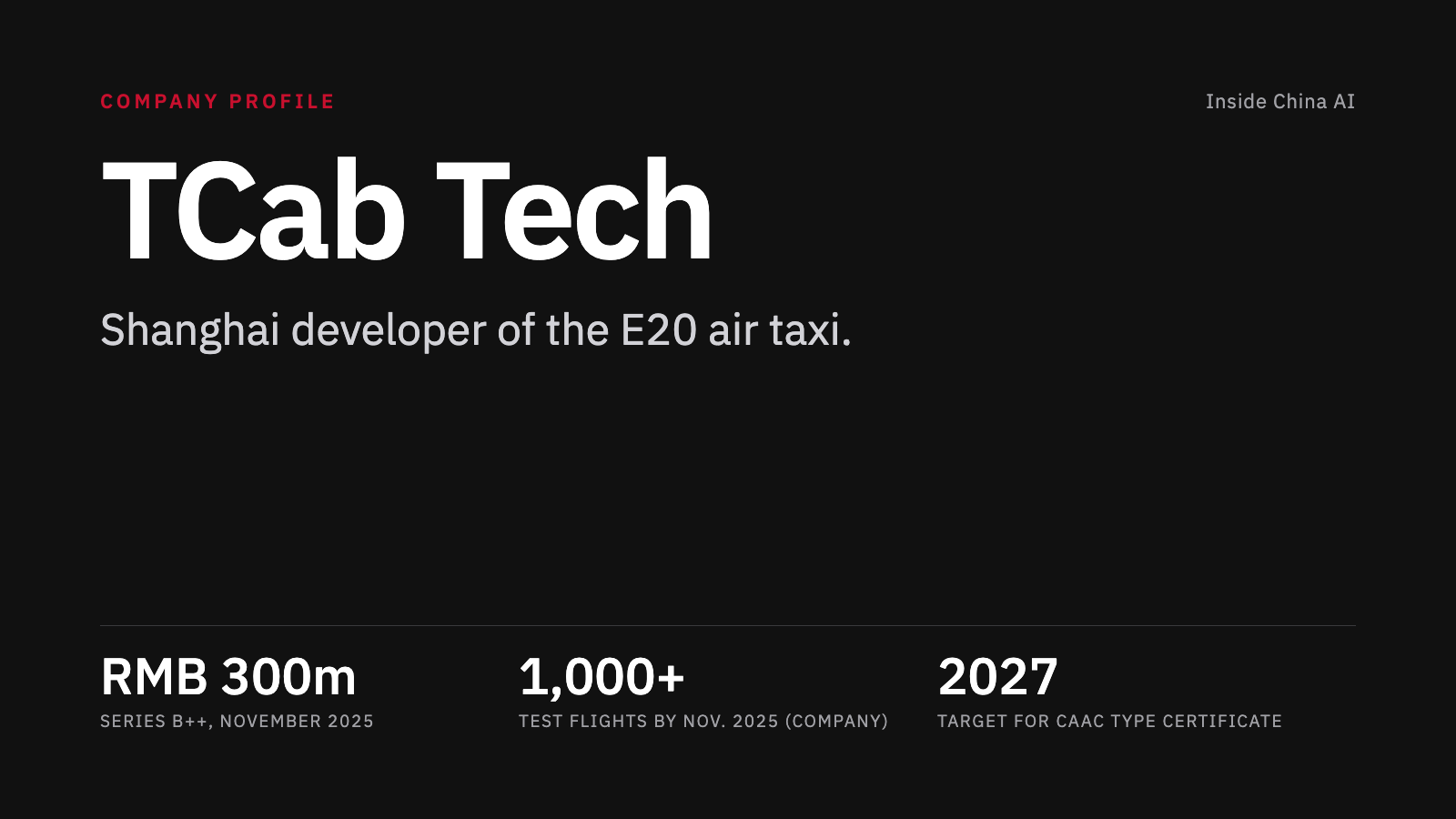
TCab is private and has not published a valuation. The company says it closed its seventh funding round in November 2025: RMB 300 million (about USD 43 million) in a Series B++ round from Meridian Capital, HuaHan Capital and Puhua Capital (company release, 13 November 2025; also reported by 投资界, 7 November 2025). Earlier rounds included a USD 20 million Series A extension in March 2024 from an unnamed “strategic investment fund aiming to introduce air-taxi applications in the Middle East region” (company release, 26 March 2024). AIN also reported the March 2024 round (AIN, 27 March 2025). TCab has not published a total for all rounds.
Local government is closely involved. On 6 November 2025 TCab signed a strategic agreement with the Shanghai Municipal Commission of Economy and Informatization and the Minhang district government to locate its headquarters and a manufacturing base in Shanghai (company post), followed on 22 July 2026 by an investment agreement with the Xinzhuang Industrial Zone in Minhang (company post). Its first factory is being built in Wanzhi District, Wuhu, in Anhui province.
What they build
The E20 is a tilt-rotor eVTOL (electric vertical take-off and landing aircraft) for one pilot and four passengers. The company gives a top speed of 320 km/h, a payload of 450 kg and a range of 200 km (TCab FAQ; release of 13 November 2025). It plans to use the aircraft first for sightseeing flights from airports and rail stations, then for intercity routes and finally within cities (TCab FAQ).
TCab is not an AI-model company. Its AI claim concerns flight control: the avionics and flight-control system was developed with the Computing Institute of AVIC, China’s state aviation group, and, the company says, embeds “AI algorithms within the flight control framework” for stable control during the tilt from vertical to forward flight (company release, 29 July 2025, published when it showed the E20 at the World Artificial Intelligence Conference in Shanghai). A company post of 2 July 2026 describes the system as fly-by-wire with “Simplified Vehicle Operation” level-1 assistance, in which the pilot always keeps final control, and with three identical flight computers plus one dissimilar backup (TCab, 2 July 2026). The E20 is not designed to fly without a pilot.
Testing has moved from scale models to a full-size aircraft. TCab says the E20 flew with passengers for the first time in October 2025, with the chief executive on board (release, 17 October 2025), completed transition flights from hover to wing-borne cruise by December 2025 (release, 3 December 2025), and had made more than 1,000 test flights by November 2025 (release, 13 November 2025). In certification, the company says it has completed the certification basis (G-1), the means of compliance (G-2) and the certification plan with CAAC (release, 9 October 2026). The target date has slipped: in 2022 TCab expected to finish type certification in 2025 (AIN, 31 May 2022); its FAQ now names 2027.
The Wuhu plant, where ground was broken on 8 August 2025, is planned with two final assembly lines and an annual capacity of 200 aircraft (release, 8 August 2025). In September 2026 the company said it planned to complete the plant within 2026 and use it for its production organisation approval (company post). Without a type certificate, there are no deliveries yet.
Key numbers
- Founded 2021, Shanghai; private
- Funding seven rounds by November 2025, latest RMB 300 million (Series B++, November 2025); total not published
- Aircraft E20, five seats (1 pilot + 4 passengers), tilt-rotor, top speed 320 km/h, range 200 km, the company says
- Certification CAAC type certification under way; target 2027 (originally 2025)
- Testing more than 1,000 test flights by November 2025; first passenger flight October 2025
- Production Wuhu plant under construction since August 2025, planned capacity 200 aircraft a year
- Agreements declarations of intent, no firm orders published: strategic agreement with BOC Leasing for 100 aircraft (April 2025); memorandum of understanding with Autocraft, Abu Dhabi, for up to 350 aircraft (July 2025)
- Staff not disclosed; more than 80% in R&D, the company says
The European angle
- Supplier link to France In 2022 TCab and Safran signed a cooperation agreement to integrate Safran’s ENGINeUS electric motor into the E20 (TCab, 7 February 2025); AIN reported at the time that six ENGINeUS motors would power the aircraft (AIN, 31 May 2022). TCab says it was Safran’s “first global eVTOL partner” for the motor, which received EASA type certification on 24 January 2025, and that its chief operating officer attended the certification ceremony in Paris. The E20 product page advertises the “First EASA-certified electric motor for air mobility” (TCab).
- A second, Chinese motor On 5 June 2026 the Control Systems Research Institute of the Aero Engine Corporation of China delivered its AEE25 integrated aviation motor to TCab in Wuxi (company post, 7 June 2026). According to the post, the motor has entered airworthiness certification.
- Physical presence None found. We found no European company, office, distributor, customer, European flight test or EASA application. A Shanghai launch event for TCab’s “Air Silk Road” partnership programme in November 2025 had guests from the United Kingdom, among other countries, but no European partner was named (release, 6 November 2025).
- Where the company is going instead TCab names China, Southeast Asia and the Middle East as its markets (release, 31 October 2024). In October 2026 it showed the E20 in Malaysia, signed a memorandum with the Selangor state agency SIDEC and announced a regional business centre in Malaysia (release, 9 October 2026); on 22 July 2026 it appointed an authorised partner in Indonesia (release).
- Lists TCab Tech does not appear on the EU’s consolidated financial sanctions list, the US Consolidated Screening List (including the Entity List) or the US Defense Department’s 1260H list (our name check, 27 November 2026).
- What a European buyer would actually encounter For now, nothing for sale. A European operator could meet the E20 only if TCab seeks EASA validation of a Chinese type certificate, and the company has announced no such plan.
What we could not verify
- The certification steps G-1, G-2 and the certification plan come from TCab’s own statements; we found no CAAC documents.
- Headcount, revenue, valuation and total funding raised.
- Whether the declarations of intent have become firm orders: the published agreements with BOC Leasing (17 April 2025) and Autocraft (16 July 2025) are a strategic agreement and a memorandum of understanding; no firm purchase contract has been published.
- Whether the Wuhu plant has been completed, as planned for 2026.
The open question for Europe: will TCab ever bring the E20 to EASA?

Comments are closed